SCOTCAT.COM  

your internet guide to all things catfish
≡
  • HOME
  • FACTSHEETS
    • By Month/Year
    • By Family
    • by Genus
    • by Common Names
    • By Specific Names
    • By Continent
      • Index
      • Africa
      • Asia
      • Australasia
      • Europe
      • North America
      • South America
  • GALLERIES
    • Photo Gallery
    • Art Gallery
    • Movie Gallery
    • Stamps Gallery
  • FAMILIES
    • A-B
      • Ailiidae
      • Akysidae
      • Amblycipitidae
      • Amphiliidae
      • Anchariidae
      • † Andinichthyidae
      • Ariidae
      • Aspredinidae
      • Astroblepidae
      • Auchenipteridae
      • Auchenoglanididae
      • Austroglanididae
      • Bagridae
    • C-D
      • Callichthyidae
      • Cetopsidae
      • Chacidae
      • Clariidae
      • Claroteidae
      • Cranoglanididae
      • Diplomystidae
      • Doradidae
    • H-I
      • Heptapteridae
      • Heteropneustidae
      • Horabagridae
      • Ictaluridae
    • K-L-M
      • Kryptoglanidae
      • Lacantuniidae
      • Loricariidae
      • Malapteruridae
      • Mochokidae
    • N-P
      • Nematogenyidae
      • Pangasiidae
      • Phreatobiidae
      • Pimelodidae
      • Plotosidae
      • Pseudopimelodidae
    • R-S-T
      • Ritidae
      • Schilbeidae
      • Scoloplacidae
      • Siluridae
      • Sisoridae
      • Trichomycteridae
  • ARTICLES
    • Index
    • Breeding
    • By Author
    • Cat-Articles
    • General
    • Numbered List
    • Ichthyology
    • Travel/Collecting
  • IDENT-A-CAT
  • RESOURCES
    • Citation
    • Etymology
    • Fishhouse
    • Glossary
    • Scientific Papers
    • ScotShop
  • SITE MAP
  • FB GROUP
  • HELP
    • Index
    • Catfish Anatomy
    • Convertors
    • FAQ
    • Ident-A-Cat
    • Water Chemistry

FACTSHEETS: August 2026 - no. 362

 Leiarius marmoratus (Gill, 1870)


 e have another quite large catfish to wet your appetite this month (August 2026), namely the "Marble antenna catfish", Leiarius marmoratus, from the Pimelodidae family. This is a very pretty member of this family, and its marbled appearance lends it its common name.
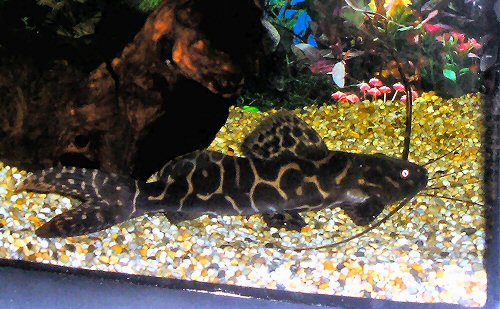
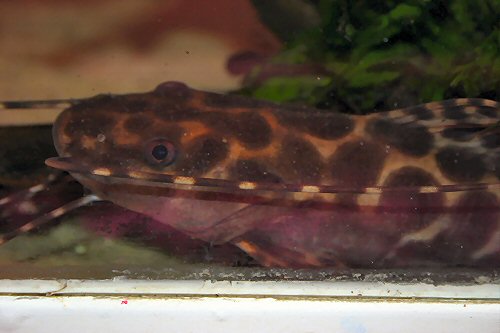
 

Leiarius marmoratus

    Leiarius marmoratus


Can we keep it in an aquarium setup?. Yes and no; it is not to be trusted with small fish, as they will be chased down during the night forays of this catfish. It would need a large aquarium due to its eventual size, with a clear area to the front of the tank and hiding places for it during the daylight hours, such as large clay land pipes and clay pots. Probably more suited to a big cat expert in the hobby.


Leiarius perruno


Leiarius perruno


Can be confused with its close cousin L. perruno, but this catfish has more of a large spotted pattern than L. marmoratus. There are five species in this genus: Leiarius perruno (Schultz 1944), which we have a factsheet on here. L. marmoratus (Gill, 1870), Leiarius arekaima (Jardine, 1841), Leiarius longibarbis (Castelnau, 1855), and Leiarius pictus (Müller & Troschel, 1849), which we also have a factsheet on here.

Whilst these are magnificent fish to observe, they are not ideally suited to life in captivity unless they are cared for in a large Public Aquarium. I have kept a number of these catfish over the years (Chris Ralph-factsheet no.166) and have noted that they can fast for periods of time, which can be slightly worrying when this happens and tends to coincide after having a particularly heavy meal. The longest fast lasted 4 weeks.


Map of the Amazon, Essequibo, and Orinoco River basins


Map of the Amazon, Essequibo, and Orinoco River basins


South America: Amazon, Essequibo, and Orinoco River basins. Type locality: Peru or Ecuador, Amazon system, Río Marañon or Río Napo.


L. marmoratus usually appears in the Amazon and Orinoco river basins, and L. pictus in the Amazon, Orinoco, and Essequibo basins. The Amazon, Essequibo, and Orinoco are three of the largest and most ecologically significant river systems in northern South America, spanning vast stretches of tropical forest, savanna, and wetlands across countries such as Brazil, Venezuela, and Guyana.

Leiarius marmoratus is naturally infrequent and sparse. In Colombia, according to Pulido and Benitez (2005), the species has suffered a population decline of more than 94% in 15 years. However, L. marmoratus has been successfully managed and reproduced in fish farming, being well spread both in Colombia and Brazil through this viability in cultivation. Hybrids between L. marmoratus and Pseudoplatystoma sp. are cultivated on fish farms (Souza et al. 2014). The overall population status of the species is unknown (ICMBio 2018).


Common Name

Marble antenna catfish

Synonyms

Sciades marmoratus

Family

Pimelodidae

Subfamily

-

Habitat

Inhabits riverbeds, deep wells and lakes. Young or sub-adults form large schools. Prefers to lay over rock and tree trunks during the day, being more active at sunrise, sunset and night.

Distribution

South America: Amazon, Essequibo, and Orinoco River basins. Type locality: Peru or Ecuador, Amazon system, Río Marañon or Río Napo.

Size

80.0cm. (32ins)

Temp.

24-26°C (75-79°F)

p.H.

6.0-7.2.

Characteristics

Large dorsal fin with 10 rays.

Colouration

Marbled colour pattern with a greyish ground colour.

Aquarium Care & Compatibility

Not to be trusted with small fish, as they will be chased down during the night forays of this catfish. Would need a large aquarium due to its eventual size, with a clear area to the front of the tank and hiding places for it during the daylight hours, such as large clay land pipes and clay pots. Needs the aquarium to be well maintained with regular water changes, as they can become lethargic and will refuse to eat, so again a catfish for the experienced aquarist. If housed in a very large aquarium, tankmates would need to be deep-bodied, such as some larger characins, as they will predate especialy at night. Provide sand as a substrate or a bare bottom, as gravel could be ingested when feeding, although large stones for decoration would suffice.

Reproduction

Not recorded.

Sexual differences

Not recorded.

Diet

Small feeder fish, lean beef, aquatic insect larvae, tablets, and frozen foods. Should only be fed about two to three times per week to avoid gluttony.

Glossary of Terms

Dorsal fin: The primary rayed fin(s) on top of the body.
Taxon: According to the Code, any formal taxonomic unit or category of organisms (species, genus, family, order, class, etc.). Taxa (pl.).

Etymology

Leiarius: leìos, smooth, allusion not explained, perhaps referring to smooth (vs. granulated) head surface of L. longibarbis; arius, possibly used here to reflect Bleeker’s classification of this taxon in a phalanx he called Ariobagri.
marmoratus: Latin for marbled or mottled, referring to its greyish ground colour, which “forms meandering lines between the large blackish spots by which it is covered”.

IUCN Red List

Despite the little information available on this species, it has a wide range and no apparent threats. Therefore, it is assessed as Least Concern (IUCN 2023).

References

Baensch, H.A. and R. Riehl 1995 Aquarien Atlas. Band 4. Mergus Verlag GmbH, Verlag für Natur- und Heimtierkunde, Melle, Germany. 864 p.
Ferraris, C.J. Jr., 2007. Checklist of catfishes, recent and fossil (Osteichthyes: Siluriformes), and catalogue of siluriform primary types. Zootaxa 1418:1-628.
Froese, R. and D. Pauly. Editors. 2009. FishBase. World Wide Web electronic publication. www.fishbase.org, version (010/2010).
Salvador, G.N. 2023. Leiarius marmoratus. The IUCN Red List of Threatened Species 2023.
Sleen, van der Peter and Albert, S. James; Field guide of the Amazon, Orinoco & Guianas. Princeton University Press, Princeton and Oxford. 2018.
The ETYFish Project Fish Name Etymology Database © Christopher Scharpf.

Photo Credits

© Andy Watson.
© Chris Ralph.
Map: Field guide of the Amazon, Orinoco & Guianas. Princeton University Press, Princeton and Oxford. 2018.

Donate towards my web hosting bill!


If you would like to contribute to the monthly factsheets with an article, information or photos, please e-mail me. You will, of course, be credited for your work.


If you would like to donate any amount of money to the site, simply click the link above. All proceeds will go to running the site and hopefully to keep it going for a few years yet.


ScotCat Sources

Etymology = Genus Etymology-genus name

Etymology = Species Etymology-specific name


Other Sources

Search  Search

Fishbase Fishbase

Catalog of Fishes Catalog of Fishes

Global Biodiversity Information Facility GBIF

FishNet2 FishNet2

iNaturalist iNaturalist

IUCN IUCN

  • Facebook about us + contact us + citation + translate + site map + scotshop + glossary + etymology +
  • help YouTube

©2026 SCOTCAT.COM