SCOTCAT.COM
your internet guide to all things catfish
FACTSHEETS: May 2003 - no. 083
Megalechis thoracata (Valenciennes in Cuvier & Valenciennes , 1840) |
Megalechis thoracata - male
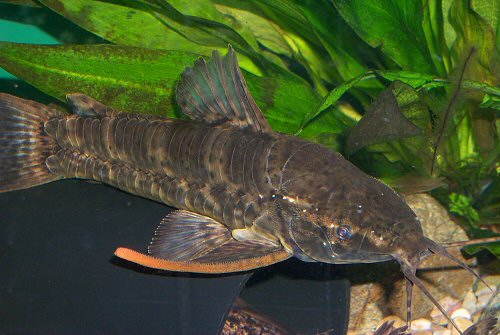
In the 1960's and 70's the catfish that the average U.K. aquarist could only get a hold of were the Corydoras with aeneus and paleatus being the norm with maybe a few other varieties thrown in. Only a few specialist shops were bringing in the more unusual pets such as a few Synodontis when imports from Africa were obtainable and the more common plecs such as the different varieties of whiptails from South America. That is why the "port" or "spotted hoplo" alongside Callichthys callichthys were much sought after all these years ago. You can distinguish between our factsheet of the month and Callichthys callichthys by the shape of the caudal fin with the latter being more rounded and also possessing smaller eyes. You may be more used to the name of Hoplosternum thoracatum when this fish was more popular but this genus was revised in 1996 by the Brazilian Ichthyologist, Roberto E.Reis, and only Hoplosternum littorale was kept with him creating a new genus for thoracata with a second species added, Megalechis personata. There has now been a second paper on the genus Megalechis (1995) and what we used to know as M. thoracata is now M. picta. The difference between these two species rests on the pattern in the caudal fin with picta possessing a band and thoracata having a spotted caudal fin. M. picta also has bands on the body whereas M. thoracata is spotted.
Megalechis picta - male
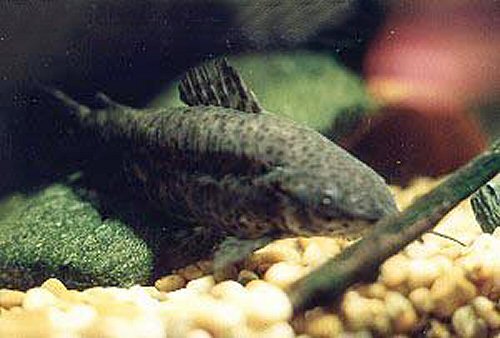
Megalechis thoracata - female
To differentiate between the sexes is not too hard. The males posses thicker pectoral spines with minute hairs adorning them and have an orangey colouration when in breeding condition (see top picture) If you can see underneath your specimens you will also see that the female has a broader gap between the thorax plates than the male so as to give room to the swelling which is involved when carrying eggs.
|
 his
month we once again return to the family Callichthyidae
but this time not to your ubiquitous Corydoras
but to an old friend in the eyes of the aquarist of
the more advancing years and a reminder that Megalechis
thoracata was once, 20 or 30 years ago, held
in the same esteem as the fancy L-numbers of today's
21st century.
his
month we once again return to the family Callichthyidae
but this time not to your ubiquitous Corydoras
but to an old friend in the eyes of the aquarist of
the more advancing years and a reminder that Megalechis
thoracata was once, 20 or 30 years ago, held
in the same esteem as the fancy L-numbers of today's
21st century.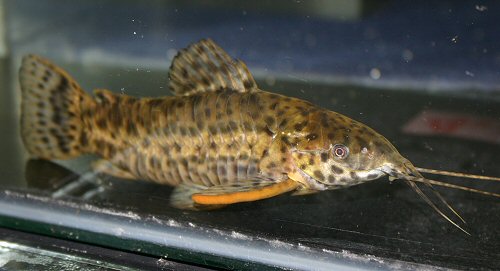
Common Name |
Armoured Catfish |
Synonyms |
Callichthys exaratus, C. personatus, Hoplosternum personatus, H. thoracatum surinamensis, Megalechis personata |
Family |
Callichthyidae |
Subfamily |
Callichthyinae |
Distribution |
South America: Amazon and Orinoco River basins, as well as coastal rivers of the Guianas and northern Brazil. |
Size |
19.0cm (7½ins) |
Temp. |
18-28°C (64-82°F) |
p.H. |
6.0-8.0. |
Characteristics |
Dorsal: 1/8: Anal: 1/6-8: 25-26 bony scutes in the upper lateral series, 23-24 in the lower. |
Colouration |
Dark olive-brown to grey-brown. Upperside often blackish-olive, underside pale brown to whitish. The whole body including the belly, is covered with large and small black blotches. Fins are spotted. Caudal fin with a spotted pattern. |
Aquarium Care & Compatibility |
| Keeping this species is not too hard. They can become quite boisterous in a community setup with their digging and unsettling other fish at night but as long as your other inhabitants are of a decent size and are not "Neon Tetra size", as remember this fish can get to nearly 8inchs in size and a small 1 inch tetra at night may be too much of a temptation to even the most docile of animals. The only time they can get aggressive is if you have a pair and they are in the throes of spawning as the males can get quite tetchy and it is not unknown for a male to kill the female in the quest to produce a family. This does not happen all the time but best to keep a look-out for any aggressive behavior. |
Reproduction |
This species is a bubblenester with the male building it at the water surface. The female lays her eggs in the nest and the male looks after them. This is the point that you may have to take the female out of the tank as the male may kill it, as they can get aggressive when guarding the nest. |
Sexual Differences |
To differentiate between the sexes is not too hard. The males posses thicker pectoral spines with minute hairs adorning them and have an orangey colouration when in breeding condition (see top picture) If you can see underneath your specimens you will also see that the female has a broader gap between the thorax plates than the male so as to give room to the swelling which is involved when carrying eggs. |
Diet |
| A good quality flake and tablet food. They also relish garden worms and frozen bloodworm. |
Glossary of Terms |
Anal fin:
The median, unpaired, ventrally
located fin that lies behind the anus, usually on
the posterior half of the fish. |
Etymology |
| Megalechis:
Greek, megas,
megalos = great + greek, echis, -eos = viper. |
References |
Reis,
RE, P-Y Le Bail & JHA Mol, 2005. (New
Arrangement in the Synonymy of Megalechis Reis,
1997 (Siluriformes: Callichthyidae). Copeia 2005:
678–682.). |
Photo Credits |
Top: ©
Chris Ralph |


|

If you would like to contribute to the monthly factsheets with an
article, information or photos, please e-mail
me. You will of course be credited for your work.
If you would like to donate any denomination of money to the site just click the above link button. All proceeds will go to running the site and hopefully to keep it going for a few years yet.
ScotCat Sources
 Etymology-genera
Etymology-specific name
Online Sources
 Search
 Fishbase
 Wikipedia
 Catalog of Fishes
 GBIF
GBIF
 Fishnet2
 iNaturalist

