SCOTCAT.COM
your internet guide to all things catfish
FACTSHEETS: October 1999 - no. 040
Microsynodontis polli Lambert, 1958 |
Microsynodontis polli
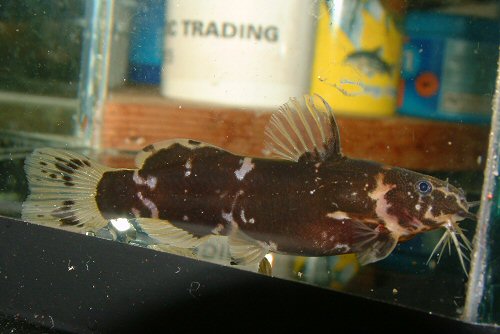
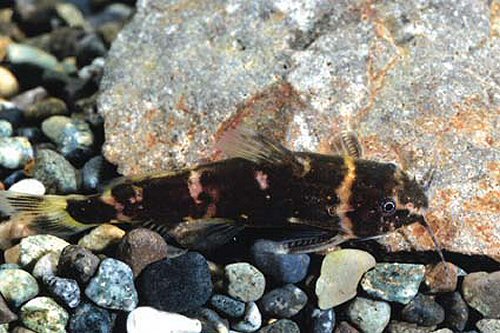
The genus Microsynodontis have a rounded caudal, small eyes and have 3 pairs of barbels, one pair of maxillary and 2 pair of mandibular, the latter having thick branches. The dorsal has one hard ray and 6 soft and a long low adipose fin. This factsheet has been updated (Dec.2002) owing to further information kindly furnished by Steven Grant a catfish enthusiast and author here in the U.K. in a study that he has carried out on the genus Microsynodontis. This is a quote taken from this very article on the genus Microsynodontis by Steven. "Baensch & Fischer (1998) appears to show M. polli on page 357 (incorrectly identified as batesii), although Heok Hee (Ichthyologist-Ed) says that the fish in Baensch & Fischer probably originates from the Zaire River near Kinshasa in the Democratic republic of the Congo, and at the moment he is not sure if this fish is a separate species from the true polli which originates from the Gbin River, Guinea, which is a considerable distance away. My photograph of polli (top picture-Ed) may also be the Zaire variant. When it was small it had no or only very minute markings on the body. The fish is now approx. 4 cm SL and the markings are more distinct now." The mystery that I find with this species is the collection points/names that they are being sold at here in the U.K., and I believe in the U.S. as well. They are being traded as Synodontis sp.'nyong', nyong being a river in the African state of Cameroon, but as Steve states, M.Polli does not come from Cameroon, Microsynodontis batessi (bottom picture) does and is probably the species concerned. The picture below shows a specimen sold as M. polli in the trade and at the moment it is being captioned as Microsynodontis sp. polli. There is now ongoing work on this genus being carried out by Heok Hee Ng a Singaporean Ichthyologist working in the U.S. and so this factsheet may even change again in the not too distant future.
Microsynodontis sp. 'Nigeria'
Update: (2011) The above specimen is still not been classified to species and is now known for the time being as Microsynodontis sp. 1. or Microsynodontis sp. 'Nigeria' along with the other species in the picture below. The first time that I kept this species a few years ago, I did not keep them very long and I thought that they were just one of those species that are hard to keep. I came across them again in 1998 in a small shop in the Scottish borders and was wary of buying them until the proprietor explained that they kept them in alkaline water, and they were very happy. So I bought 5, took them home and they settled fine in a livebearer tank which was just over the p.H. of 7.
Microsynodontis sp. 'Nigeria'
They certainly like their food and seem to scurry along the bottom at breaknet speed, between the caves and pots that I have set up for them, looking for any morsels of food at feeding time. They do seem to relish frozen bloodworm and they can get quite rotund with this diet. This species seems
to be very slow growing and I think in the future
could be a candidate for a spawning success, once
a little more information is forthcoming about their
spawning habits.
|
 his
is one of three poorly documented pygmy Synodontis,
the other two being M.lamberti and M.batesii.
The members of this genus are sometimes confused with
another small member of the Mochokidae family, namely
Mochokielia paynei, but paynei has a
forked tail whereas members of Microsynodontis
possess a rounded caudal and do not have branched
maxillary barbels like M. paynei.
his
is one of three poorly documented pygmy Synodontis,
the other two being M.lamberti and M.batesii.
The members of this genus are sometimes confused with
another small member of the Mochokidae family, namely
Mochokielia paynei, but paynei has a
forked tail whereas members of Microsynodontis
possess a rounded caudal and do not have branched
maxillary barbels like M. paynei.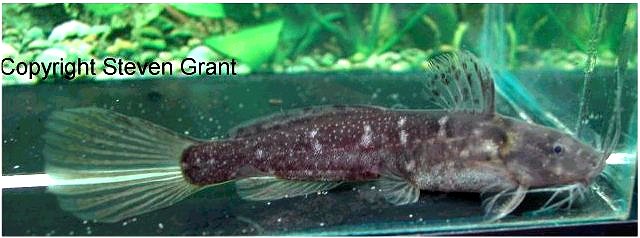
Common Name |
Pygmy Synodontis, Pretty Woman Pygmy Synodontis |
Synonyms |
None |
Family |
Mochokidae |
Subfamily |
Mochocinae |
Distribution |
Africa: Gbin River, upper Niger in Guinea. Reported from Saint John, Liberia. |
Size |
6.0cm. (2½ins) |
Temp. |
24-27°C (75-81°F) |
p.H. |
7.0-7.5. |
Characteristics |
Rounded caudal, small eyes and have 3 pairs of barbels, one pair of maxillary and 2 pair of mandibular, the latter having thick branches. The dorsal has one hard ray and 6 soft and a long low adipose fin. |
Colouration |
(Microsynodontis sp. polli) Brown body colouration with 3 indiscriminate broken yellow/white bands circling body. Two yellow/white bands run from eye to snout. One yellow/white band runs from between dorsal insertion and eye, over top of head and round body. One runs around body just before insertion of adipose fin and the third broken line is just situated behind adipose fin. Caudal and adipose fin have markings. Dorsal and anal fin have colouration at the base of soft rays and colour in the first hard ray of the dorsal. |
Aquarium Care & Compatibility |
| No problem in a community tank as long as the water parameters are adhered to and it is not housed with boisterous species such as larger Cichlids. |
Reproduction |
Not known. |
Sexual Differences |
Females are rounder in the body than males. |
Diet |
| Will take most prepared aquarium foods such as frozen bloodworm, whiteworm, tablet food and sunken flake. |
Etymology |
| Microsynodontis:
Micro = small; Syn = together; odontis
= teeth.(fused tooth plates). |
References |
Burgess
E. Warren Dr: An Atlas of Freshwater and
Marine Catfishes, 1989. |
Photo Credits |
Top image: © Steven
Grant:
@ |


|

If you would like to contribute to the monthly factsheets with an
article, information or photos, please e-mail
me. You will of course be credited for your work.
If you would like to donate any denomination of money to the site just click the above link button. All proceeds will go to running the site and hopefully to keep it going for a few years yet.
ScotCat Sources
 Etymology-genera
Etymology-specific name
Online Sources
 Search
 Fishbase
 Wikipedia
 Catalog of Fishes
 GBIF
GBIF
 iNaturalist

