SCOTCAT.COM
your internet guide to all things catfish
FACTSHEETS: September 1999 - no. 039
Mochokiella paynei Howes, 1980 |
Mochokiella paynei
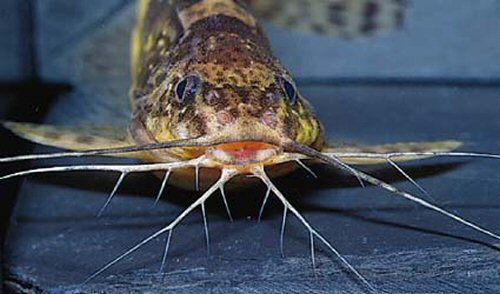
It is very close to the Synodontis species but can be told apart by its very long branched barbels ( outer mandibular = 3 branches, inner mandibular = 4 ) and its comparatively small size. It is also very much like in appearance, the genus Microsynodontis, but as mentioned before they have longer mandibular barbels, a larger eye, smaller adipose fin and a forked caudal fin, whereas the Microsynodontis genus has a rounded caudal and smaller eyes.
Mochokiella paynei
It likes clean water with low nitrates, so keep up the monthly water changes in your aquarium. If affordable purchase more than one individual as I'm sure this species would be a prime candidate for a determined and successful breeder in the future.
Mochokiella paynei
Above image shows the branched barbels unique to this species
|
 his is
the only representative of the Mochokiella genus
in the Mochokidae family. It was described
by Dr.Gordon Howes of the Natural History Museum in
London with a specimen provided in 1980 by Steve Pritchard
a friend and fellow member of the
his is
the only representative of the Mochokiella genus
in the Mochokidae family. It was described
by Dr.Gordon Howes of the Natural History Museum in
London with a specimen provided in 1980 by Steve Pritchard
a friend and fellow member of the 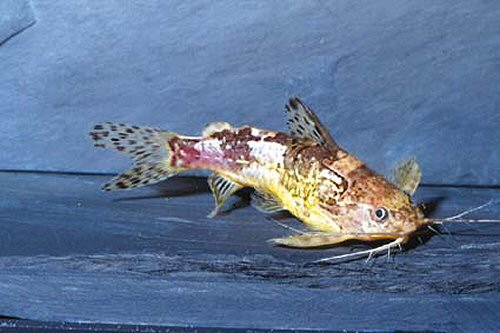
Common Name |
Payne's Catfish |
Synonyms |
None |
Family |
Mochokidae |
Subfamily |
Mochocinae |
Distribution |
Africa: Sierra Leone, type locality, Kassawe Forest Reserve, Sierra Leone. |
Size |
8.0cm. (3¼ins) |
Temp. |
22-26°C (71-80°F) |
p.H. |
6.2-7.5 |
Characteristics |
Head markedly curved, snout rounded. Mouth small, lower lip not developed as in Synodontis. Eye supero-lateral. Humeral process elongate and pointed, almost as long as the pectoral fin, barbels with unilateral branching. |
Colouration |
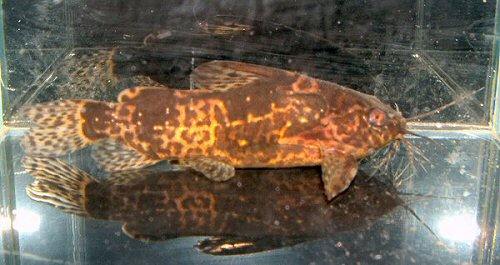
Mottled, reticulated dark brown markings on beige-creamy background. Most distinctive are the dark bands across the head and those linking the eye with the nostrils and corner of the mouth. The anterier part of the body is uniformly dark but posteriorly is reticulate. Particularly noticeable is the diagonal stripe from the rear of the adipose fin to the anal fin. The adipose fin has a light border, all other fins are barred and blotched. All barbels are barred. |
Aquarium Care & Compatibility |
| This catfish is an excellent addition to any community tank. It can be very secretive during the day but is certainly happier if you furnish the aquarium with hiding places such as bogwood/logs, pipes or rockwork. You can then see it occasionally with such a set-up. |
Sexual Differences |
Males are slimmer than the females and in some of this genera the caudal fin is longer in the males with the females being indented. |
Diet |
| Will take most prepared aquarium foods such as frozen bloodworm, whiteworm, shrimp, prawns, tablet food, flake and pellets. |
Etymology |
| Mochokiella:
From the Latin -ella; in reference to the small size
of the fish (literally: "a small Mochokus"). |
IUCN Red List |
Mochokiella paynei is only known from the type locality, the Kassawe Forest Reserve in Sierra Leone. Although it has a relatively restricted range, with an extent of occurrence (EOO) of 1,110 km², it is protected within the reserve and there are no known ongoing or potential future threats to the species. It is therefore assessed as Least Concern (IUCN 2020). |
References |
Baensch,
H.A. and R. Riehl 1985 Aquarien atlas. Band
2. Mergus, Verlag für Natur- und Heimtierkunde
GmbH, Melle, Germany. 1216 p. |
Photo Credits |
Top
& Bottom image: © |


|

If you would like to contribute to the monthly factsheets with an
article, information or photos, please e-mail
me. You will of course be credited for your work.
If you would like to donate any denomination of money to the site just click the above link button. All proceeds will go to running the site and hopefully to keep it going for a few years yet.
ScotCat Sources
 Article
 Etymology-genera
Etymology-specific name
Online Sources
 Search
 Fishbase
 Wikipedia
 Catalog of Fishes
 GBIF
GBIF
 Fishnet2
 iNaturalist
 IUCN
IUCN

