SCOTCAT.COM
your internet guide to all things catfish
FACTSHEETS: April 1997 - no. 007
Corydoras narcissus Nijssen & Isbrucker, 1980 |
Corydoras narcissus
They are usually quite pricey when they do appear in the retail outlets stopping most aquarists from buying a few specimens, hence the lack of success of spawning them. But if you have spawned them please let me know so I can share it with the online community. As with most of the longer nosed cory's, care must be taken regarding water quality as they don't seem to be as hardy as the normal short nosed varieties. They also like a good water movement in the aquarium, so an internal filter would be a good idea. Corydoras narcissus occurs sympatrically with C. arcuatus. The original specimen was collected by Axelrod, Bleher, Bossche, Gery and Schwartz in a creek flowing into the Rio Ipixuna, 7°31'S, 63°16'W, 30 km west of Humaitá, Rio Purus system, Amazonas, Brazil.
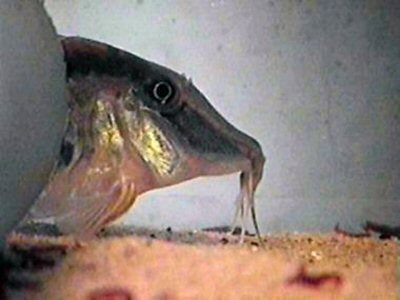
Corydoras narcissus - head view
The etymology (The science that treats of the origin and history of words and modification of a particular word) of narcissus is for the Greek river god Kephissus who fell in love with his own reflection in the water in memory of those who collected undescribed species of Corydoras and suggested their own names for the scientific description. There is one man, who will not be named here, who I believe was the architect for this story.
Remarks: This is a "saddle nosed" species which would place it in Lineage 1. When there is a revision they will stay as Corydoras (Lacépède, 1803) with the type species of C. geoffroy La Cépède, 1803.
|
 his months factsheet is a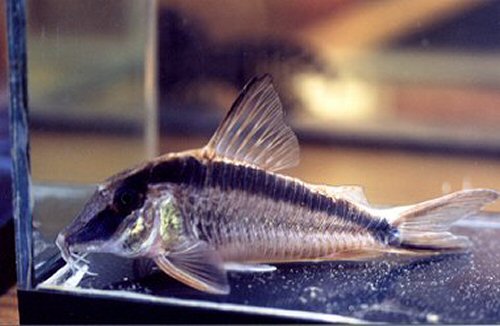
Common Name |
Narcissus Cory |
Synonyms |
None |
Family |
Callichthyidae |
Subfamily |
Corydoradinae |
Distribution |
South America: Brazil, Rio Ipixuna on Paranapixuna, a tributary of the Rio Purus, 30km west of Humaita. |
Size |
Male: 7.5cm (3ins) Female: 8.0cm (3¼ins) |
Temp. |
23-25°C (73-77°F) |
p.H. |
6.0-7.2 |
Characteristics |
Dorsal 1/7; Anal 1/5; Pectorals; 1/10. Two pairs of rictal barbels, one pair of mental barbels; rictal "flap" present. Medial border of pectoral fin spine strongly serrate. Intercoracoid area naked. Pectoral fin spine covered with thick mucous skin, embedding conspicuous odontodes. This my be an indication that the holotype is a nuptial male, since in some species with a strong secondary sexual dimorphism (Corydoras barbatus, C.macropterus, C.octocirrus) the pectoral fin spines of mature males show a similar cover. |
Colouration |
Ground colour of head and body whitish. Area dorso-posterier to eye with widely scattered black pigment, forming a conspicuous uneven stripe from the anterior edge of the nuchal plate to the posterior of the last dorso-lateral body scute. The contour of this stripe is straight to below the adipose fin spine, after which it bends down and forms a vague concentration of pigment on the caudal peduncle. A thin black line is visible on the body below the dorsal fin spine. Widely scattered black pigment on the snout, obliquely running forward from the eye. Dorsal pair of rictal barbels greyish. The two branched caudal fin rays, just dorsal to the lower principal unbranched ray are black coloured. A similar, though less intense pigmentation is present in the opposite lobe. Upper half of dorsal fin spine and adjacent branch of first dorsal fin ray with black pigment. Adipose fin with black pigment on posterior edge. Remaining fins clear. |
Aquarium Care & Compatibility |
| As this is one of the longer snouted species it will be well suited to most community tanks. A well planted tank with a soft substrate such as sand so they can bury their snouts while searching out food. |
Reproduction |
There is a breeding report that the eggs are very tiny and are laid in two's around the tank and usually in the flow of an internal filter much like Corydoras aeneus. Temperature was quite high at 25c (77f) with a pH.of 7.8. |
Diet |
| As per usual for the fry (if you are lucky enough to breed them.) with microworm, brine shrimp naupli and egglayer fry food after they have used up their yoksac. |
Etymology |
| Corydoras:
Cory = helmeted;
doras = leathery
skin,(helmeted Doras) cuirass. |
References |
Alexandrou,
Markos & Taylor, Martin. (2011). Evolution,
ecology and taxonomy of the Corydoradinae revisited.
|
Photo Credits |
Top image: © Allan
James @ Bottom image: ©
Julian Dignall @
|


|

If you would like to contribute to the monthly factsheets with an
article, information or photos, please e-mail
me. You will of course be credited for your work.
If you would like to donate any denomination of money to the site just click the above link button. All proceeds will go to running the site and hopefully to keep it going for a few years yet.
ScotCat Sources
 Etymology-genera
Etymology-specific name
Online Sources
 Search
 Fishbase
 Wikipedia
 Catalog of Fishes
 GBIF
GBIF
 iNaturalist

