SCOTCAT.COM
your internet guide to all things catfish
FACTSHEETS: May 2005 - no. 107
Neosilurus ater (Perugia, 1894) |
Neosilurus ater
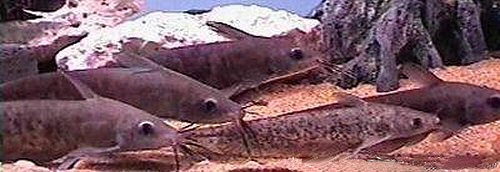
There are about 30 species of the Plotosidae family that inhabit coastal seas, estuaries, and inland waters (Allen, 1989) of Australia and New Guinea. The majority reside in streams and lakes with slow running water but Neosilurus ater is found in streams and rivers where the current is fairly swift and as such would be better housed in an aquarium with moving water. The juveniles of this species (up to 18cm-7ins) possesses a silver mottled appearance and when reaching adulthood they take on a grey to black body colour with a lighter underbelly. You can see a smaller mottled juvenile in the picture below.
Neosilurus ater
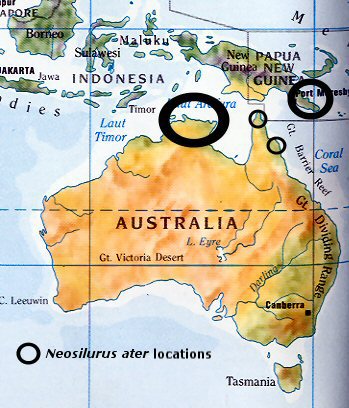
You can see on the map below the habitat locations for this species in Australia centre around the streams in the north. There are two populations in Australia (Allen, 1989). The Western population occurs in the Carson River range and the two smaller populations in the Cape York Peninsula in the Jardine and Starcke rivers. In New Guinea they are found in the central southern area. It is thought that the individuals seen in the trade come from the New Guinea area.
It has to be remembered that the members of this family posses venomous and sharp spines on the pectoral and dorsal fins and so care must be taken to avoid a nasty wound when handling. In its natural habitat they feed on aquatic and terrestrial insects, mollusc, and prawns. An aquarium set-up
would contain a gravel substrate with hiding places
such as PVC pipes or slate/stonework as this is a
shy species and such a set-up will make this species
feel secure in its surroundings. The tank must not
be too small as N.ater can grow upwards of
40cm (16ins), but may have a smaller size in captivity,
and so needs this space to move around in. You can
keep this species in a group but as mentioned you
would need to provide a pretty large aquarium to carry
out this task.
|
 e
are off "down under" for our latest factsheet
this month (May 2005) with a visit to a member of
the Plotosidae family, the Narrow-Fronted or Black
Tandon Catfish, Neosilurus ater from Northern
Australia and New Guinea.
e
are off "down under" for our latest factsheet
this month (May 2005) with a visit to a member of
the Plotosidae family, the Narrow-Fronted or Black
Tandon Catfish, Neosilurus ater from Northern
Australia and New Guinea.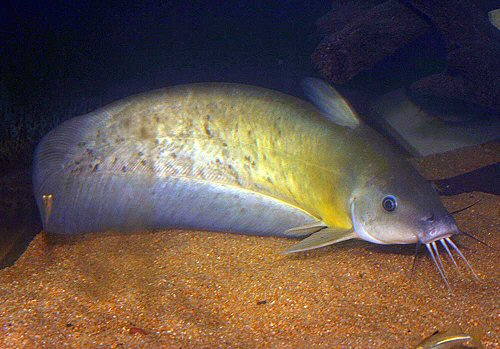
Common Name |
Narrow - fronted Tandon, Black Tandon |
Synonyms |
Lambertia atra, Tandanus ater, Neosilurus mediobarbis, Neosilurus ater sepikensis |
Family |
Plotosidae |
Subfamily |
- |
Distribution |
Northen Australia: Carson River range, Cape York Peninsula in the Jardine and Starcke Rivers. New Guinea: Southern region. |
Size |
40.0cm. (16ins) but may grow smaller in the aquarium. |
Temp. |
22-30°C (71-87°F) |
p.H. |
6.0-8.0 |
Characteristics |
Head broad and slightly flattened; body tapering posteriorly. Small dorsal fin composed of a sharp spine with 5 to 7 soft rays; second dorsal and anal fin confluent with caudal fin, composed of about 120 to 160 rays. Pectoral spine with sharp spine and 11 to 13 soft rays; ventral rays 12 to 15. |
Colouration |
Grey to black, often lighter on underside; sometimed with paler blotching on side. |
Aquarium Care & Compatibility |
| Juveniles up to 18.0cm (7ins) are peacefull schooling fishes but with ongoing size they can become predatory towards smaller 6.0mm (2ins) fish. |
Reproduction |
No reports on the breeding of this species in captivity. In their natural habitat they lay their eggs in the month of December in shallow areas with a good water flow over a gravel or sand substrate. The eggs are 2mm in size. |
Diet |
| A good quality flake food, tablet food and pellets and live foods of any kind. |
Etymology |
| Neosilurus:
Neo means "new" in latin and "silurus"
From 'silouros', a kind of river fish. Silurus,
sheetfish, catfish. According to
Lacepede (1803) this word indicates the rapidity with
which Silurus can move its tail. |
IUCN Red List |
Listed as Least Concern because it is widespread, common, and there are no major threats, (IUCN 2019). |
References |
Allan,
R.Gerald Dr.; Freshwater Fishes of Australia
T.F.H. Publications, Inc. 1989 p59. |
Photo Credits |
©
Dave Wison @ |


|

If you would like to contribute to the monthly factsheets with an
article, information or photos, please e-mail
me. You will of course be credited for your work.
If you would like to donate any denomination of money to the site just click the above link button. All proceeds will go to running the site and hopefully to keep it going for a few years yet.
ScotCat Sources
 Etymology-genera
Etymology-specific name
Online Sources
 Search
 Fishbase
 Wikipedia
 Catalog of Fishes
 GBIF
GBIF
 Fishnet2
 iNaturalist
 IUCN
IUCN

