SCOTCAT.COM
your internet guide to all things catfish
FACTSHEETS: August 2005 - no. 110
Ompok bimaculatus (Bloch, 1794) |
This particular species can be found widespread throughout Asia in the rivers of Afghanistan to China, Thailand and Borneo. This particular catfish has endangered status in the Western Ghats in India and is documented as being found in both freshwater and brackish environments. Ompok bimaculatus naturally occurs in streams and rivers which range in size and flow with currents that can best be described as sluggish to moderate. The rivers are usually quite shallow ranging from 0.5 to 1.5m in depth, and are often muddy and murky. These large catfish are also found in canals and inundated fields into which they move during the flood season. These catfish can attain a length of 450mm or 18” standard length.
Ompok bimaculatus
The ideal water parameters for these catfish are pH in the range of 6-8, hardness in the range of 4-28°dGH and temperature in the range of 20-26°C. This is one of the larger species of catfish, and due to the size that it can attain I would not recommend that you keep this catfish in with small fish as they are most likely going to form part of its diet. Also this particular species requires a larger size aquarium and I would suggest a minimum of 72” x 24” x 24” for it. You are most unlikely to see this catfish amongst importations due to the fact that it is a food fish in the countries in which it naturally occurs. Where offered for sale as a food fish you might encounter Ompok bimaculatus being sold fresh or smoked on skewers!.
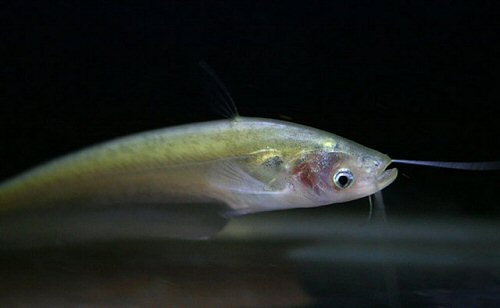
Ompok bimaculatus - head view
Update: Ompok siluriodes was at one time a synomyn for O. bimaculatus but O. siluriodes has a marbled body pattern against the silver of O. bimaculatus.
|
 n to the month of August 2005
we welcome back author Chris Ralph who is the catfish
expert to the U.K. fishkeeping magazine 'Tropical
Fish'. Chris concentrates on his favourite cats 'The
biggies' with a look at the Asian catfish, Ompok
bimaculatus.
n to the month of August 2005
we welcome back author Chris Ralph who is the catfish
expert to the U.K. fishkeeping magazine 'Tropical
Fish'. Chris concentrates on his favourite cats 'The
biggies' with a look at the Asian catfish, Ompok
bimaculatus.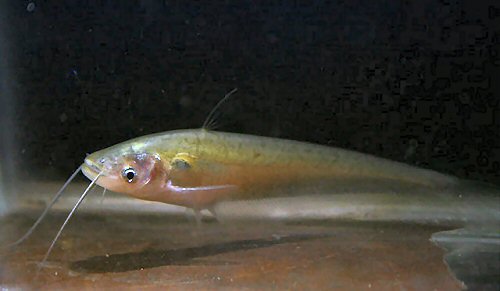
Common Name |
Two-spot Glass Catfish, Glass Catfish, Butter Catfish |
Synonyms |
Silurus bimaculatus, Callichrous bimaculatus, Pseudosilurus bimaculatus, Phalacronotus siluroides, Ompok siluroides, Ompok canio, Silurus canio, Schilbe pabo, Silurus chechra, Silurus duda, Callichrus affinis, Callichrus immaculatus, Callichrus nebulosus, Wallago microcephalus, Silurus mysoricus, Silurus indicus, Callichrous gangeticus, Callichrous macrophthalmus, Callichrous sindensis, Wallago miostoma, Ompok sindensis. |
Family |
Siluridae |
Subfamily |
Silurinae |
Distribution |
Asia: Indian subcontinent and Myanmar. |
Aquarium size |
72” x 24” x 24” (180 x 60 x 60mm) |
Size |
450mm s.l. (standard length is the measurement from the tip of the snout to the base of the caudal peduncle). |
Temp. |
20-26°C (67-79°F) |
p.H. |
6.0-8.0 |
Hardness |
4-28°dGH |
Characteristics |
The body is elongated? The dorsal fin is described as being small and has a total of 4 soft rays, whilst the anal fin which is described as being long has a total of 54-74 soft rays. The pelvic fins are described as being small with 7-8 soft rays. The pectoral fins have 12-14 soft rays. The caudal fin is forked. Ompok bimaculatus has two pairs of barbels; one pair of maxillary barbels which reach the reaching anal fin; and one pair of mandibular barbels which are described as being small in length. The eyes are small and are covered by skin. Ompok bimaculatus is described as having vomerine teeth in 2 patches. |
Colouration |
The base colour of the body is silver, with a conspicuous round black blotch above and behind the pectoral fin base. The second of the two spots is at the base of the caudal peduncle hence the species name bimaculatus. |
Aquarium Care & Compatibility |
| Ompok bimaculatus is described as being peaceful but, has quite a large mouth, and it is for this reason that I would suggest that you keep this catfish as part of a shoal of its own kind or with other large species of fish. |
Reproduction |
There are no known documented spawnings of this catfish in aquaria, which is most likely due to the fact that this catfish is rarely imported and also due to the size of aquarium required. Whilst there are no documented aquarium spawnings it is documented that these catfish are bred in India using hormone injections. |
Sexual Differences |
The males tend to be more slender than the females and are described as having serrations on the posterior edge of the pectoral fin spines, whilst the female’s pectoral fins lack these serrations. |
Diet |
| The natural diet of this catfish includes vegetable matter, fish, crustaceans and molluscs. In captivity these catfish readily accept catfish pellets, prawns and frozen foods. |
Glossary of Terms |
Mandibular
- in relation to the mandible or lower jaw.
|
Etymology |
| Ompok:
It has been suggested that the name is a bad reproduction
of the Malay name 'limpok'. Or from the vernucular
name, 'Ompok'. |
References |
Froese, R. and D. Pauly. Editors. 2005. FishBase.World Wide Web electronic publication. www.fishbase.org, version (07/2005). |
Photo Credits |
© Beta Mahatvaraj |
|

If you would like to contribute to the monthly factsheets with an
article, information or photos, please e-mail
me. You will of course be credited for your work.
If you would like to donate any denomination of money to the site just click the above link button. All proceeds will go to running the site and hopefully to keep it going for a few years yet.
ScotCat Sources
 Etymology-genera
Etymology-specific name
Online Sources
 Search
 Fishbase
 Wikipedia
 Catalog of Fishes
 GBIF
GBIF
 Fishnet2
 iNaturalist

