SCOTCAT.COM
your internet guide to all things catfish
FACTSHEETS: May 2001 - no. 059
Phractura ansorgii Boulenger, 1901 |
|
Phractura ansorgii - female dorsal view
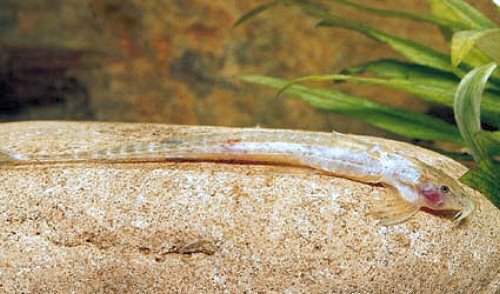
Of course a look at the long barbels (3 pairs) and the long nose gives the game away (plus no sucker mouth) but for unsuspecting aquarists coming into the catfish side of the hobby for the first time, it is easy to see why there would be confusion. The one strange thing that captivated me was the role reversal of the sexes as the female is actually the most striking of the pair (see picture above) even though they are not the most colourful of fish. The bars or bands on her body get a quite dark brown texture when in good condition. The males have no bars at all (picture below) and are quite a pale looking fish even when its water conditions are met. Its when they get into their breeding attire that the males come into their own as they take on a reddish colour to the whole of their body.
Phractura ansorgii - male
They swim in a most curious manner just like a sidewinder snake that you see on one of these T.V. wildlife documentories, moving across the sand, and they find their food this way.
|
 hese
catfish commonly known as 'African Whiptails' tends
to ratify the theory that the two great continents
of the America's and Africa where at one time, one
great mass of land as they look on first glance to
be superficially like South American Whiptails, such
as from the Rineloricaria/Hemiloricaria
genus.
hese
catfish commonly known as 'African Whiptails' tends
to ratify the theory that the two great continents
of the America's and Africa where at one time, one
great mass of land as they look on first glance to
be superficially like South American Whiptails, such
as from the Rineloricaria/Hemiloricaria
genus.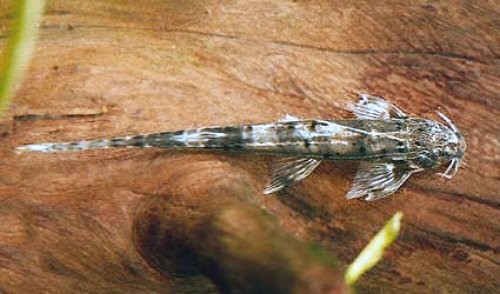
Common Name |
African Whiptailed Catfish |
Synonyms |
Phractura ansorgei, Phractura intermedia |
Family |
Amphiliidae |
Subfamily |
Doumeinae |
Distribution |
Africa: Lower Niger River. Type locality: Agberi, Nigeria. |
Size |
9.0cm. (3¾ins) |
Temp. |
20-24°C (67-75°F) |
p.H. |
6.5-7.2. |
Characteristics |
Origin of dorsal fin in front of base of ventral fins; no spine preceeding pectoral or adipose fins. Slender elongate body. Barbels, short, thick and papillose not reaching the pectoral fin origin. |
Colouration |
Females with dark brown bars and males without this feature taking on a red lustre to their body when in breeding condition. |
Aquarium Care & Compatibility |
| These catfish inhabit fast flowing waters and spend a lot of their time clinging to aquatic leaves and if you provide long stemmed plants, such as Vallisneria for instance, you will see this habit. To keep this species and other members of this African hillstream family you will have to provide a well oxygenated planted aquarium and keep up your water changes as they are not as hardy as the South American equivalents. What I found to my disappointment is they do not like a low p.H. as I had let a tank, which I had placed 2 pairs of this species, drop below 6 and I lost one pair before I realised my predicament, and over the next 48 hrs gradually raised the p.H.to a more respectable 7 which suited them just fine. |
Reproduction |
A report on the breeding of this species is documented in the Baench Aquarium Atlas 3 and was carried out by Dr. Walter Foersch as far back as the late 50's. Chirping noises could be heard in the aquarium. The male curved his body like a U over the female and this position was maintained for several seconds. The female produced 100 eggs that had a thick gelatinous cuticle and were similar in appearance to amphibian eggs. The fry hatched after 2-3 days and accepted food after an additional 5-6 days. He lost many of the young as he couldn't determine what the fry were eating but managed to raise the rest which resembled newt larvae when they were 12 mm in length. |
Sexual Differences |
Females with dark brown bars and males without this feature taking on a red lustre to their body when in breeding condition. |
Diet |
| It has been documented that they will eat algae but I found that they were not interested in it and preferred frozen bloodworm which they eat as if it was going out of style. They will also take tablet food and other worm foods such as grindle and white worm. You can try vegetable foods such as corgette (zucchini) and also lettuce and monitor to see if they do eat them. |
Etymology |
| Phractura:
Protected tail. |
References |
Baensch,
H.A. and R. Riehl 1991 Aquarien atlas. Bd.
3. Melle: Mergus, Verlag für Natur- und Heimtierkunde,
Germany. 1104 p. |
Photo Credits |
© |

|

If you would like to contribute to the monthly factsheets with an article, information or photos, please e-mail me. You will of course be credited for your work.
If you would like to donate any denomination of money to the site just click the above link button. All proceeds will go to running the site and hopefully to keep it going for a few years yet.
ScotCat Sources
 Etymology-genera
Etymology-specific name
Other Sources
 Search
 Fishbase
 Wikipedia
 Catalog
of Fishes
Catalog
of Fishes
 GBIF
GBIF
 Fishnet
 iNaturalist

