SCOTCAT.COM
your internet guide to all things catfish
FACTSHEETS: May 1999 - no. 035
Pimelodus albofasciatus Mees, 1974 |
|
Pimelodus albofasciatus
This genus has been in confusion for a good number of years now especially with another close member of the family, Pimelodella. Below are the following characteristics from the two genus. Pimelodella : Adipose fin long, low with a curved margin. The humeral process is long and spikey. Body usually plain with a dark lateral stripe; rather depressed body. Pimelodus: Adipose fin short, high, with a straight or sloping margin. Humeral process broad, triangular. Body variously patterned, usually quite deep, like Synodontis.
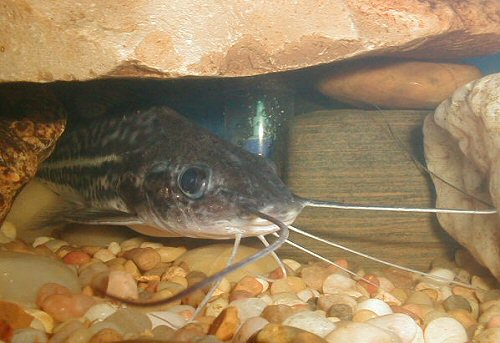
Pimelodus albofasciatus - head view
Water parameters are not too critical with this species as they are quite hardy, along with the other members of this genus, as long as it is not too way out of course. I do find that if the nitrate values drop the barbels will very quickly wear away, but a few water changes will have them looking their best again. If you keep your normal tank maintenance up with regular water changes ( to keep the nitrates down) and good filtration (power filters) you should have this catfish living for a good number of years. A planted aquarium can sometimes be a problem with Pimelodus as they can be quite boisterous and can dig up the plants in their night -time forays. Strong plants like Java Fern tied to bogwood or rockwork usually work out the best bet, but you can try the trial and error method with planting to find the best solution. Another thing to point out are the hard rays of the dorsal and pectoral fins can give you a nasty sting if you are unfortunate enough to come in contact with them. The results of this jab vary from individual to individual, but the pain can usually last for a full day after it draws blood but it is not a common occurrence.
|
 o
many non-catfish hobbyists or to people who have not
kept fish at all, the members of the Pimelodidae
family are usually recognisable as being "oh
yes these are catfishes" category, having the
typical catfish shape and the long barbels associated
with the "cats".
o
many non-catfish hobbyists or to people who have not
kept fish at all, the members of the Pimelodidae
family are usually recognisable as being "oh
yes these are catfishes" category, having the
typical catfish shape and the long barbels associated
with the "cats". 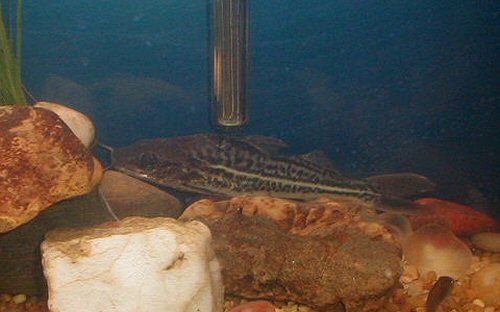
Common Name |
White-Striped Pimelodus |
Synonyms |
None |
Family |
Pimelodidae |
Subfamily |
Pimelodidinae |
Distribution |
South America: Amazon, Orinoco, upper Corantijn and Sipaliwini River basins. |
Size |
25.0cm. (10ins) |
Temp. |
23-26°C (73-79°F) |
p.H. |
6.5-7.0. |
Hardness |
up to 10° dGH |
Characteristics |
Dorsal 1/6; Anal 10-14; ventrals; 6. Pectoral fin spine is strong, pungent and serrated on both margins.Caudal fin deeply forked with the lobes pointed. Dorsal fin with a strong spine with teeth on the posterior margin. |
Colouration |
Upper part of body dark blue/grey with some slightly paler indistinct wavy lines. A broad white band runs along the lateral line from operculum to base of caudal fin, below this white band is a slightly broader dark blue/grey band of equal length. A short blue/grey band runs from the operculum to the ventral base. Base of dorsal fin and dorsal spine with dark pigment, including the caudal, which also has spots on the top lobe (which are not always present). Adipose fin with spots and blotches and a dark margin. Remaining fins only slightly pigmented. |
Aquarium Care & Compatibility |
| Pimelodus albofasciatus can of course be predatory along with most of the members of this family, so they must be kept with species larger or compatible with it. An aquarium 36" long would accommodate one individual but over this size you can house two or more, as I have been keeping two together now for a number of years in a 4' x 18" x 15" tank with no problems apart from a few skirmishes, which don't amount to much. Give them pipes or rockwork to create their own territory to make them feel comfortable in their surroundings. |
Reproduction |
Not reported. |
Diet |
| Mostly live foods such as earthworms, whiteworms and frozen foods such as bloodworm and tubifex. Will also accept catfish pellets and tablet food. |
Glossary of Terms |
Humeral
process:
Bony extension of the pectoral girdle. |
Etymology |
| Pimelodus:
Pimel = fat; odus = tooth. |
References |
Baensch,
H.A. and R. Riehl 1985 Aquarien atlas. Band
2. Mergus, Verlag für Natur- und Heimtierkunde
GmbH, Melle, Germany. 1216 p. |
Photo Credits |
© Leigh Murphy |
|

If you would like to contribute to the monthly factsheets with an article, information or photos, please e-mail me. You will of course be credited for your work.
If you would like to donate any denomination of money to the site just click the above link button. All proceeds will go to running the site and hopefully to keep it going for a few years yet.
ScotCat Sources
 Etymology-genera
Etymology-specific name
Other Sources
 Search
 Fishbase
 Catalog
of Fishes
Catalog
of Fishes
 GBIF
GBIF
 Fishnet
 iNaturalist

