SCOTCAT.COM
your internet guide to all things catfish
FACTSHEETS: February 2022 - no. 308
Platydoras costatus (Linnaeus, 1758) |
Platydoras costatus
The specimen depicted above was owned by U.K. Dorad specialist Daphne Layley in about 1985 and lived for many years in her care (see further information below in Aquarium Care & Compatibility). The Photograph was taken in a U.K. shop owned by David Sands just before she bought it in that year. It is depicted in David Sands book, Catfishes of the World Vol. 4 in page 38b as Platydoras spp. Most of the images depicted online as P. costatus are actually P. armatulus. This species has never, or very rarely been exported.
Platydoras armatulus
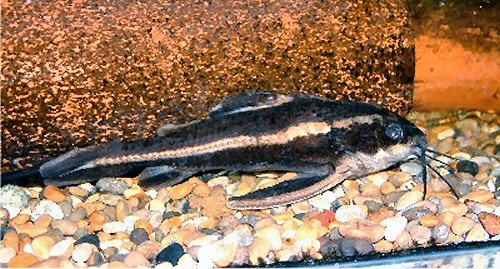
The image above shows P. armatulus which for many years we thought of as P. costatus. In common with most of the Doradidae family it can create a sound by grating its fin bones in each socket and amplifying the noise via the swim bladder. A record of cleaning behavior by Platydoras costatus has been documented by Carvalho et al in 2003, but I would imagine that the species depicted would have been Platydoras armutulus instead. "Records of cleaning symbiosis between freshwater fish are scarce. Here we report on juvenile catfish, Platydoras costatus, cleaning the piscivorous characin Hoplias cf. malabaricus in a stream of the Rio Araguaia drainage in the Brazilian Amazon. The scarcity of records on cleaning behavior in freshwater systems seems to be in part a consequence of the few observational studies under natural conditions in the Neotropics. Otherwise, the rareness of this behavior in freshwaters is possibly related to the short evolutionary time available to the fish fauna to develop these complex interactions, when compared to the ocean environment".
As a footnote this is a fairly easy catfish to keep as long as you can provide it with shelter such as pipes or cave work. It will even jam itself into the pipe with its pectoral spines and will be unremovable. Remarks: There is another slightly different Platydoras with shallower scutes but does not congregate with the true P. costatus. This has been named before description as Platydoras sp. "shallow scute". This "shallow scute" species may in the future be named as Platydoras helicophalis which at the moment (Feb. 2022) is a synonym of P. costatus.
|
 ue
to the work carried out in the paper by Piorski,
N.M., J.C. Garavello, M. Arce & M.H. Sabaj Pérez
in 2008 we came to realise that the real P. costatus
was indeed indigenous to the coastal drainages of
Suriname and French Guiana and what we had called
for years, P. costatus, was in fact
ue
to the work carried out in the paper by Piorski,
N.M., J.C. Garavello, M. Arce & M.H. Sabaj Pérez
in 2008 we came to realise that the real P. costatus
was indeed indigenous to the coastal drainages of
Suriname and French Guiana and what we had called
for years, P. costatus, was in fact 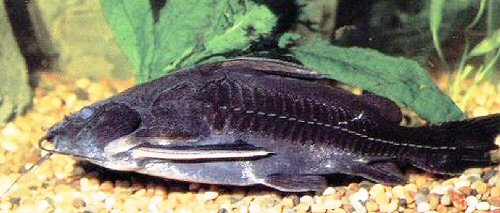
Common Name |
Synonyms |
Silurus costatus, Platydoras helicophilus |
Family |
Doradidae |
Subfamily |
Doradinae |
Distribution |
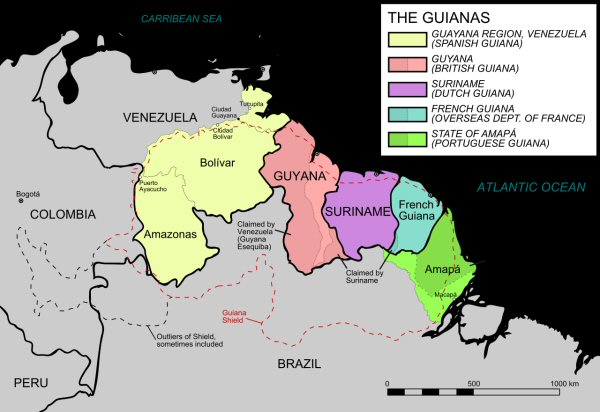
South America: Negro, Essequibo, Demerara, and upper Orinoco basins. Essequibo River basins and coastal drainages in French Guiana and Suriname to Argentina. Type locality: Indiis (South America). |
Size |
24.0cm (9½ins) |
Temp. |
24-30ºC (75-87ºF) |
p.H. |
6.0-7.5. |
Characteristics |
Mouth almost terminal. Large head which is depressed (width equal to or larger than head length); large eyes (2 times in interorbital distance) in the anterier half of the head; caudal fin emarginated to deeply forked; adipose fin extending forward as a long keel; medium to large. Caudal peduncle provided with plates above and below. |
Colouration |
Dark brown dorsally, grey-white ventrally, sometimes with a yellow-white longitudinal band along the lateral line (this band is especially prounounced in juveniles). |
Aquarium Care & Compatibility |
| f you do have the good luck to have this species it is a fairly easy catfish to keep as long as you can provide it with shelter such as pipes or cave work. It will even jam itself into the pipe with its pectoral spines and will be unremovable. The following text is from Daphne Layley, "I found mine was quite nocturnal but it would come out of its cave in the twilight when food was offered. It ate bloodworms, small earthworms and dried catfish pellets. It wasn’t aggressive, but would defend its cave if necessary. It eventually became quite knowing and tame, and would stand upright on its tail with its mouth open at the feeding corner waiting for me to drop food in" |
Reproduction |
Not reported in the aquarium. |
Sexual differences |
Females seem to be deeper bodied and the males have better colouring overall. |
Diet |
| In its natural habitat it feeds on mollusks, crustaceans and detritus. In the aquarium it is easy to feed on frozen food such as bloodworm, tablet and pellet foods. In youngsters it is better to feed at night after lights out, the older they get they will get bolder and come out at feeding time. |
Glossary of Terms |
Adipose fin:
Fleshy finlike projection without rays, behind the
rayed dorsal fin. |
Etymology |
| Platydoras:
Platys = broad; doras = cuirass. |
IUCN Red List |
Platydoras costatus has a wide distribution extended along coastal drainages of Suriname and French Guiana, in Corantijn River, Maroni/Marowijne River, Mana River, Suriname River, and Paramaribo River. Despite local impacts in the subpopulation from Brokopondo area, and illegal mining activities in Maroni River, these impacts are unlikely to affect the species' long-term persistence. Thus, Platydoras costatus is assessed as Least Concern (LC) due to its wide distribution and the lack of any known severe threats (IUCN 2022). |
References |
Calegari,
B.B. 2022. Platydoras costatus.
The IUCN Red List of Threatened Species 2022. |
Photo Credits |
©
Daphne Layley |

|

If you would like to contribute to the monthly factsheets with an article, information or photos, please e-mail me. You will of course be credited for your work.
If you would like to donate any denomination of money to the site just click the above link button. All proceeds will go to running the site and hopefully to keep it going for a few years yet.
ScotCat Sources
 Etymology-genera
Etymology-specific name
Other Sources
 Search
 Fishbase
 Wikipedia
 Catalog
of Fishes
Catalog
of Fishes
 GBIF
GBIF
 Fishnet2
 iNaturalist
 IUCN
IUCN

