SCOTCAT.COM
your internet guide to all things catfish
FACTSHEETS: August 2006 - no. 122
Scobiancistrus aureatus Burgess, 1994 |
|
Scobiancistrus aureatus
This catfish as with many other species is best described as being a substrate dweller, with its typical suckermouth adapted to feeding upon different food types found on the substrate. I have seen a number of these striking catfish available for sale over the years and I would suggest that you would expect to pay anything from £30 for a juvenile specimen to in excess of £100 for an adult fish. Scobiancistrus aureatus prefer to be kept in water which has a pH in the range of 5.8-7.2. This catfish is ideally suited to temperatures in the range of 25-29ºC. It fares best in well aerated, clean water conditions with a preference for a good water flow.
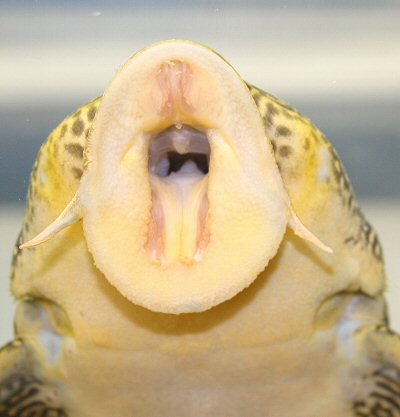
Scobiancistrus aureatus - showing the mouth structure
I would suggest a minimum size of 48” x 24” X 24”, although a larger aquarium would be preferred for one of these fascinating larger catfish. I would suggest good quality aquarium sand such as BD Aquarium Sand, or very smooth rounded gravel as the preferred substrate when keeping these catfish. The aquarium should provide some shelter in the form of rocks or bogwood along with a small covering of aquatic plants. As with all other species of fish, water quality and general husbandry is very important, and I would recommend that a minimum of 25% water is changed on a weekly basis.
|
 his
month (August 2006) we welcome back regular
contributor, U.K. author Chris Ralph, and his look
at the Sunshine or Goldie Pleco Scobiancistrus
aureatus.
his
month (August 2006) we welcome back regular
contributor, U.K. author Chris Ralph, and his look
at the Sunshine or Goldie Pleco Scobiancistrus
aureatus.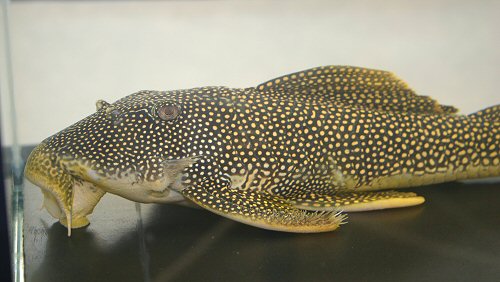
Common Name |
L014, Goldie Pleco and Sunshine Pleco |
Synonyms |
None |
Family |
Loricariidae |
Subfamily |
Loricariinae |
Distribution |
South America: Namely the Rio Xingu and Para in Brazil. The type locality for Scobiancistrus aureatus is documented as being the Ihla da Fazenda. |
Size |
300mm S.L. (12ins) (standard length – this is the measurement of the fish from the tip of the snout to the base of the caudal peduncle). |
Temp. |
25-29c (77-85f) |
p.H. |
5.8-7.2. |
Characteristics |
The body shape of Scobiancistrus aureatus is described as being elongate and flattened. The body is completely covered with small spines. The mouth is described as being inferior with lips forming a disc-like shape. The teeth are arranged in rows. The eyes have a peg-shaped iris lobe which is typical of most species of Loricariid. The adipose fin consists of a spiny projection which supports a membrane. This catfish has distinctive nasal flutes. |
Colouration |
The base colour of the body and head is dark olive green. The suckermouth is yellowy white in colour. In juvenile specimens the body is overlaid with large yellow or gold coloured spots along the length of the body, which can be seen extending from the body into the base of the fins. The fins are a vivid orange colour in juvenile fish, with the exception of the adipose fin which shares the same base colour of the body with spots. In adult specimens the body is overlaid with a greater number of spots which can also be seen spread over the majority of the surface of the fins. The tips of the fins become yellow in colour as opposed to the vivid orange colour in juvenile fish. |
Aquarium Care and Compatibility |
| Scobiancistrus aureatus is an ideal addition to an aquarium containing such fish as South American cichlids, discus and angelfish, just as long as the other occupants are not too aggressive and can withstand the higher water temperatures. |
Reproduction |
As far as I am aware there are no documented records of Scobiancistrus aureatus having been spawned in aquaria to date, which is most likely due to the cost of purchasing the breeding stock and also to the potential size of aquarium required. |
Sexual Differences |
The males tend to be more slender and larger than the females. The males tend to develop bristles around the cheeks and head, with larger spines or odontodes being present along the leading edge of the pectoral fin ray. |
Diet |
| Scobiancistrus aureatus readily accepts a mixed and varied diet which includes sinking foods such as catfish pellets, frozen bloodworm and any other good quality foods which sink to the substrate. These catfish also have a preference to feed upon meatier foods such as dead fish, mussels and prawns. |
Glossary of Terms |
Adipose:
defined as a second dorsal fin which consists of fatty
tissue with a single spine supporting a thin membrane.
|
Etymology |
Scobinancistrus:
Latin, scobis = sawdust
+ Greek, agkistron = hook. |
Photo Credits |
All images by Author |
|

If you would like to contribute to the monthly factsheets with an article, information or photos, please e-mail me. You will of course be credited for your work.
If you would like to donate any denomination of money to the site just click the above link button. All proceeds will go to running the site and hopefully to keep it going for a few years yet.
ScotCat Sources
 Etymology-genera
Etymology-specific name
Online Sources
 Search
 Fishbase
 Catalog of Fishes
 GBIF
GBIF
 Fishnet2
 iNaturalist

