SCOTCAT.COM
your internet guide to all things catfish
FACTSHEETS: May 1998 - no. 023
Sturisoma barbatum (Kner,1854) |
Sturisoma barbatum
Good water conditions are a priority, with a careful watch on Nitrates which in my experience Loracariids do not do well in if they get too high, so regular water changes are a must or they will succumb pretty quickly. A good water current is called for giving a high oxygen content in a tank that is at least 3' 0" long as this species can get quite large and needs plenty of room in an under stocked tank. Due to the southern catchment area they would need to be kept at not too high a temperature.
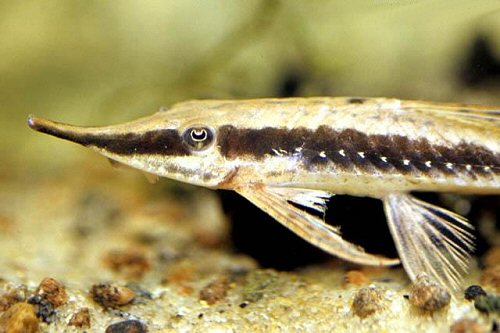
Sturisoma barbatum - showing nose
Remarks: On the latest paper by Cardoso, Y. et al (2023) this species is now considered a senior synonym of Sturisoma robustum. Abstract: Researchers ask, how many species of Sturisoma catfishes inhabit the La Plata Basin? Uptil now, there are two recognised species, S. barbatum and S. robustum, however this study indicates these two species are part of an intraspecific variation within a single species, with S. barbatum (the valid species) as the senior synonym of S. robustum (Cardoso, Y. et al 2023), Therefore S. barbatum and S. robustum are the same species.
UPDATE: The work carried out by Covain et.al. 2016 confines the Sturisoma genera to east of the Andes (cis-Andean), and the Sturisomatichthys genera restricted to the west of the Andes (trans-Andean).
|
 his Sturisoma
species is called the Long-Nosed Whiptail as you can
see in the accompanying photograph, it is in fact
reminiscent of a Farlowella species being long
and slender. Sturisoma barbatum can be seen
often during the daylight hours as this is not quite
so much a nocturnal species compared to others in
this genus.
his Sturisoma
species is called the Long-Nosed Whiptail as you can
see in the accompanying photograph, it is in fact
reminiscent of a Farlowella species being long
and slender. Sturisoma barbatum can be seen
often during the daylight hours as this is not quite
so much a nocturnal species compared to others in
this genus. 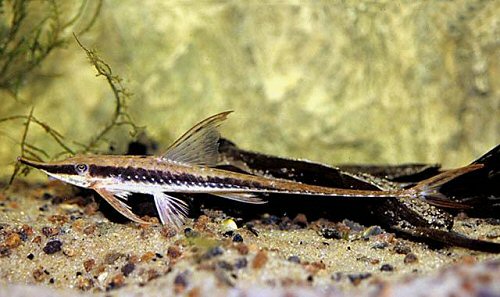
Common Name |
Long-Nosed Whiptail |
Synonyms |
Loricaria barbata, Oxyloricaria barbata |
Family |
Loricariidae |
Subfamily |
Loricariinae |
Distribution |
South America: Brazil, Paraguay, Paraguay River basin, Rio Cajuba. |
Size |
25.0cm. (10¼ins) |
Temp. |
22-24°c (71-75°f.) |
p.H. |
6.5-7.2. |
Characteristics |
Genera description: Moderately elongate body, oval in cross section through the dorsal fin origin; snout convex in dorsal view; mouth subterminal; eye of medium size, dorsolateral, with free margin; premaxillary tooth plate wide, not bearing projection at posterolateral angle; maxillary barbel moderately long its extremity usually reaching the end of the pectoral fin. Pectoral fins usually with 8-10 branched rays; first dorsal fin ray (spinelet) absent. Anal fin short having 11-15 rays; caudal fin deeply forked. Lateral line usually continues to caudal peduncle. |
Colouration |
Ground colour of head and body brownish, ventral region paler. Fins with dark spots or bars confined to the rays. |
Aquarium Care & Compatibility |
| In common with the Sturisoma genus it is very peaceful so you should not mix it with any fin nipping species as the long filaments to the caudal fin can be a magnet for this behavior. Provide large flat stones or roots for this species as it likes to "sprawl" out full length so needs this priority to fulfill this entitlement. A good water current and filtration is called for giving a high oxygen content in a tank that is at least 3' 0" long as this species can get quite large and needs plenty of room in an under stocked tank. Will be seen during the daylight hours. Due to the southern catchment area they would need to be kept at not too high a temperature. |
Reproduction |
Not yet known but is sure to be similar to Sturisomatichthys aureus where eggs are usually placed on the glass sides of the tank where the male guards the eggs and cleans them for up to 8 days, and when released from their egg cases will be ignored by the parents. A good first food is greens and brine shrimp. |
Sexual Differences |
Males can be differentiated from the females as having cheek and head bristles, with the females being that bit heavier looking. |
Diet |
| Algae and green foods are a must for the parents as well as the fry featuring lettuce, peas, cucumber and courgette (zucchini). They will also eat on occasion good quality flake food and frozen bloodworm. |
Etymology |
| Sturisoma:
With a
body like a sturgeon. |
IUCN Red List |
This species is listed as Least Concern because it is widely distributed, the population is presumed to be stable, is present in protected areas and because there are no major widespread threats currently affecting it (needs updating IUCN 2016). |
References |
Baensch,
H.A. and R. Riehl
1985 Aquarien atlas. Band 2. Mergus, Verlag für
Natur- und Heimtierkunde GmbH, Melle, Germany. 1216
p. |
Photo Credits |
© |

|

If you would like to contribute to the monthly factsheets with an article, information or photos, please e-mail me. You will of course be credited for your work.
If you would like to donate any denomination of money to the site just click the above link button. All proceeds will go to running the site and hopefully to keep it going for a few years yet.
ScotCat Sources
 Etymology-genera
Etymology-specific name
Other Sources
 Search
 Fishbase
 Wikipedia
 Catalog
of Fishes
Catalog
of Fishes
 GBIF
GBIF
 Fishnet2
 iNaturalist
 IUCN
IUCN

