SCOTCAT.COM
your internet guide to all things catfish
FACTSHEETS: November 2005 - no. 113
Synodontis bastiani Daget, 1948 |
The scientific community currently recognises this fish as Synodontis bastiani. In aquarist circles we recognise this fish from its junior synonym name of Synodontis euberneensis. The Ivory Synodontis comes to us from Ghana and the Ivory Coast. Here it is found in riverine habitats.
Synodontis bastiani
If purchasing a young Ivory Synodontis find a full bodied fish as emaciated youngsters never regain the habit to feed. Youngsters really know how to fend for themselves and will feud not only with each other but with any other Synodontis species housed within their aquarium. Be warned as their aggression can hit times when it knows no bounds. At the juvenile stage they like to hideaway among the décor emerging into the open in hyperactive bursts that will see them 'spook' and bully small tank companions. As far as the U.K. goes these fish are relative newcomers to the aquarium scene and thus have only been seen in any number since the autumn of 2003. These fish tend to grow very quickly. In general fast growing Synodontis have the shortest natural life spans so we will wait and see what happens with these fish? An aquarium of 48x12x12" allows enough room for movement (my trio are housed in an aquarium 60x10x10"). These fish are sold for Rift Valley communities but are not at home in the hard water conditions found in such an aquarium and this affects their eyes, which go extremely cloudy, very quickly. A pH of 7 and a high water temperature of 79 F suites them very well. As long as regular water changes are maintained filtration can be minimal. Décor of rounded pebbles and mopani wood with a substrate of fine gravel. The skin of this specie is not as strong as that of many other Synodontis so avoid using sharp edged rocks etc. in your aquarium. Rough territories are formed. Please remember that the pectoral spines of this specie are extremely sharp so we never catch an Ivory Synodontis in a net but lower the water level and shepherd them into a plastic bowl. When removed from water many Synodontis make squeaking noises but I have never heard such sound coming from an Ivory Synodontis.
Synodontis bastiani
This article was also written for the Ryedale Reporter, Ryedale Aquarist Society, England
|
 his
month (November 2005) we welcome a new contributor
in David Marshall a keen Synodontis keeper
who is a member of English fish club, Ryedale Aquarist
Society, and also the editor of their newsletter,
Ryedale Reporter. He is a regular contributor to Aquarticles
on the net. I now hand you over to David on how to
take care of the "Ivory Synodontis".
his
month (November 2005) we welcome a new contributor
in David Marshall a keen Synodontis keeper
who is a member of English fish club, Ryedale Aquarist
Society, and also the editor of their newsletter,
Ryedale Reporter. He is a regular contributor to Aquarticles
on the net. I now hand you over to David on how to
take care of the "Ivory Synodontis". 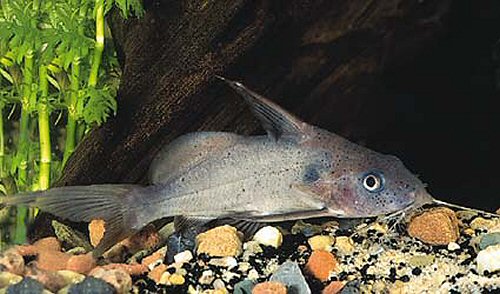
Common Name |
Ivory Synodontis |
Synonyms |
Synodontis eburneensis, Synodontis dageti |
Family |
Mochokidae |
Subfamily |
Mochocinae |
Distribution |
Africa: Sassandra, Bandama and Bia basins (Côte d'Ivoire), also from the Comoe and Agnébi Rivers. Type locality: Côte d’Ivoire: Bouaflé. |
Size |
20.0cm. (8ins) |
Temp. |
22-26°C (72-79°F) |
p.H. |
6.5-8.0. |
Characteristics |
Dorsal spines (total): 1; Anal spines: 0. Diagnosis: gill slits not extending ventrally beyond pectoral-fin insertions; eye not more than 20% of head length, and 26% of head width; in adults, post-orbital length at least 60% of snout length; maxillary barbels usually longer than head (except in young individuals), unbranched, without tubercles but with a broad, black basal membrane; outer mandibular barbels with rather long, tuberculate ramifications; branches of inner mandibular barbels shorter and strongly globose; mandibular teeth long, numbering 27-38 (33 in the holotype); dorsal-fin spine smooth anteriorly; denticulations of pectoral-fin spines finer on outer than on inner margin; humeral process not keeled ventrally, triangular, slender and pointed in young specimens, and deep, more strongly arched, and more blunt posteriorly in adults; dorsal- and pectoral-fin spines prolonged into a black filament; adipose fin not very well developed; head more flattened in young than in adults; outer margins of caudal-fin lobes black-edged; body covered with fine specks. |
Colouration |
Body rather pale and covered with fine black specks and with larger spots in young individuals; rayed fins light and often spotless, but adipose fin always spotted; outer margins of caudal-fin lobes black-edged; broad black spot above humeral process. |
Aquarium Care & Compatibility |
| As they mature their behaviour becomes more stable, particularly when kept as a trio or group, but they can turn on the aggression, should the need or mood dictate. The mature trio in my care live alongside Synodontis decorus, S. schoutedeni, S. njassae, large Plecostomus, Raphael catfish, large Botia species and a group of red parrot cichlids. Perhaps the secret is to keep them in a fairly crowded aquarium? I would definitely not trust them with smaller species. |
Reproduction |
This occurs during the West African rainy season when large tracts of grassland become flooded. Scientific research indicates that distinct pairing takes place. Dark coloured eggs are scattered in open water and over the substrate. There is no parental care of these eggs. As the eggs hatch the fry feed upon abundant micro-organisms so that they grow quickly and put on enough body fat that will enable a high number to survive when the dry season begins and the waters thus recede back to their normal river courses. As yet there are no reports of aquarium or commercial breeding of the Ivory Synodontis. |
Diet |
| Feeding causes no problems as large sized flake foods, catfish pellets, prawns and pieces of Thai crabstick are taken with great gusto. My trio have a strict pecking order but all three make sure of getting plenty to eat. |
Etymology |
| Synodontis:
Syn = together; odontis = teeth
(fused tooth plates). |
IUCN Red List |
This is a widespread species known from the Bandama, Comoé, Sassandra, Agnébi, Black Volta, Mé rivers and Bia rivers in Ghana, Burkina Faso and Cote d'Ivoire. Although it is threatened by over exploitation, its wide range means it is assessed as Least Concern (IUCN 2020). |
Photo Credits |
Top
image: © |

|

If you would like to contribute to the monthly factsheets with an article, information or photos, please e-mail me. You will of course be credited for your work.
If you would like to donate any denomination of money to the site just click the above link button. All proceeds will go to running the site and hopefully to keep it going for a few years yet.
ScotCat Sources
 Etymology-genera
Etymology-specific name
Other Sources
 Search
 Fishbase
 Wikipedia
 Catalog
of Fishes
Catalog
of Fishes
 GBIF
GBIF
 Fishnet2
 iNaturalist
 IUCN
IUCN

