SCOTCAT.COM
your internet guide to all things catfish
FACTSHEETS: June 2000 - no. 048
Tatia aulopygia (Kner, 1858) |
Tatia aulopygia
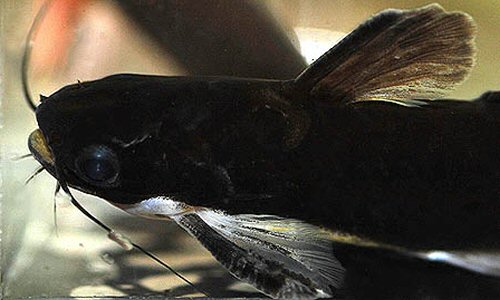
Tatia tend to be kept by catfish fanatics (for the want of a better word!) as you will not see them from one week to another as they are nocturnal (active at night) and you have to feed at lights out or as I do, put food into the pipe or crevice that you will find them jammed into. Tatia aulopygia is quite a plain catfish. The eyes are large with a skin over them and a few non catfish aquarists tend to think that they have cloudy eye's and it is a disease, but this is normal for the Auchenipteridae family. The barbels are moderate in length reaching to the end of the dorsal fin and they tend to bend them upwards when looking for food. They can also tuck their barbels alongside their cheeks making them nearly invisible. I tend to think that there is a groove in this area where they can lay their barbels in. They possess two pairs of barbels, one pair of mandibular and one pair of maxillary. They have quite a chunky body with a broad based caudal peduncle (between the dorsal and caudal) which is unusual in itself as in most fish it slopes down to the caudal fin. Tatia possess a very small adipose fin and a moderately sized ventral and anal.
Tatia aulopygia - head view
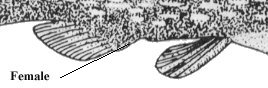
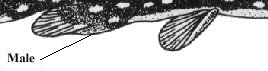
The anal fin is the key to the sexual dimorphism of this genus, if you think of the male and female of most livebearer fish (Goodeidae family) and you will not be too far away with this assumption. As you can see above the female has a normal anal fin but the males are modified into a copulatory organ with the first and second ray thickened and longer, it is thought that the male uses this to clasp the female during the spawning embrace.
|
 he
genus Tatia contains around about 14 species
(2010) distributed throughout South America east of
the Andes from Venezuela and Colombia to Southern
Brazil. They don't grow big and the largest size recorded
is 12cm.( 5ins).
he
genus Tatia contains around about 14 species
(2010) distributed throughout South America east of
the Andes from Venezuela and Colombia to Southern
Brazil. They don't grow big and the largest size recorded
is 12cm.( 5ins). 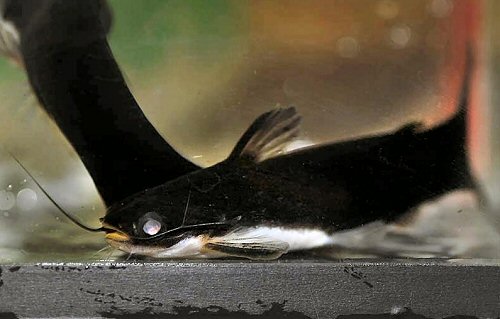
Common Name |
Snowflake Woodcat |
Synonyms |
None |
Family |
Auchenipteridae |
Subfamily |
Centromochlinae |
Distribution |
South America: Occurs in the Madeira river drainage of the Amazon basin. Most records are from upper reaches, in the Guaporé and Mamoré rivers. |
Size |
10.0cm (4ins) |
Temp. |
21-24c (69-75f) |
p.H. |
6.5-7.5. |
Characteristics |
Dorsal fin I,5 (n=7); dorsal-fin spine with 14-16 antrorse serrations along entire anterior margin; posterior margin smooth. Pectoral fin I,5 (n=7); pectoral-fin spine with 21-24 antrorse serrations along anterior margin; small serrations close to spine base; 14-16 retrorse serrations along posterior margin; serrations along both margins progressively larger toward spine tip. Pelvic fin i,5 (n=7); margin rounded. Adipose fin small, origin on vertical through end of anal-fin base. Anal fin iii,7-8 (n=7); anal-fin pterygiophores in eight rod-like proximal radials and seven cartilaginous distal radials. Caudal fin forked, lobes with rounded tips, 8+9 principal rays, 18- 20 upper procurrent, 17-20 lower procurrent rays (n=7). Pleural ribs 10-11 attached to consecutive vertebrae. PostWeberian vertebrae 38-39 (n=4). |
Colouration |
Body coloration is somewhat variable, usually with large bands or blotches irregularly distributed over sides of body. In some specimens colouration is uniformly dark or pale brown, with caudal fin mottled. Some young specimens have small spots over ventrolateral parts of body and a barred caudal fin. |
Aquarium Care & Compatibility |
| Give them small pipes, and they do seem to like to hide in the crevices of bogwood as well. They appear to be happier if they can jam themselves in with the use of their pectoral fins. Community tanks are fine for this species although you may find that they will predate on fry from other species, but apart from that they come well recommended but don't expect to see them too often. |
Reproduction |
Internal fertilisation with the eggs deposited 24-48 hours later. Also a report on Tatia creutzbergi, (T. gyrina) with them placing their adhesive eggs on the underside of wood with no broodcare after the event. A few members of the Auchenipteridae family have been spawned in the hobby with a successful breeding and raising of the young of Trachelyichthys decaradiatus by Dick Thompson, a former member of The Northern Area Catfish Group (now the Catfish Study Group) |
Diet |
| In its native habitat they feed on small invertebrates and crustaceans and in the aquarium they will eat anything given such as frozen bloodworm inserted in to their hideaway, catfish tablets, white worm (sparingly) and prawns and shrimp. They do like their food and you can see them shooting out of their hideouts and swimming in a frenzied manner to try and take all for themselves, especially when you feed them their favourite food, frozen bloodworm. |
Etymology |
| Tatia:
In honour of Mr. C. Tate Regan. |
References |
Baensch,
H.A. and R. Riehl 1991 Aquarien atlas. Bd.
3. Melle: Mergus, Verlag für Natur- und Heimtierkunde,
Germany. 1104 p. |
Photo Credits |
© Johnny
Jensen @ |

|

If you would like to contribute to the monthly factsheets with an article, information or photos, please e-mail me. You will of course be credited for your work.
If you would like to donate any denomination of money to the site just click the above link button. All proceeds will go to running the site and hopefully to keep it going for a few years yet.
ScotCat Sources
 Etymology-genera
Etymology-specific name
Other Sources
 Search
 Fishbase
 Catalog
of Fishes
Catalog
of Fishes
 GBIF
GBIF
 Fishnet2
 iNaturalist

