SCOTCAT.COM
your internet guide to all things catfish
FACTSHEETS: April 2024 - no. 334
Trachelyopterichthys taeniatus (Kner, 1857) |
There are only two described species, our factsheet
of the month and T. anduzei Ferraris &
Fernandez, 1987 (Upper Orinoco River basin, Venezuela).
This other species can not be mixed up with T.
taeniatus as it sports spots and no lateral lines
and it is much rarer.
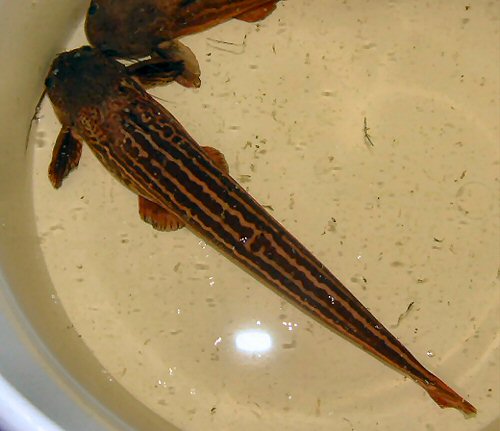
Trachelyopterichthys taeniatus - dorsal view
From the paper by Ferraris & Fernandez. 1987. The Auchenipterid catfish genus Trachelyopterichthys was created by Bleeker in 1862 to accommodate Kner's (1858) Trachelyopterichthys taeniatus, a species then known only from its holotype. Trachelyopterichthys taeniatus remains a poorly known fish, being represented by only a handful of specimens in museums. Little has been written about this species due to the dearth of material available for anatomical studies. Recent collecting
(1987) in the Rio Orinoco system of Venezuela has
uncovered another species of this genus, again from
a unique specimen.Studies associated with the description
of this new species and the recent importation of
specimens of T. taeniatus into the U.S. aquarium
fish trade led to the discovery of previously unknown
sexually dimorphic characters in Trachelyopterichthys.
(Ferraris & Fernandez, 1987).
|
 n
interesting and pretty looking species from the Auchenipteridae
family is the subject of the April 2024 factsheet.
It is interesting because of the lack of an adipose
fin and the very long body. The colour and markings
stand it apart from other members of this family and
it is well sought after in the hobby. There are reputedly
another two undescribed species in this genus from
the Rio Madeira and the Rio Tocantins (Grant. S. 2021).
n
interesting and pretty looking species from the Auchenipteridae
family is the subject of the April 2024 factsheet.
It is interesting because of the lack of an adipose
fin and the very long body. The colour and markings
stand it apart from other members of this family and
it is well sought after in the hobby. There are reputedly
another two undescribed species in this genus from
the Rio Madeira and the Rio Tocantins (Grant. S. 2021).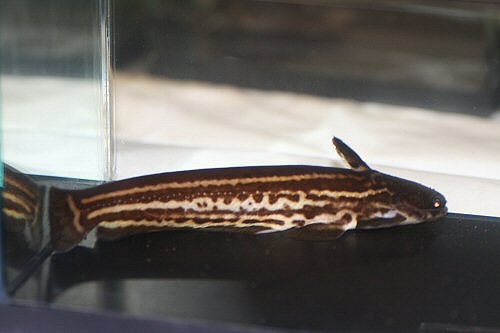
Common Name |
Striped Woodcat |
Synonyms |
Trachelyopterus taeniatus |
Family |
Auchenipteridae |
Subfamily |
Auchenipterinae |
Distribution |
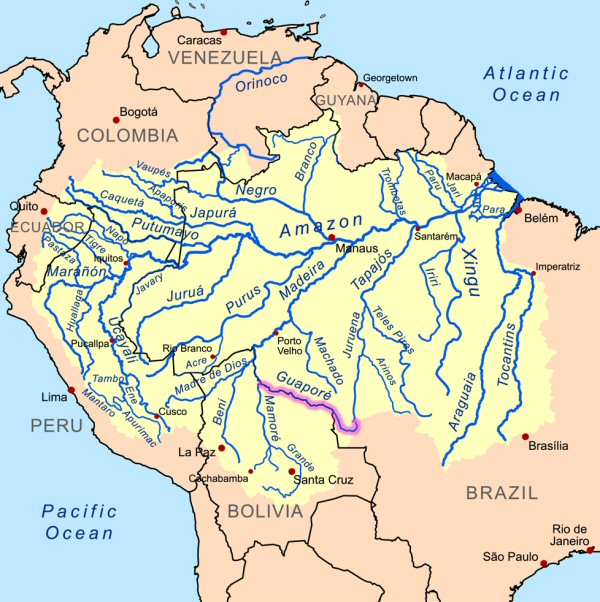
South America: Upper Amazon River basin. Type locality: Rio Guaporé, Brazil. |
Size |
18.0cm. (7¼ins) |
Temp. |
20-25°c (67-77°f.) |
p.H. |
6.0-7.2. |
Characteristics |
Adipose fin absent, 9-16 pelvic fin branched rays; 4 branched dorsal fin rays; body with 2 or 3 longitudinal stripes. The lateral line has a row of very small spots. The pectoral spine is heavily ornamented, with an irregular patch of small rounded serrae proximally on its ventral surface, and an accessory row of pointed serrae both dorsal and ventral to the anterior edge of the spine. In larger individuals, serrae are more prominent and more widely distributed on the dorsal and ventral surfaces. |
Colouration |
Yellow to deep orange or brown with darker stripes along body. A row of very small whitish spots along the length of the lateral line from the caudal peduncle to the anterior insertion of the dorsal fin. |
Aquarium Care & Compatibility |
| Relatively peaceful but will eat smaller fish when larger. Provide floating plants for seclusion as this is a nocturnal species. Provide caves/pipes for hiding out during the daylight hours. |
Reproduction |
They lay their eggs in previously cleaned caves or flat surfaces. |
Sexual differences |
The males first rays of the anal fin are modified, longer and thicker than those immediately posterior. The urogenital pore is located at the distal tip of the anterior margin of the anal fin in contrast to the enlarged pore anterior to the anal fin base in females. In mature males the dorsal and pectoral fins are longer and arched at the tip. |
Diet |
| Feeds on small fishes and insect larvae. In the aquarium they can be fed frozen, tablet and flake foods. |
Glossary of Terms |
Adipose
fin: Fleshy finlike projection
without rays, behind the rayed dorsal fin. |
Etymology |
| Trachelyopterichthys:
from the
Greek, trachelos, meaning neck, pteron, meaning fin
and ichthys, meaning fish; in reference to the long
cranial shield, giving the appearance that the dorsal
fin starts in the region of the neck area. |
References |
Baensch, H.A. and
R. Riehl 1985
Aquarien atlas. Band 2. Mergus, Verlag für
Natur- und Heimtierkunde GmbH, Melle, Germany. 1216
p. |
IUCN Red List |
Although there is little information available on this species, it is assessed as Least Concern due to its wide range and no direct threats. |
Photo Credits |
© Allan James
@ |

|

If you would like to contribute to the monthly factsheets with an
article, information or photos, please e-mail
me. You will of course be credited for your work.
If you would like to donate any denomination of money to the site just click the above link button. All proceeds will go to running the site and hopefully to keep it going for a few years yet.
ScotCat Sources
 Etymology-genus name
Etymology-specific name
Other Sources
 Search
 Fishbase
 Wikipedia
 Catalog
of Fishes
Catalog
of Fishes
 GBIF
GBIF
 FishNet2
 iNaturalist
 IUCN
IUCN

