SCOTCAT.COM
your internet guide to all things catfish
FACTSHEETS: August 2025 - no. 350
Trachydoras paraguayensis (Eigenmann & Ward, 1907) |
|
Trachydoras
paraguayensis occurs in the Madeira (Amazon Basin)
and Paraguay River basins. The species also appears
in the Middle and Lower portions of the Paraná
basin. It stretches throughout Brazil, Bolivia, Paraguay
and Argentina. In 1982, the species was introduced
in the upper portion of the Paraná basin following
the filling of the Itaipú reservoir (Sabaj
and Hernandéz 2017). The type locality has
always stated being in Corumba, Paraguay, but this
catch location is in Brazil, where it borders Paraguay
to the south and Bolivia to the west.
|



Common Name |
None |
Synonyms |
Hemidoras paraguayensis |
Family |
Doradidae |
Subfamily |
Doradinae |
Distribution |
South America: Paraná River basin Paraguay, Brazil, Argentina, Bolivia. Type locality: Corumba, Brazil. |
Size |
19.0cm. (7½ins) |
Temp. |
20-26°C (67-79°F) |
p.H. |
6.0-7.0. |
Characteristics |
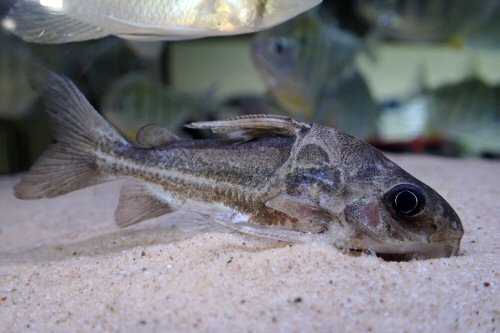
Body deep; greatest body depth contained 2.7 to 3.1, head length 3.3 to 3.8 times in SL; snout length contained 1.9 to 2.2, horizontal orbital diameter 2.5 to 3.1 and least interorbital width 2.2 to 2.8 times in HL; orbital diameter contained 1.0 to 1.3 times in interorbital width. Mouth subterminal; with dentigerous plates in both premaxilla and dentary. Lateral line with 28-30 plates. Dorsal fin with I,6, pectoral fin with I,7, pelvic fin with 7 and anal fin with 12-14 rays. (Graça, Pavanelli, 2007). |
Colouration |
Ground colour greyish dorsally, whitish to yellowish ventrally. Hyaline or light-beige fins; caudal fin with dark-grey oblique stripe on each lobe |
Aquarium Care & Compatibility |
| Peaceful species for a mid sized community tank, planted with hiding places such as pipes or driftwood/bogwood. |
Reproduction |
Unknown
|
Sexual differences |
Females are deeper and wider bodied. |
Diet |
| Tablet and pellet foods, frozen bloodworm and live foods should keep this catfish in good condition. |
Glossary of Terms |
Anal
fin: The median, unpaired,
ventrally located fin that lies behind the anus, usually
on the posterior half of the fish. |
Etymology |
| Trachydoras:
Trachýs (Gr.), jagged or
rough, referring to granular opercle, preopercle and
coracoid-process; Doras, type genus of family. |
IUCN Red List |
Despite the little information available on this species, it has a wide range and no apparent threats. Therefore, it is assessed as Least Concern (IUCN 2024). |
References |
California
Academy of Sciences |
Photo Credits |
©
Allan
James @ |
 courtesy of


|

If you would like to contribute to the monthly factsheets with an
article, information or photos, please e-mail
me. You will of course be credited for your work.
If you would like to donate any denomination of money to the site just click the above link button. All proceeds will go to running the site and hopefully to keep it going for a few years yet.
ScotCat Sources
 Etymology-genus name
Etymology-specific name
Other Sources
 Search
 Fishbase
 Wikipedia
 Catalog
of Fishes
Catalog
of Fishes
 GBIF
GBIF
 FishNet2
 iNaturalist
 IUCN
IUCN

