SCOTCAT.COM
your internet guide to all things catfish
FACTSHEETS: August 2010 - no. 170
Wallago attu (Bloch & Schneider, 1801) |
|
Wallago attu
There are at present 5 species of Wallago listed on Fishbase (2010), our factsheet of the month W. attu, W. hexanema, (which is probably W. attu) Wallago leeri, now Wallagonia leerii, W. maculatus, and a new species which was described in 2004 by Heok Hee Ng from mainland Southeast Asia, Wallago micropogon, now Wallagonia micropogon
Wallago
attu
- line
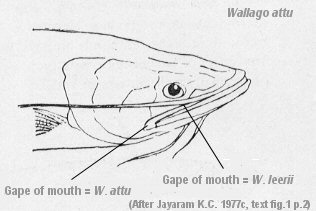
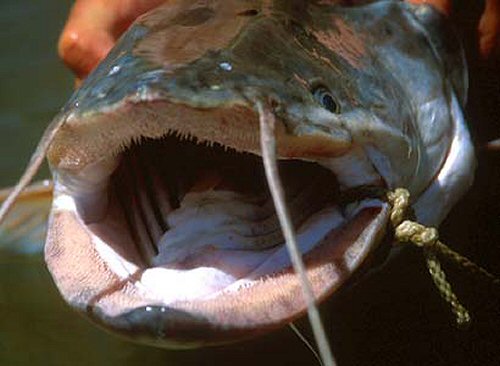
drawing To distinguish W. attu from the very similar W. leeri you have to look at the dorsal fin first. W. attu has a pointed extension while W. leerii does not and is more rounded at the tip. The mouth gape of W. attu ( see above) reaches beyond the insertion of the eye and W. leerii has the mouth only reaching to the beginning of the eye. W. attu has a longer anal fin than W. leerii with 77- 97 with the latter possessing between 64-75 fin rays. You can see below the massive mouth and the rows of conical teeth.
Wallago attu - view of mouth
In the Mekong, it is reported to migrate to smaller streams, canals and to the floodplain during the flood season. When the water level in the Mekong drops and the flood recedes, it moves to the Mekong or larger tributaries, where it stays in deep pools until the next inundation period. Destructive to other more valuable food-fishes. Bites strongly if handled, with its huge mouth, formidable jaws, and band of conical teeth. W.attu is threatened due to over harvesting. In Malaysia they are bred commercially in fish farms for food. It is ritually offered to the goddess Kali by the Hindus (Talwar and Jhingran 1991)
|
 he
name of 'Freshwater Shark" may give you a hint
that this months factsheet
(August 2010) is not for the
faint hearted and as we follow on from its cousin
he
name of 'Freshwater Shark" may give you a hint
that this months factsheet
(August 2010) is not for the
faint hearted and as we follow on from its cousin
Common Name |
Wallago, Freshwater Shark |
Synonyms |
Silurus attu, Wallagonia attu, Wallago attu valeya, Pinniwalago kanpurensis |
Family |
Siluridae |
Subfamily |
Silurinae |
Distribution |
Asia: Pakistan to Viet Nam and Indonesia. Reported from Afghanistan. Lower risk - near threatened status in Western Ghats, India. |
Size |
200.0cm (6ft 8ins) |
Temp. |
22-25°C (71-77°F) |
p.H. |
6.5-8.0. |
Characteristics |
Dorsal soft rays (total): 5 - 5; Anal soft rays: 77 - 97. Head broad, snout depressed. Body elongate, strongly compressed. Mouth very deeply cleft, its corner reaching far behind eyes. Teeth in jaws set in wide bands; vomerine teeth in two small patches. Barbels two pairs; maxillary barbels extending to anterior margin posterior of anal fin, mandibulary barbels to angle of mouth. Eyes small, with a free orbital margin. Dorsal fin small, anal fin very long. Mandibular barbel longer than pelvic fin; 24-30 gill rakers on the first arch. Eye in front of vertical through corner of mouth. |
Colouration |
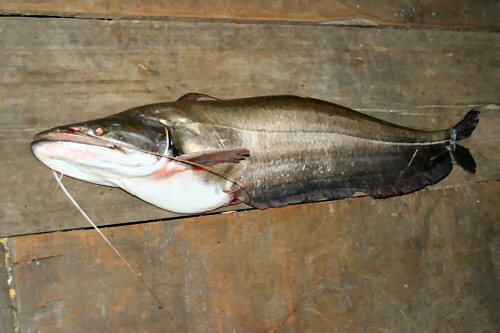
Body uniform silvery or olive with golden gloss above, sides a dull white. A faint orange/yellow band along the lateral line. Anal and caudal fins dusky. |
Aquarium Care & Compatibility |
| Only juveniles can be kept in aquaria and fed on tablet food, beef heart and similar foods. This fish is not deemed suitable for aquarium keeping due to its size, verocity and its feeding needs for live fish. |
Reproduction |
In Bangladesh they spawn during the premonsoon season from June to August. As soon as the streams are flooded by rains, the fishes run up the shallow water for breeding, build nests and offer parental care. |
Sexual Differences |
Not known |
Diet |
| Juveniles feed mainly on insects; adults feed on smaller fish, crustaceans, and mollusks. |
Etymology |
| Walago: Bleeker, in 1851 took the Indian fish name 'Wallagoo', gave it generic rank, and used it in connection with a new species. |
References |
Mohsin, ABM. Encyclopedia of Flora and Fauna of Bangladesh. Vol.23. Freshwater Fishes. Asiatic Society of Bangladesh. 300p. |
Photo Credits |
© Jean-Francois
Helias @ |

|

If you would like to contribute to the monthly factsheets with an article, information or photos, please e-mail me. You will of course be credited for your work.
If you would like to donate any denomination of money to the site just click the above link button. All proceeds will go to running the site and hopefully to keep it going for a few years yet.
ScotCat Sources
 Etymology-genera
Other Sources
 Search
 Fishbase
 Wikipedia
 Catalog
of Fishes
Catalog
of Fishes
 GBIF
GBIF
 Fishnet2
 iNaturalist

