SCOTCAT.COM  

your internet guide to all things catfish
≡
  • HOME
  • FACTSHEETS
    • By Month/Year
    • By Family
    • by Genus
    • by Common Names
    • By Specific Names
    • By Continent
      • Index
      • Africa
      • Asia
      • Australasia
      • Europe
      • North America
      • South America
  • GALLERIES
    • Photo Gallery
    • Art Gallery
    • Movie Gallery
    • Stamps Gallery
  • FAMILIES
    • A-B
      • Ailiidae
      • Akysidae
      • Amblycipitidae
      • Amphiliidae
      • Anchariidae
      • † Andinichthyidae
      • Ariidae
      • Aspredinidae
      • Astroblepidae
      • Auchenipteridae
      • Auchenoglanididae
      • Austroglanididae
      • Bagridae
    • C-D
      • Callichthyidae
      • Cetopsidae
      • Chacidae
      • Clariidae
      • Claroteidae
      • Cranoglanididae
      • Diplomystidae
      • Doradidae
    • H-I
      • Heptapteridae
      • Heteropneustidae
      • Horabagridae
      • Ictaluridae
    • K-L-M
      • Kryptoglanidae
      • Lacantuniidae
      • Loricariidae
      • Malapteruridae
      • Mochokidae
    • N-P
      • Nematogenyidae
      • Pangasiidae
      • Phreatobiidae
      • Pimelodidae
      • Plotosidae
      • Pseudopimelodidae
    • R-S-T
      • Ritidae
      • Schilbeidae
      • Scoloplacidae
      • Siluridae
      • Sisoridae
      • Trichomycteridae
  • ARTICLES
    • Index
    • Breeding
    • By Author
    • Cat-Articles
    • General
    • Numbered List
    • Ichthyology
    • Travel/Collecting
  • IDENT-A-CAT
  • RESOURCES
    • Citation
    • Etymology
    • Fishhouse
    • Glossary
    • Scientific Papers
    • ScotShop
  • SITE MAP
  • FB GROUP
  • HELP
    • Index
    • Catfish Anatomy
    • Convertors
    • FAQ
    • Ident-A-Cat
    • Water Chemistry

FACTSHEETS: October 2024 - no. 340

 Xyliphius barbatus Alonso de Arámburu & Arámburu, 1962


he banjo catfish, Xyliphius barbatus, belongs to the Aspredinidae family and typically inhabits the main channels of medium to large rivers in the La Plata River basin. The work carried out by Terán GE et al in 2024, have bridged the information gaps with the distributional range for X. barbatus being extended to the upper Bermejo River basin in northwestern Argentina more than 750 km from the previously distribution record of the species. The original description of X. barbatus was based solely on two specimens. Consequently, little is known about its osteology, distribution, and phylogenetic relations but has a close relation to
Xyliphius melanopterus Orcés V. 1962


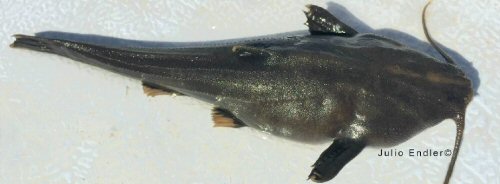
Xyliphius barbatus

    Xyliphius barbatus

Xyliphius barbatus was originally described from the Paraná River in Rosario (Alonso de Arámburu and Arámburu 1962), and has a few records along the La Plata River basin: Paraná River in Misiones, Santa Fe (García 1992; Calviño and Castello 2008) and Chaco provinces (type locality of Xyliphius lombarderoi Risso & Risso, 1964, a synonym of Xyliphius barbatus) (Risso and de Risso, 1964); in the Uruguay River in Uruguay (Loureiro et al. 2013) and, more recently, in the Paraguay River basin, Pantanal, Brazil (Gimênes Junior and Rech 2022).


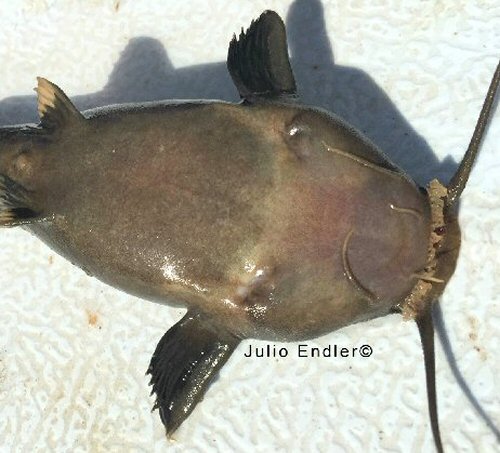
Xyliphius barbatus - head view


  Xyliphius barbatus - head view


There are seven described species in this genera including our factsheet of the month. Xyliphius anachoretes Figueiredo & Britto, 2010, Xyliphius kryptos Taphorn & Lilyestrom, 1983, Xyliphius lepturus Orcés V., 1962, Xyliphius magdalenae Eigenmann, 1912, Xyliphius melanopterus Orcés V. 1962, and Xyliphius sofiae Sabaj, Carvalho & Reis, 2017. All these species are found buried in the sand and perhaps gravel of swift flowing streams.


Paraguay-Paraná River basin


Distrbution: Paraguay-Paraná River basin. Type locality: Río Paraná en Rosario, provincia de Santa Fe, Argentina.


The Paraná Basin stretches from the Brazilian state of Mato Grosso in the north to northern Argentina and Uruguay in the south. The southern portion in Uruguay is locally known as Norte Basin.

This is a rare species considering its habitat preference. This species is found in the main channel of large rivers and the collection for these kind of habitats is unusual in the practice of ichthyology considering the high cost and logistic needs. The habitat was characterised as the main canal of river at about 40 m deep, without luminosity, suspended mud and sediment (Calviño and Castello 2008). Very little is known about its general ecology. Most taxa within the Aspredinidae family appear to be generalised omnivores with stomach contents of aquatic invertebrates, terrestrial insects and organic debris (Friel 2003).


Common Name

Little guitar

Synonyms

Xyliphius lombarderoi

Family

Ariidae

Subfamily

Aspredinidae

Distribution

South America: Paraguay-Paraná River basin. Endemic in Argentina. Type locality: Río Paraná en Rosario, provincia de Santa Fe, Argentina.

Size

9.0cm. (3½ins)

Temp.

20-24°C (67-75°f.)

p.H.

6.0-7.0.

Characteristics

Head triangular with a rounded snout. Eyes reduced, located closer to snout tip than to supraoccipital protuberance, and covered with skin less pigmented than surroundings areas. Two nares, anterior nostril tubular, posterior one smaller and located closer to eyes than to anterior nostril. Maxillary barbel on side of snout, inserted just above rictus. Maxillary barbel reaching pectoral-fin base. Two pairs of mental barbels smaller than maxillary ones and located close to the mouth gape. The external one just before the vertical line through eye, reaching mouth gape when adpressed; inner mental barbels smaller, reaching outer barbels origin, surpassing the lower lip and reaching end of papillae when adpressed. Mouth subterminal, much wider than snout, with 20 to 30 dendritic papillae. Anterior margin of snout with a groove at middle line in dorsal view. Gill slits small, located ventrally on head, before pectoral-fin origin; gill membranes united to isthmus. Small genital papillae just posterior to anus (Terán GE et al 2024).

Colouration

Ground of body dark brown to black, head light brown, pectoral region lighter than dorsal region. A barely evident light brown middorsal stripe on head from snout tip to the middle of caudal peduncle, interrupted at dorsal-fin base. Lateral rows of tubercles brown, lighter than the background. Maxillary barbels dark brown with lighter tips; the remaining barbels light brown. Pectoral fins black with whitish tips; anal fin black with distal half whitish; all the other fins black with the distal third whitish. After the fixation process, the colour tends to become paler brown, and the white portions on the fins are less noticeable (Terán GE et al 2024).

Aquarium Care & Compatibility

An extremely peaceful and lethargic species that can be kept in groups. May eat fry but other than that will not harm other fish. Should be kept with peaceful tankmates. Provide a deep sand substrate for burrowing into as they are a fossorial species.

Reproduction

As yet unknown.

Sexual differences

There are no proven external sexual differences but the sexes could differ in colour (Grant, S. 2021)

Diet

May prove difficult to feed on introduction to aquarium life so better to feed frozen or live bloodworm and or live tubifex worm for acclimatisation after lights out. The Aspredinidae family appear to be generalised omnivores with stomach contents of aquatic invertebrates, terrestrial insects and organic debris (Friel 2003).

Glossary of Terms

Anal fin: The median, unpaired, ventrally located fin that lies behind the anus, usually on the posterior half of the fish.
Barbels: Whisker-like structure on the heads of most catfish.
Caudal fin: The tail.
Caudal peduncle: The narrow part of a fish's body to which the caudal or tail fin is attached.
Dorsal fin: The primary rayed fin(s) on top of the body.

Fossorial:
Adapted for digging.
Isthmus: A narrow part inside the body that connects two larger structures.
Maxillary: Pertaining to the upper jaw. (maxillary barbels).
Mental: Pertaining to the chin, on the lower jaw, (mental barbels).
Papillae: A small fleshy projection, plural papillae.
Pectoral: The paired fins just behind the head.
Rictus: The opening or gape of a mouth.
Tubercles: Tentacle-like projections.

Etymology

Xyliphius: Derived from the Greek word, xylephion = a little piece of wood (referring to the woodlike appearance of the type species of the genus).
barbatus: Bearded, referring to the 30 dendritic papillae on lower lip.

References

Ferraris, C.J. Jr., 2007. Checklist of catfishes, recent and fossil (Osteichthyes: Siluriformes), and catalogue of siluriform primary types. Zootaxa 1418:1-628.
Figueiredo Carlos A, Britto Marcelo R. A new species of Xyliphius, a rarely sampled banjo catfish (Siluriformes: Aspredinidae) from the rio Tocantins-Araguaia system. Neotrop. ichthyol. 2010 Mar [cited 2011 Feb 10].
Grant, S. (2021): Banjos, Dorads and Woodcats. Aspredinidae, Doradidae and Auchenipteridae Catfishes. ATS-Aquashop, Neustadt am Rübenberge: 1-300.
Terán GE, Méndez-López A, Benitez MF, Serra WS, Bogan S, Aguilera G. (2024) Re-description of Xyliphius barbatus (Siluriformes, Aspredinidae), with comments on osteology and distribution. Zoosystematics and Evolution 100(3): 1085-1097.
The ETYFish Project Fish Name Etymology Database © Christopher Scharpf.

IUCN Red List

This species has been confirmed to occur in the Paraguay-Paraná River basin in Argentina and Paraguay. Records from Uruguay require confirmation. The best estimate of the area of occupancy (AOO) is between 48 km2 and 1,999 km2. Canalization of rivers for commercial boat passing (hydrovia Paraguay-Paraná) is the most serious plausible threat. There are two locations based on this threat. At present, it is unknown as to whether this is causing continuing declines. Therefore, this species is assessed as Near Threatened (2023).

Photo Credits

© Julio Endler
Map: Wikipedia 2024.

Donate towards my web hosting bill!


If you would like to contribute to the monthly factsheets with an article, information or photos, please e-mail me. You will of course be credited for your work.

If you would like to donate any denomination of money to the site just click the above link button. All proceeds will go to running the site and hopefully to keep it going for a few years yet.


ScotCat Sources

Etymology = Genus Etymology-genus name

Etymology = Specific name Etymology-specific name


Other Sources

Search  Search

Fishbase Fishbase

Wikipedia Wikipedia

Catalog of Fishes Catalog of Fishes

Global Biodiversity Information Facility GBIF

iNaturalist iNaturalist

IUCN IUCN

  • Facebook about us + contact us + citation + translate + site map + scotshop + glossary + etymology +
  • help YouTube

©2025 SCOTCAT.COM