SCOTCAT.COM
your internet guide to all things catfish
FACTSHEETS: January 2024 - no. 331
Zaireichthys pallidus Eccles, Tweddle & Skelton, 2011 |
Zaireichthys pallidus - From the Chobe Rapids at the recreational Centre in Kasane, Botswana
Roberts (2003) provided a detailed diagnosis of the subfamily Leptoglanidinae (incorrectly formed by Roberts as Leptoglaninae (Ferraris, 2007)) and the genus Zaireichthys. Briefly, Zaireichthys are small (max. SL <50 mm), soft bodied amphiliid catfishes with stout bony serrated spines in the dorsal and pectoral fins that form a defensive tripod when locked into erect positions (Eccles, D.H et al. 2011).
Because of their
small size, not exceeding 50 mm SL, Zaireichthys
were often overlooked by early collectors, or were
taken for juveniles of other species and discarded.
Thus little material was available for study until
collections in southern Africa, reviewed by Jubb (1961,
1967) and BellCross & Minshull (1988), and an
electric fishing survey of rivers and streams in Malawi
by Tweddle & Willoughby (1978) yielded many specimens
that were then attributed to Z.
rotundiceps (at that
time in the genus Leptoglanis), (Eccles,
D.H et al. 2011).
|
 t
is the first month of 2024 and we bring you a little
known small genus of African catfish from the Amphiliidae
family, namely Zaireichthys and the "Pale
sand catlet" Zaireichthys pallidus.
The type species is Zaireichthys zonatus
Roberts, 1967.
t
is the first month of 2024 and we bring you a little
known small genus of African catfish from the Amphiliidae
family, namely Zaireichthys and the "Pale
sand catlet" Zaireichthys pallidus.
The type species is Zaireichthys zonatus
Roberts, 1967.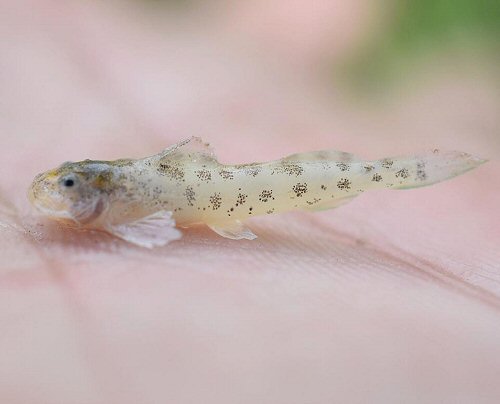

Common Name |
Pale sand catlet |
Synonyms |
None |
Family |
Amphiliidae |
Subfamily |
Leptoglaninae |
Distribution |
Africa: Known only from the Upper Zambezi up to and including the Barotse Floodplain in Zambia (Tweddle et al., 2004), and the Chobe and Kwando rivers, in the area of the Eastern Caprivi, Namibia. |
Size |
2.5cm (1ins) |
Temp. |
22-25°c (71-77°f.) |
p.H. |
6.5-7.2. |
Characteristics |
Dorsal spines (total): 2; Dorsal soft rays (total): 4-5; Anal spines: 0; Anal soft rays: 9 - 12; Vertebrae: 36 - 38. This species is generally more pallid and less conspicuously marked than other species of Zaireichthys. It differs from Zaireichthys conspicuus, Z. kunenensis, Z. lacustris and Z. maravensis in possessing a narrow premaxillary tooth patch, less than 40% of the mouth width; from Z. monomotapa by the smaller number of rays in the dorsal fin, 4-5 soft rays vs. 5-6), pectoral fins, 5-7 vs. 7-8, and caudal fin, 9-13 vs. 14-16; from Z. kavangoensis in colour pattern. |
Colouration |
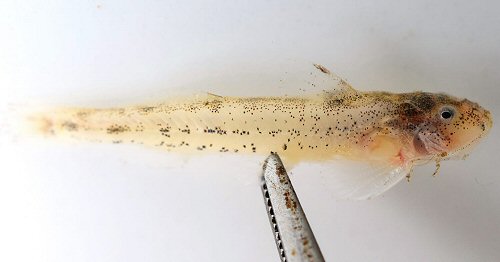
In life it is almost transparent, preserved and usually very pale yellow, with a few minute black spots scattered irregularly over the body. A few specimens are darker, but rarely show a definite pattern except for a series of darker patches along the back, the first at the base of the dorsal, and an irregular darker line mid-laterally. The dark individuals can be readily distinguished from the other members of the genus by the shape of the melanophores, which are unusually large and rectangular in shape. |
Aquarium Care & Compatibility |
| Found in shallow water with a sandy bottom where it buries itself. A sandy substrate in the Aquarium with boulders and rocks alternated with these sandy areas would suffice. Smaller fish such as Tetras etc. can be added as tankmates. |
Reproduction |
Not recorded but may practice brood care (Seegers, L., 2008). |
Sexual differences |
Not recorded |
Diet |
| It feeds on small invertebrates, including mayfly nymphs and caddis fly larvae. Small live foods should be added to their diet. |
Glossary of Terms |
Anal
fin: The median, unpaired,
ventrally located fin that lies behind the anus, usually
on the posterior half of the fish. |
Etymology |
| Zaireichthys:
A fish from Zaire. |
References |
Eccles, D.H., D.
Tweddle and P.H. Skelton, 2011.
Eight new species in the dwarf catfish genus Zaireichthys
(Siluriformes: Amphiliidae). Smithiana Bull. (13):3-28. |
Photo Credits |
©
Nathan Cook |
|

If you would like to contribute to the monthly factsheets with an
article, information or photos, please e-mail
me. You will of course be credited for your work.
If you would like to donate any denomination of money to the site just click the above link button. All proceeds will go to running the site and hopefully to keep it going for a few years yet.
ScotCat Sources
 Etymology-genus
Etymology-specific name
Other Sources
 Search
 Fishbase
 Catalog
of Fishes
Catalog
of Fishes
 GBIF
GBIF
 FishNet2
 iNaturalist

