SCOTCAT.COM
your internet guide to all things catfish
Ancistrus abilhoai Bifi, Pavanelli & Zawadzki, 2009 |
Image contributors to this species: |
Ribeiro MO et al (1) |
ScotCat Sources: |
|

Other Sources: |
|
|


Relevant Information: |
Description: Dorsal spines (total): 1; Dorsal soft rays (total): 7; Anal spines: 1; Anal soft rays: 3 - 4. This species differs from its congeners inhabiting the Río de La Plata and coastal basins of southern Brazil, except A. agostinhoi, A. multispinis, A. mullerae, A. taunayi and A. formoso, by possessing a maxillary barbel shorter and not free from its lower lip (vs. longer and free from lower lip); from the first 4 species, by the width of mandibulary teeth row 13.4-15.5% of HL (vs. 15.8-19.3%, 15.5-19.4%, 16.5-21.0% and 15.8-23.1%, respectively) and 32.9-37.9% of interorbital width (vs. 38.4-53.6%, 40.7-53.8%, 39.3-58.0% and 39.4-51.4%, respectively); from A. formoso by orbital diameter 11.9-15.3% of HL (vs. 8.3-8.7%), caudal peduncle depth 9.0-10.9% of SL (vs. 7.8-8.7%) and number of dentary teeth 40-68 (vs. 110). Habitat: Ancistrus abilhoai is endemic to the Iguaçu River basin, being more common in the upper and middle portion of the Iguaçu River (Baumgartner et al. 2012, Bifi et al. 2009). Aquarium Care: The Ancistrus genera make good community fish where they do not grow too big for the aquarium. Some species have different requirements in the aquarium so best to read up on the species you have whereas if they need higher oxygen requirements or not, or if they prefer cooler waters if they originate from the southern parts of South America against the species from further up north. Diet: Vegetable foods such as cucumber and courgette and also tablet and meaty foods. Reproduction: The female lays her eggs in caves or crevices... that the male has chosen and cleaned.... as a cluster. The male usually then guards the eggs after ejecting the female. The fry then cling to the sides of the cave and when they use up their yolk sac, which is around the four to seven day period, they will be ready to feed on infusuria, vegetable matter, brine shrimp naupli or micro worms. In a community tank a few will survive if enough hiding places are afforded to them. Etymology: The specific name abilhoai: in honour of Vinícius Abilhoa, curator of fishes, Museu de História Natural do Capão de Imbuia (Curitiba, Paraná, Brazil), who collected some of the type series, and who has been of great assistance to the authors in this and other studies. Remarks: No significant threats have been identified that put the Ancistrus abilhoai population at risk (IUCN 2009). |
Common Name: |
None |
Synonyms: |
None |
Family: |
Loricariidae |
Distribution: |
South America: Brazil, Iguaçu River basin. Type locality: Lapa, middle Rio Iguaçu basin, Rio Iguaçu, 25°47'35"S, 50°11'59"W, Paraná State, Brazil. |
Size: |
Male: 10.5cm. (4¼ins) Female: 8.5cm. (3¼ins) |
Temp: |
22-27°c (71-81°f.) |
p.H. |
|
6.0-7.2. |
IUCN Red List |
Ancistrus abilhoai is endemic to the middle and upper Iguaçu River basin. In this region, it is naturally infrequent and not very abundant. As no significant threats to its population have been detected, Ancistrus abilohai has been categorised as Least Concern (LC), (IUCN 2022). |
Reference: |
Fish
in the News
2024 |

Family: Loricariidae Back to Ident-A-Cat Click on Thumbnails |
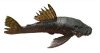 Ancistrus
abilhoai Ancistrus
abilhoaiIritim and Padros rivers, Brazil |
If you would like to contribute to the monthly factsheets with an article, information or photos, please e-mail me. You will of course be credited for your work.

If you would like to donate any denomination of monies to the site just click the above link button. All proceeds will go to running the site and hopefully to keep it going for a few years yet.

