SCOTCAT.COM
your internet guide to all things catfish
Corumbataia cuestae Britski, 1997 |
Image contributors to this species: |
|
Junior Hübner (2) Angelo Rodrigo Manzotti (2) |
ScotCat Sources: |
|

Other Sources: |
|


Relevant Information: |
Corumbataia was proposed by Britski (1997) when describing Corumbataia cuestae from the Upper Paraná basin in the Rio Tietê and Corumbataia tocantinensis, from the Rio Araguaia and Rio Tocantins basins. Description: This genus was delimited by an exposed portion in the middle of the scapular bridge formed only by the coracoid; compound hypurals 1 and 2 completely fused to the compound hypurals 3-5; atrophic maxillary barbel, and anastomosis of the infraorbital and otic sensory canals over the pterotic-supracleitrum (Britski, 1997). Four species were subsequently described: C. britskii Ferreira & Ribeiro, 2007, C. veadeiros Carvalho, 2008, C. lucianoi Silva, Roxo, Souza & Oliveira, 2018 and C. liliai Silva, Roxo, Souza & Oliveira, 2018. Additionally, two species formerly described in Gymnotocinclus were transferred to Corumbataia by Roxo et al. (2019): C. anosteos (Carvalho, Lehmann & Reis, 2008) and C. canoeiro (Roxo, Silva, Ochoa & Zawadzki, 2017). This genera contains six species (2020) C. tocantinensis Britski, 1997, C. cuestae Britski, 1997, C. anosteos (Carvalho, Lehmann A. & Reis, 2008), C. britskii Ferreira & Ribeiro, 2007, C. canoeiro (Roxo, Silva, Ochoa & Zawadzki, 2017), and C. veadeiros Carvalho, 2008. They are an intermediate between the genera's, Parotocinclus and Otocinclus and don't posses an adipose fin. and the body is stockier than these two previous genera. Colouration: Corumbataia species have a dark band along the body. Sexual Differences: Males have longer pectoral fins and also differing morphology of the genital papilla. Aquarium Care: Quite problematic to keep due to the cooler temperatures and having to facilitate a flow current in the water. Diet: Aufwuch feeder with the usual aquarium fare of flake and tablet foods. Etymology: The specific name cuestae: Of a cuesta, geological term for a hill or ridge with a gentle slope on one side (<5°) and a steep slope on the other; all specimens were collected in streams that originate in the cuesta that traverses much of São Paulo, Brazil. |
Common Name: |
Synonyms: |
None |
Family: |
Loricariidae |
Distribution: |
South America: Tietê River basin, Brazil. Type locality: Cachoeira de Analândia, rio Corumbataí, Analândia, SP [Brazil]. |
Size: |
3.5cm. (1½ins) |
Temp: |
18-24°c (63-75°f.) |
p.H. |
|
6.0-7.0. |
IUCN Red List |
Corumbataia cuestae occurs in headwater streams in the basaltic cuesta area of the Tietê River basin. Despite a relatively restricted distribution, the species is abundant and, to date, no direct threats have been identified that compromise the population. Thus, Corumbataia cuestae has been listed as Least Concern (LC), (IUCN 2022). |
Reference: |
Chico
Mendes Institute for Biodiversity Conservation (ICMBio).
2022. Corumbataia cuestae. The IUCN Red List
of Threatened Species 2022. |

Family: Loricariidae Back to Ident-A-Cat Click on Thumbnails |
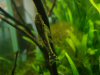 Corumbataia
cuestae Corumbataia
cuestaeRio Jaú, Brazil |
 Corumbataia
cuestae Corumbataia
cuestaeLocation-Rio Jaú, Brazil |
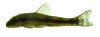 Corumbataia
cuestae Corumbataia
cuestaeSão Manuel, São Paulo, Brazil |
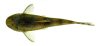 Corumbataia
cuestae Corumbataia
cuestaeDorsal view-São Manuel, São Paulo, Brazil |
If you would like to contribute to the monthly factsheets with an article, information or photos, please e-mail me. You will of course be credited for your work.

If you would like to donate any denomination of monies to the site just click the above link button. All proceeds will go to running the site and hopefully to keep it going for a few years yet.

