SCOTCAT.COM
your internet guide to all things catfish
Harttia fluminensis Covain & Fisch-Muller, 2012 |
Image contributors to this species: |
|
Karsten Schönherr (2) |
ScotCat Sources: |
|


Other Sources: |
|


Relevant Information: |
Similar to H. surinamensis but differs in colour and morphometrics. Description: Dorsal soft rays (total): 7; Anal spines: 1; Anal soft rays: 5. Distinguished from all other species of the genus Harttia except Harttia tuna and Harttia trombetensis by having an incomplete abdominal cover, restricted to preanal and abdominal lateral plates with a row of platelets joining these two series of plates (vs. absence of row of platelets making junction between preanal and lateral abdominal plates), and by its specific barcode sequence (JF292263). Differs from Harttia tuna by having a deeper head (37.31-43.30, mean 38.94 ± 1.42% of HL, vs 31.96-38.77, mean 36.52 ± 1.80% of HL), and from Harttia trombetensis by its colour pattern of caudal fin (a large dark band at base of caudal fin vs. a dark rounded blotch). Can be further diagnosed from all other congeners by having a greater minimum caudal peduncle depth (mean = 1.60 ± 0.11% of SL vs. 1.35 ± 0.13 < mean < 1.43 ±0.11% of SL); and a greater interorbital width (mean = 24.25 ±1.02% of HL vs. 22.04 ± 1.27 < mean < 23.12 ± 1.11% of HL). Aquarium Care: Not the easiest genera to keep as they will need clean, oxygen rich water and a strong current. Does not do well in imports due to its difficulty in traveling containers. Diet: Dry foods, algae wafers, Spirulina and normal tablet foods. Frozen foods, Artemia nauplii, glass worms and Daphnia. Sexual Differences: Males tend to have odontodes (hair like structures) on the first ray of the pectoral fins and the head in males is broader. Etymology: The specific name fluminensis: The specific name 'fluminensis' is from the Latin flumen meaning river, in reference to the ecology of Harttia that represents a group of rheophilic fish from the main channel of rivers. |
Common Name: |
None |
Synonyms: |
None |
Family: |
Loricariidae |
Distribution: |
South America: Known only from the Coppename River drainage in Suriname. |
Size: |
15.0cm. (6ins) |
Temp: |
25-28°c (75-83°f.) |
p.H. |
|
6.0-7.0. |
IUCN Red List |
Harttia fluminensis has a restricted range of distribution and is known only from Coppename River drainage, Suriname. The extent of occurrence (EOO) is estimated at 3,231 km2, and the area of occupancy (AOO) at 2,848 km2. However, it is suspected that the species has a larger distribution than currently known due to its recent description, occurring in other tributaries of the river. Further survey work is needed to look for the species in more localities in order to better understand its real range. The overall area of distribution seems well preserved and there is no apparent impacts in the environment. Thus, Harttia fluminensis is assessed as Least Concern (LC). However, the restricted range may immediately place the species under threat if exposed to any impacts in its habitat. Thus, since this species is not well known, it is recommended to continually assess and monitoring the presence of any possible impacts. (IUCN 2022). |
Reference: |
Calegari,
B.B. 2022. Harttia fluminensis. The
IUCN Red List of Threatened Species 2022. |

Family: Loricariidae Back to Ident-A-Cat Click on Thumbnails |
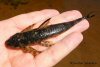 Harttia
fluminensis Harttia
fluminensis |
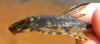 Harttia
fluminensis Harttia
fluminensisHead view-Boven Coppename, Suriname |
If you would like to contribute to the monthly factsheets with an article, information or photos, please e-mail me. You will of course be credited for your work.

If you would like to donate any denomination of monies to the site just click the above link button. All proceeds will go to running the site and hopefully to keep it going for a few years yet.

