SCOTCAT.COM
your internet guide to all things catfish
Hemiancistrus megalopteryx Cardoso, 2004 |
Image contributors to this species: |
Caio Feltrin (1) |
ScotCat Sources: |
|

Other Sources: |
|


Relevant Information: |
Description: Dorsal spines (total): 1; Dorsal soft rays (total): 7; Anal spines: 1; Anal soft rays. Presence of numerous fleshy oval flaps along the border of lower lip and several small papillae. Long male pectoral fin. Dorsal profile of body gently arched from snout tip to dorsal fin origin. Body mostly straight and tapering slightly to caudal fin base. Body and caudal peduncle mostly rounded in cross section, slightly flattened ventrally and more compressed caudally. Abdomen with small patches of platelets between pelvic fins, and larger patches between pectoral fins. Narrow band of minute platelets along area between pectoral and pelvic fin origins. Minute platelets on middle of platelets. Cheek plates present on lateral margins of head; snout plates reduced to few granular platelets, snout tip with oval naked area. Snout broad and rounded anteriorly; slightly convex anterior to nares. Body progressively narrow caudally from cleithrum. Head slightly concave between orbits; dermal plates not carinate; upper margin of orbits (dorsolateral margin of frontal and sphenotic bones) slightly elevated. Eyes large, dorsolaterally placed. Lips well developed, occupying most of ventral surface of head. Lower lip mostly covered by papillae. Border of lower lip with about 28-30 fleshy oval flaps and small papillae. Maxillary barbel short, triangular. Teeth small, bifid; inner cusp large, bladelike, and slightly rounded; lateral cusp minute, pointed, approximately 1/3 length of major cusp. Premaxillary teeth 58-72, mean 64. Dentary teeth 60-86, mean 70. Interopercle region armed with 35-40 hypertrophied evertible odontodes with curved tips, longest odontode 1.5 times eye diameter. Dorsal fin origin at same vertical line through pelvic fin base; nuchal plate and dorsal fin spinelet present. Tip of last branched dorsal fin ray reaching or almost reaching adipose fin base. Pectoral fin with strong spine covered with hypertrophied odontodes with subtly curved tips on outer margin. Pectoral fin sometimes reaching tip of pelvic fin spine in mature males. Pectoral fin and odontodes in males larger than in females. Pelvic fin surpassing anal fin origin when depressed. First anal fin pterygiophore not exposed. Caudal fin I, 14, I. Colouration: (in alcohol): head dark grey, dorsally and laterally with numerous dark spots; dorsal and lateral plates of body dark grey with dark spots larger than head spots; ventral surface of head and abdomen whitish, without dark spots; all fins dark grey with large dark spots on fin spines and occasionally on membranes between fin rays, but never on branched rays; spots less numerous towards caudal peduncle. Aquarium Care: Good aquarium habitants for a large tank and you can also house more than one species. They like water movement in the aquarium. Diet: Mainly a vegetarian diet but can also be fed tablet foods and frozen and live foods such as mosquito larvae, brine shrimp and shrimps. Etymology: The specific name megalopteryx: From the Greek megale, meaning large, and pteryx, meaning wing or fin, alluding to its large pectoral fin. Remarks: Hemiancistrus is also known in some literature as Ancistomus but is also similar to the Peckoltia genera but has a longer body and a naked ventral region. |
Common Name: |
None |
Synonyms: |
None |
Family: |
Loricariidae |
Distribution: |
South America: Rio Tubarão drainage in Santa Catarina, Brazil. Type Locality: Brazil: Santa Catarina: Braço do Norte: rio Braço do Norte, downstream dam (tributary of rio Tubarão), approx. 28º16'38"S 49º11'1"W. |
Size: |
28.5cm. (11¼ins) |
Temp: |
25-29°c (77-85°f.) |
p.H. |
|
6.0-7.2. |
IUCN Red List |
Hemiancistrus megalopteryx has a known occurrence restricted to the Tubarão River basin in the state of Santa Catarina. Originally, the description indicates that the species is neither frequent nor abundant, with only five known specimens. Furthermore, collection efforts in 2011 recorded only one individual in the Cintra River, municipality of Pedras Grandes (SC), totaling six specimens. In the region of the municipalities of Criciúma and Tubarão, there is a strong impact from coal mining in the headwaters of the rivers, which directly interferes with the survival of the subpopulations that occur in three different water bodies of the basin, which were considered three locations. The extent of occurrence (EOO) is 211 km². Thus, Hemiancistrus megalopteryx was categorised as Endangered (EN) according to criteria B1ab(iii), (IUCN 2022). |
Reference: |
Cardoso, A.R.,
2004. Hemiancistrus megalopteryx, a new species of
loricariid catfish from the rio Tubarao drainage,
Santa Catarina State, Brazil (Teleostei: Siluriformes:
Loricariidae). Ichthyol. Explor. Freshwat. 15(2):173-178. |

Family: Loricariidae Back to Ident-A-Cat Click on Thumbnails |
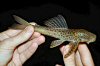 Hemiancistrus megalopteryx
 |
If you would like to contribute to the monthly factsheets with an article, information or photos, please e-mail me. You will of course be credited for your work.

If you would like to donate any denomination of monies to the site just click the above link button. All proceeds will go to running the site and hopefully to keep it going for a few years yet.

