SCOTCAT.COM
your internet guide to all things catfish
Rhinelepis aspera Spix & Agassiz, 1829 |
Image contributors to this species: |
Robin Warne (1) Hudson Crizanto Gonçalves (4) |
ScotCat Sources: |
|
|

Other Sources: |
|


Relevant Information: |
Description: The Rhinelepis group is unique among Loricariids for possessing a round (normal) iris versus a bilobed iris (although it is often hard to see the flap in bilobed, preserved fishes). The species has also thick plates and lacks an adipose fin. Habitat: Among the Loricariidae of the São Francisco river basin, R. aspera is the one that reaches the largest size, and can exceed 4 kg of body weight. R. aspera can be found throughout the basin of the São Francisco and Paraná rivers, with its typical location in the São Francisco river (Fowler, 1954). The black armored catfish Rhinelepsis aspera Agassiz, 1829 (‘cascudo-preto’) is an important and currently rare commercial fish of the São Francisco River, although still found in large numbers in its main tributary, the Paracatu River. Its flesh is firm, tasty and practically devoid of bones and fat. It is caught with gill nets. Reproduction: May not be possible as this genera migrate to spawn, and scatter their eggs with no parental protection. Aquarium Care: Grows rather large and would need a large tank to accommodate it. Diet: Omnivore: Feed veg, frozen foods and also tablet and pellet food. Etymology: The specific name aspera: Latin for rough, referring to “minute rough needles” (translation) all over body. |
Common Name: |
Black armored catfish |
Synonyms: |
None |
Family: |
Loricariidae |
Distribution: |
Brazil: São Francisco and upper Paraná River basins. Type locality: In flumine S. Francisci, Brazil. |
Size: |
30.0cm. (12ins) |
Temp: |
23-27°c (73-81°f) |
p.H. |
|
6.0-7.0. |
IUCN Red List |
Rhinelepis aspera is an important species for fishing, both in the São Francisco basin and in the upper Paraná River basin. The combined effect of hydroelectric dam construction and intensive commercial fishing has led to a decline in both the São Francisco and upper Paraná populations in the last 27 years (three generations) at a rate of c. 25%; a population decline is currently also inferred. Stretches with local extinctions are already observed in the São Francisco basin, where the species is no longer recorded in its lower course; a continuing decline in mature individuals is therefore inferred. Given the moderate rates of decline in the past, this species is thus assessed as Near Threatened, (IUCN 2024). |
Reference: |
Armbruster, J.W.,
1998. Phylogenetic relationships of the suckermouth
armored catfishes of the Rhinelepis group (Loricariidae:
Hypostominae). Copeia 1998(3):620-636. |

Family: Loricariidae Back to Ident-A-Cat Click on Thumbnails |
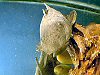 Rhinelepis
aspera Rhinelepis
asperaHead view |
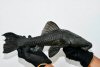 Rhinelepis
aspera Rhinelepis
aspera |
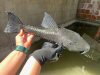 Rhinelepis
aspera Rhinelepis
aspera |
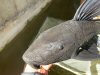 Rhinelepis
aspera Rhinelepis
asperaHead view |
 Rhinelepis
aspera Rhinelepis
aspera |
If you would like to contribute to the monthly factsheets with an article, information or photos, please e-mail me. You will of course be credited for your work.

If you would like to donate any denomination of monies to the site just click the above link button. All proceeds will go to running the site and hopefully to keep it going for a few years yet.

