SCOTCAT.COM
your internet guide to all things catfish
Rineloricaria misionera Rodriguez & Miquelarena, 2005 |
Image contributors to this species: |
Felipe Alonso (1) |
ScotCat Sources: |
|
|

Other Sources: |
|


Relevant Information: |
Description: Distinguished from all other species in the genus by the following combination of characters: anterior abdomen covered by plates, except for the area corresponding to the pectoral girdle, which usually lacks plates, when present in this region, plates are relatively small and few; posterior abdomen with a well-developed preanal plate, bordered anteriorly by a series of 3-5 usually polygonal plates; premaxillary and dentary teeth with unequal-sized cusps; uppermost caudal ray not prolonged in a filament; and snout tip with an oval naked area not reaching the last pore of the infraorbital sensory canal. Habitat: Inhabits small streams with swift current over rocky and sandy bottoms. Active mainly during the night and seeks shelter between rocks, gravel and crevices during the day. Reproduction: The Rineloricaria species are usually cave spawners, where the female will place their eggs after the male has cleaned inside. The male will then guard and fan the eggs until hatching. The eggs will hatch in 4-5 days whereas the male can now be removed. More breeding information can be found here in the articles breeding section. Aquarium Care: As with all Rineloricaria provide long leaved plants or bamboo stalks for them to hang on to. Diet: Omnivore. Vegetable food such as cucumber and other various foods such as tablet, flake and frozen. Etymology: The specific name misionera: refers to Misiones, the Argentinian Province containing the type locality. |
Common Name: |
None |
Synonyms: |
None |
Family: |
Loricariidae |
Distribution: |
South America: Paraná and Uruguay River basins in Argentina. |
Size: |
10.0cm (4ins) |
Temp: |
20-24°c (67-75°f) |
p.H. |
|
6.0-7.0. |
IUCN Red List |
This species occupies a moderately small range, with the best estimates (calculated as the median of the lower [from points] and upper [from hydroBASINS] estimates) of the AOO and EOO equating to 5,814 km2 and 12,413 km2, respectively. Within this small range, the species occurs in 4 threat-based locations and is undergoing a continuing decline in habitat quality as a result of ongoing threats due to land-use changes. As such, using the best estimate values of range calculations, this species is assessed as Vulnerable under criterion B1ab(iii), (IUCN 2023). |
Reference: |
Froese, R. and D. Pauly.
Editors. 2019. FishBase. World Wide Web electronic
publication. www.fishbase.org, ( 08/2019 ). |

Family: Loricariidae Back to Ident-A-Cat Click on Thumbnails |
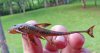 Rineloricaria misionera
 |
If you would like to contribute to the monthly factsheets with an article, information or photos, please e-mail me. You will of course be credited for your work.

If you would like to donate any denomination of monies to the site just click the above link button. All proceeds will go to running the site and hopefully to keep it going for a few years yet.

