SCOTCAT.COM
your internet guide to all things catfish
Spatuloricaria terracanticum Londoño-Burbano, Urbano-Bonilla, Rojas-Molina, Ramírez-Gil & Prada-Pedreros, 2018 |
Image contributors to this species: |
Yann Fulliquet (1) Johnny Jensen's Photographic Library (2) |
ScotCat Sources: |
|

Other Sources: |
|


Relevant Information: |
Description: Dorsal spines (total): 1; Dorsal soft rays (total): 7; Anal spines: 1; Anal soft rays: 5. This species is distinguished from all its congeners by having a small group of plates posterior to the urogenital pore (vs. plates absent) and by having a broad, dark brown bar on the first pre-dorsal plate, which occupies the entire plate, reaching the preopercle, and sometimes reaching the second pre-dorsal plate (vs. no bar except in S. evansii); differs further, except from S. euacanthagenys, by having the abdominal surface with scattered, very small plates leaving naked areas (vs. abdomen totally naked or abdominal region partially to completely covered with larger plates); differs S. euacanthagenys and S. fimbriata by having 5 transverse dark brown bars on the dorsal region (vs. 4, and 3 in S. curvispina, 6 in S. caquetae); differs from S. caquetae, S. evansii, S. fimbriata, S. nudiventris, S. tuira by having preanal plates (vs. absent), (Londoño-Burbano, A., et al 2018). Was given the commom name of Spatuloricaria sp. "Colombia" before being described by Londoño-Burbano, A., et al 2018. This is not an easy genera to keep, even for the most experienced aquarists plus the identification of many of these Loricariid catfish have been problematic until an up-to-date revision of the genus is carried out. Aquarium Care: The Spatuloricria genera all grow to a considerable length and are not the easiest Loricaria species to keep in the home aquarium. Good water quality and a spacious tank are a must and also the water needs to be well oxygenated. This is a shy species during the day and can be seen out at night searching for food. Provide a sand substrate due to the foraging habits of this fish. Sexual Differences: Adult males can possess impressive odontodes to the cheek area when in breeding condition. Diet: A mixed diet, foods that will find their way to the substrate including vegetables such as lettuce, cucumber and cauliflower. Etymology: The specific name terracanticum: Name from Latin 'terra' or earth and 'canticum' for song; dedicated to the Llanos work songs (cantos de vaquería). Remarks: Spatuloricaria terracanticum is assessed as Least Concern given its wide distribution and lack of significant threats across the range (IUCN 2021). |
Common Name: |
None |
Synonyms: |
None |
Family: |
Loricariidae |
Distribution: |
Colombia: Meta and Guaviare River drainages, Orinoco basin. |
Size: |
28.5cm. (11¼ins) |
Temp: |
26-29°c (77-85°f) |
p.H. |
|
6.0-7.5. |
Reference: |
Londoño-Burbano,
A., A. Urbano-Bonilla, Y. Rojas-Molina, H. Ramírez-Gil
& S. Prada-Pedreros (2018): A new species
of Spatuloricaria Schultz, 1944 (Siluriformes: Loricariidae),
from the Orinoco River basin, Colombia. Copeia v.
106 (no. 4): 611-621. |

Family: Loricariidae Back to Ident-A-Cat Click on Thumbnails |
 Spatuloricaria
terracanticum Spatuloricaria
terracanticumHead view |
 Spatuloricaria
terracanticum Spatuloricaria
terracanticum |
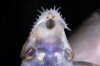 Spatuloricaria
terracanticum Spatuloricaria
terracanticumMouth view |
If you would like to contribute to the monthly factsheets with an article, information or photos, please e-mail me. You will of course be credited for your work.

If you would like to donate any denomination of monies to the site just click the above link button. All proceeds will go to running the site and hopefully to keep it going for a few years yet.

