SCOTCAT.COM
your internet guide to all things catfish
Synodontis guttatus Günther, 1865 |
Image contributors to this species: |
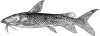
Boulenger 1911 (Line Drawing 1) |
ScotCat Sources: |
|

Other Sources: |
|
|


Relevant Information: |
Description: Like all members of the genus Synodontis, S. guttatus has a strong, bony head capsule that extends back as far as the first spine of the dorsal fin. The head contains a distinct narrow, bony, external protrusion called a humeral processand the shape and size of the humeral process helps to identify the species. In S. guttatus, the humeral process is rough, much longer than it is broad, and pointed at the end. All members of the Synodontis genera have a structure called a premaxillary toothpad, which is located on the very front of the upper jaw of the mouth. This structure contains several rows of short, chisel-shaped teeth. In S. guttatus, the toothpad forms a broad crescent-shaped band. On the lower jaw, or mandible, the teeth of Synodontis are attached to flexible, stalk-like structures and described as "s-shaped" or "hooked". The number of teeth on the mandible is used to differentiate between species; in S. guttatus, there are about 30 teeth on the mandible. Colouration: The base body colour is brown, and the body is covered with small, round dark spots. Aquarium Care: Would need a very large aquarium befitting a large river species. Would be better housed in a Public Aquaria setting. Etymology: The specific name guttatus: Latin or dappled, speckled or spotted, referring to numerous brown spots on body, small and rounded on adipose fin and “hinder parts” of tail. |
Common Name: |
None |
Synonyms: |
Synodontis guttata |
Family: |
Mochokidae |
Distribution: |
Africa: Lower Niger basin. Type locality: Niger. |
Size: |
65.0cm. (26ins) |
Temp: |
23-26°C (73-79°F) |
p.H. |
|
6.5-7.2. |
IUCN Red List |
This species is endemic to the Niger Delta in Nigeria, where it is known only from its type locality, giving an area of occupancy (AOO) of 4 km2. Although the exact location of its type locality within the delta is unknown, and there is no information on its population status, all freshwater habitats in the area are threatened with decline and loss of quality due to oil exploration activities and urban and agricultural development. It has also not been recorded in the wild since 1865. It is therefore assessed as Critically Endangered (Possibly Extinct), (IUCN 2020). |
Reference: |
Awaïss, A., Lalèyè,
P. & Olaosebikan, B.D. 2020. Synodontis
guttatus. The IUCN Red List of Threatened Species
2020. |

Family: Mochokidae Back to Ident-A-Cat Click on Thumbnails |
 Synodontis
guttatus Synodontis
guttatus |
If you would like to contribute to the monthly factsheets with an article, information or photos, please e-mail me. You will of course be credited for your work.

If you would like to donate any denomination of monies to the site just click the above link button. All proceeds will go to running the site and hopefully to keep it going for a few years yet.

