SCOTCAT.COM
your internet guide to all things catfish
Synodontis geledensis Günther, 1896 |
Image contributors to this species: |
J. Green-Boulenger (1911) (2) |
ScotCat Sources: |
|

Other Sources: |
|
|


Relevant Information: |
|
Description: The maxillary barbels are on located on the upper jaw, and two pairs of mandibular barbels are on the lower jaw. The maxillary barbel is straight without any branches, with a broad membrane at the base. It extends about 1+1/4 the length of the head. The outer pair of mandibular barbels is about twice as long as the inner pair, have long, slender branches with secondary branches. The front edges of the dorsal fins and the pectoral fins are hardened into stiff spines. In S. geledensis, the spine is 4/5 as long as the head, nearly straight, serrated in the front and smooth on the back. The remaining portion of the dorsal fin is made up of seven branching rays. The spine of the pectoral fin is as long as the head, and serrated on both sides. The adipose fin is 4 times as long as it is deep and the anal fin contains four unbranched and eight branched rays, and is obtusely pointed in front. The caudal fin, is deeply forked. The premaxillary toothpad, which is located on the very front of the upper jaw of the mouth contains several rows of short, chisel-shaped teeth. In S. geledensis, the toothpad forms a short, broad band. On the lower jaw, or mandible, the teeth of Synodontis are attached to flexible, stalk-like structures and described as "s-shaped" or "hooked". The number of teeth on the mandible is used to differentiate between species; in S. geledensis, there are about 18 teeth on the mandible. Colouration: The colour of the fish is brownish on the back and sides, and whitish on the underside. Habitat: Uebi Shebeli (Somalia), Lorian Swamps and Ewaso Nyiro (Uebi Giuba basin, Kenya), also reported from Wabi Shebele in Ethiopia. Aquarium Care: As far as we know this species has not yet been exported to the hobby. Etymology: Named for Geledi on the Shebeli in Somalia, its type locality. |
Common Name: |
Geledi squeaker |
Synonyms: |
None |
Family: |
Mochokidae |
Distribution: |
Africa: Uebi Shebeli, Somalia; Lorian Swamps and Uasso Nyiro (Uebi Giuba basin), Kenya. Type locality: Geledi on the Shebeli. |
Size: |
30.5cm. (14ins) |
Temp: |
23-27°C (73-81°F) |
p.H. |
|
6.0-8.0. |
IUCN Red List |
This species is known from only three or four locations in Kenya and Wabe Shebele basin, but it is thought to have a far wider range, with an AOO of more than 2,000 if it is assumed that this species is present in the extent of the basin. It is therefore assessed as Least Concern. Threats include dam building on Genale, and irrigation. If a smaller distribution is found or expected, this species will need to be reassessed, but needs updating (IUCN 2010). |
Reference: |
| Boulenger, George Albert
(1909). Catalogue of the fresh-water fishes
of Africa in the British museum (Natural history).
London: British Museum. pp. 458–459. |

Family: Mochokidae Back to Ident-A-Cat Click on Thumbnails |
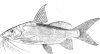 Synodontis
geledensis Synodontis
geledensisLine drawing |
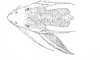 Synodontis
geledensis Synodontis
geledensisLine drawing-dorsal head view |
If you would like to contribute to the monthly factsheets with an article, information or photos, please e-mail me. You will of course be credited for your work.

If you would like to donate any denomination of monies to the site just click the above link button. All proceeds will go to running the site and hopefully to keep it going for a few years yet.

