SCOTCAT.COM
your internet guide to all things catfish
Microglanis oliveirai Ruiz & Shibatta, 2011 |
Image contributors to this species: |
Steven Grant (3) Mark Henry Sabaj (1) |
ScotCat Sources: |
|

Other Sources: |
|


Relevant Information: |
Very similar to M.
poecilus but the lateral
line is shorter. Small species. Specimens collected
at the Rio Cristalino basin have larger interorbital
width and possess an overall darker colouration when
compared with specimens of the Rio das Mortes basin.
Description:
Readily distinguished from all congeners in the possession
of the following characters: short lateral line, reaching
only the vertical line through base of dorsal-fin
spine; 3-6 lateral line pores; 3-6 gill rakers in
the first branchial arch; 10-11 branched caudal fin
rays; 5 pleural ribs; 27-28 free vertebrae; large
anterior fontanel; small supraoccipital process not
contacting anterior nuchal plate; small nuchal shield.
Colouration: Ground
colour light brown. Ventral region of body and head
pale with brown spots. Head dark brown, with lateral
portions of head, margin of opercle, anterior and
posterior nostrils, and pores of cephalic canals light
colored. Wide, irregular light band passing through
nape and anterior portion of trunk, immediately after
opercular opening. Upper lip dark, lower lip light.
Light barbels speckled with dark brown spots. Etymology:
The specific name oliveirai: Named in honour
of Claudio de Oliveira, from the Universidade Estadual
Paulista “Júlio de Mesquita Filho”,
campus Botucatu (SP), in recognition of his extensive
contribution to the knowledge of |
Common Name: |
None |
Synonyms: |
None |
Family: |
Pseudopimelodidae |
Distribution: |
South America: From tributaries of Rio das Mortes and Rio Cristalino, upper-middle rio Araguaia basin, State of Mato Grosso. Type Locality: Brazil, Mato Grosso, Barra do Garças, Vale dos Sonhos District, BR-158 road, km 750, rio Corrente (right margin tributary of the rio das Mortes), rio Araguaia basin, 15°29’56.3”S 52°12’10.8”W, 31 Jul 2008. |
Size: |
2.6cm. (1ins) |
Temp: |
21 -25°C (69-77°F) |
p.H. |
|
6.0-7.5. |
IUCN Red List |
Microglanis oliveirai is endemic to Brazil and is known only from descriptive work for the Rio das Mortes and Rio Cristalino, both tributaries of the Araguaia River, in the state of Mato Grosso. Individuals of this species were collected in small rivers with muddy bottoms. Despite being reasonably abundant, M. oliveirai is cryptobiotic and difficult to collect, requiring targeted collection and hindering knowledge of its true geographic distribution. The only recorded location of the species is situated in the area near the site of the Couto Magalhães hydroelectric power plant (UHE), Araguaia, Brazil. Due to uncertainties regarding the species' true geographic distribution, and the fact that the only recorded area is likely under the influence of the aforementioned UHE construction, it is difficult to measure the degree of threat and assess its conservation status. Therefore, Microglanis oliveirai was categorised as Data Deficient (DD), (IUCN 2022). |
Reference: |
Chico Mendes Institute
for Biodiversity Conservation (ICMBio). 2022.
Microglanis oliveirai. The IUCN Red List
of Threatened Species 2022. |

Family: Pseudopimelodidae Back to Ident-A-Cat Click on Thumbnails |
 Microglanis oliveirai
 |
 Microglanis
oliveirai Microglanis
oliveirai |
 Microglanis
oliveirai Microglanis
oliveiraiDorsal view |
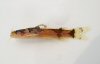 Microglanis
oliveirai Microglanis
oliveirai |
If you would like to contribute to the monthly factsheets with an article, information or photos, please e-mail me. You will of course be credited for your work.

If you would like to donate any denomination of monies to the site just click the above link button. All proceeds will go to running the site and hopefully to keep it going for a few years yet.

