SCOTCAT.COM
your internet guide to all things catfish
Wallago attu (Bloch & Schneider, 1801) |
Image contributors to this species: |
Johnny Jensen's Photographic Library (2) Frants Lehmann (1 Stamp) Jean-Francois Helias (7) Andrew Rao (1) |
ScotCat Sources: |
|
|


Other Sources: |
|


Relevant Information: |
Description: Dorsal soft rays (total): 5 - 5; Anal soft rays: 77 - 97. Head broad, snout depressed. Body elongate, strongly compressed. Mouth very deeply cleft, its corner reaching far behind eyes. Teeth in jaws set in wide bands; vomerine teeth in two small patches. Barbels two pairs; maxillary barbels extending to anterior margin posterior of anal fin, mandibulary barbels to angle of mouth. Eyes small, with a free orbital margin. Dorsal fin small, anal fin very long. Mandibular barbel longer than pelvic fin; 24-30 gill rakers on the first arch. Eye in front of vertical through corner of mouth. Habitat: Found in large rivers, lakes and tanks. A large, voracious and predatory catfish which thrives in heels with grassy margins. Mostly hides under holes in river banks and canals. Associated with deep, still or slow-flowing water with a mud or silt substrate . Sluggish and stays on muddy or silty bottom in search of food. Juveniles feed mainly on insects; adults feed on smaller fish, crustaceans, and mollusks. Destructive to other more valuable food-fishes. Bites strongly if handled, with its huge mouth, formidable jaws, and band of conical teeth. Threatened due to over harvesting. Reproduction: Oviparous, distinct pairing possibly like other members of the same family. Abundant during the warm season; a pre-monsoon summer breeder. In the Mekong, it is reported to migrate to smaller streams, canals and to the floodplain during the flood season. When the water level in the Mekong drops and the flood recedes, it moves to the Mekong or larger tributaries, where it stays in deep pools until the next inundation period. Aquarium Care: Only juveniles can be kept in aquaria and fed on tablet food, beef heart and similar foods. Adult fish are not deemed suitable for aquarium keeping due to the size, verocity and its feeding needs for living fish. Etymology: The specific name attu: From Attu-vahlay, Malayan name for this catfish in southern India. |
Common Name: |
Wallago, Freshwater Shark |
Synonyms: |
Silurus attu, Wallagonia attu, Wallago attu valeya, Pinniwalago kanpurensis |
Family: |
Siluridae |
Distribution: |
Asia: Pakistan to Viet Nam and Indonesia. Reported from Afghanistan. Lower risk - near threatened status in Western Ghats, India. |
Size: |
200.0cm. (6ft 8ins) |
Temp: |
22-25°C (71-77°F) |
p.H. |
|
6.5-8.0. |
IUCN Red List |
This species has undergone significant decline due to overexploitation as a food fish, particularly in the Indian subcontinent (the population is estimated to have declined by 30% over the last 60 years). Empirical studies available from numerous locations throughout its range all indicate that current levels of exploitation are unsustainable, a trend that can be extrapolated across the species' known range. This situation is exacerbated by the fact that the species is possibly extirpated in Java. Although there is taxonomic uncertainty about the species, until it is resolved, the populations currently known as Wallago attu are assessed as Vulnerable under criterion A2d. Further studies on taxonomy and impacts of harvest on populations along with population monitoring are required to reassess the status of the species, (IUCN 2019). |
Reference: |
Baensch, H.A. and R.
Riehl 1985 Aquarien atlas. Band 2. Mergus,
Verlag für Natur- und Heimtierkunde GmbH, Melle,
Germany. 1216 p. |

Family: Siluridae Back to Ident-A-Cat Click on Thumbnails |
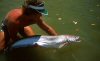 Wallago
attu Wallago
attu |
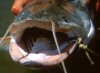 Wallago
attu Wallago
attuThe business end! |
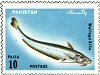 Wallago
attu Wallago
attuStamp |
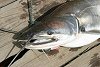 Wallago
attu Wallago
attuHead view |
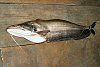 Wallago
attu Wallago
attu |
 Wallago
attu Wallago
attuCaught by Image contributor Jean-Francois Helias |
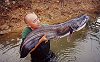 Wallago
attu Wallago
attuCaught by Image contributor Jean-Francois Helias |
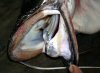 Wallago
attu Wallago
attuMouth view |
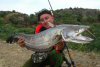 Wallago
attu Wallago
attuCaught by Image contributor Jean-Francois Helias |
 Wallago
attu Wallago
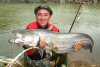
attuCaught by Image contributor Jean-Francois Helias |
 Wallago
attu Wallago
attuJuveniles |
If you would like to contribute to the monthly factsheets with an article, information or photos, please e-mail me. You will of course be credited for your work.

If you would like to donate any denomination of monies to the site just click the above link button. All proceeds will go to running the site and hopefully to keep it going for a few years yet

