SCOTCAT.COM
your internet guide to all things catfish
Homodiaetus anisitsi Eigenmann & Ward, 1907 |
Image contributors to this species: |
Freshwater Fish from Uruguay 2nd. edition (1) demianlescano (1) |
ScotCat Sources: |
|
|

Other Sources: |
|


Relevant Information: |
Description: Homodiaetus is currently distinguished from other genera of Stegophilinae by the combination of the origin of the pelvic fin midlength between the tip of the snout and the caudal-fin origin, the opercle with three or more odontodes, and the gill membranes confluent with the isthmus. Homodiaetus species are small and grow up to 42 millimetres (1.7 in) SL. They are transparent with the except of the head and abdomen. They have a thin body and depressed head that is almost as wide as the head is long. The dorsal and ventral profiles are straight except for a convex head. The mouth is inferior. Among the other three species, H. graciosa has 5–6 rows of teeth in the dentary (vs. 6–7 in the other two species). H. graciosa has 7–9 (usually 8) opercular odontodes, H. passarellii has 6–7, and H. banguella has 9. Colouration: H. anisitsi has three dark bands on its caudal fin, while dark lines are irregular or absent in the other three species. Habitat: The distribution of Homodiaetus is restricted to the southeastern South America, from Uruguay to Paraguay Rivers in the west to the coastal drainages of the Rio de Janeiro State, Brazil. H. anisitsi originates from the Paraná-Paraguay River basin. H. banguela inhabits the São João River and H. passarellii is known from coastal basins in the State of Rio de Janeiro. H. graciosa is distributed in coastal basins of southeastern Brazil in states of Paraná and São Paulo. Etymology: The genus name of Homodiaetus: according to Eigenmann (1922), “living or eating with others” (homos, same; diaeta, manner of living or diet), referring to the “known parasitic habits of some of its relatives”. The specific name of anisitsi: in honour of Juan Daniel Anisits (1856-1911), National University of Paraguay, who provided Indiana University with a “well-preserved” collection of fishes, including type of this one. Remarks: These fish are known to be lepidophagous, meaning they feed upon the scales of other fish. Homodiaetus anisitsi is the type species. |
Common Name: |
None |
Synonyms: |
Homodiaetus vazferreirai |
Family: |
Trichomycteridae |
Distribution: |
South America: Paraná-Paraguay River basin (Argentina, Brazil, Paraguay and Uruguay. Type locality: Small creek at Villa Rica, Paraguay. |
Size: |
5.0cm. (2ins) TL. |
Temp: |
25 -28°c (77-83°f.) |
p.H. |
|
6.0-7.0. |
Reference: |
Ferraris, C.J. Jr.,
2007. Checklist of catfishes, recent and fossil (Osteichthyes:
Siluriformes), and catalogue of siluriform primary
types. Zootaxa 1418:1-628. |

Family: Trichomycteridae Back to Ident-A-Cat Click on Thumbnails |
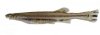 Homodiaetus
anisitsi
Homodiaetus
anisitsi |
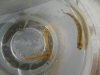 Homodiaetus
anisitsi Homodiaetus
anisitsiDorsal view-Rosario, Santa Fe, Argentina |
If you would like to contribute to the monthly factsheets with an article, information or photos, please e-mail me. You will of course be credited for your work.

If you would like to donate any denomination of monies to the site just click the above link button. All proceeds will go to running the site and hopefully to keep it going for a few years yet.

