SCOTCAT.COM
your internet guide to all things catfish
Tatia galaxias Mees, 1974 |
Image contributors to this species: |
Paul Turley (1) |
ScotCat Sources: |
|
|


Other Sources: |
|


Relevant Information: |
Description: Dorsal spines (total): 1; Dorsal soft rays (total): 5; Anal soft rays: 9 - 10; Vertebrae: 32 - 33. The following unique characters separate this species from all other species of Tatia: postcleithral process well developed, reaching almost to a vertical through the dorsal-fin origin; orbital diameter 37.0-42.9% HL; and snout length 23.1-28.9% HL . Can be further distinguished by the following features: narrow elliptical cranial fontanel; ribs 7; nasal ossified with wide medial flanges partially sutured to lateral margin of mesethmoid; Colouration: Variable, sides of body usually dark with light, rounded spots or dots, or sometimes uniformly pale brown; toothed prevomer in examined large adult specimens. Aquarium Care: Give them small pipes, as they do seem to like to hide in the crevices of bogwood as well. They appear to be happier if they can jam themselves in with the use of their pectoral fins. Community tanks are fine for this species although you may find that they will predate on fry from other species, but apart from that they come well recommended but don't expect to see them too often. Diet: In its native habitat they feed on small invertebrates and crustaceans and in the aquarium they will eat anything given such as frozen bloodworm inserted in to their hideaway, catfish tablets, white worm (sparingly) and prawns and shrimp. They do like their food and you can see them shooting out of their hideouts and swimming in a frenzied manner to try and take all for themselves, especially when you feed them their favourite food, frozen bloodworm. Another food that they love is Fish Farm pellets but you have to watch the water quality with this food as it can quickly foul the water, so feed sparingly. Etymology: galaxias: milky, also spotted. Remarks: T. galaxias is quite a rare find in imports as you will be probably looking at T. intermedia instead, as this species is often sold as T. galaxias. Mees (1974) described T. galaxias on the basis of its diagnostic colour pattern of small white spots evenly spaced over a dark body. Mees, (1974: 88) considered its colouration reminiscent of that of T. intermedia, except in T. galaxias the body is darker, the spots smaller, and the tail dark with white spots (vs. pale with dark spots and cross-bars in T. intermedia). |
Common Name: |
Milky Way Woodcat |
Synonyms: |
None |
Family: |
Auchenipteridae |
Distribution: |
Soth America: Middle Orinoco River basin. Type locality: Caño de Quiribana into Río Orinoco, Venezuela. |
Size: |
10.0cm. (4ins) |
Temp: |
22-26°c (71-79°f.) |
p.H. |
|
6.5-7.2. |
IUCN Red List |
This species can be found throughout the lowlands of the Orinoco River Basin in Colombia and Venezuela. The data in biological collections and different regional reports do not suggest a perceptible reduction in the population of the species. Therefore, it is evaluated as Least Concern (IUCN 2021). |
Reference: |
Baensch, H.A. and R.
Riehl 1991 Aquarien atlas. Bd. 3. Melle:
Mergus, Verlag für Natur- und Heimtierkunde,
Germany. 1104 p. |

Family: Auchenipteridae Back to Ident-A-Cat Click on Thumbnails |
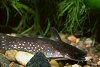 Tatia
galaxias Tatia
galaxias |
If you would like to contribute to the monthly factsheets with an article, information or photos, please e-mail me. You will of course be credited for your work.

If you would like to donate any denomination of monies to the site just click the above link button. All proceeds will go to running the site and hopefully to keep it going for a few years yet.

