SCOTCAT.COM
your internet guide to all things catfish
Corydoras davidsandsi Black, 1987 |
Image contributors to this species: |
Allan James (3) Mona Opland (2) Karsten Schönherr (1) Mark Goh (1) Haakon Haagensen (1) Benny Hubel Hansen (1) |
ScotCat Sources: |
|


Other Sources: |
|


Relevant Information: |
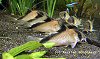
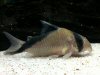
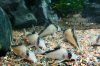
This species is found in the middle stretches of the Rio Negro in Brazil and is a look-alike. It has the same colouration as C. metae from the river of the same name in Colombia but davidsandsi has a longer snout and the black stripe carries on into the bottom lobe of the caudal fin while C. metae stops short at the caudal peduncle. The C. melini connection has melini having the same black body stripe ending on the bottom lobe of the caudal fin, but the stripe separates just behind the dorsal fin and continues as two lines over the back of the body. The colouration is also different with melini being a dirty white with black specks to the edges of the body scutes, while davidsandsi has a tan colouration with no specks. Lineage: Placed in Lineage 9, the "short-snouted" species with the designated type species: C. punctatus. A revision in the future would constitute the resurrection of the genus name Hoplosopma (Agassiz, 1846). Aquarium Care: This is akin to most of this genus, very peaceful, and would be best housed with small to medium sized tankmates such as Tetras, Rasboras and Danios or in a species tank for breeding purposes. Best to purchase 6 individuals or more as they will be happier in a group. Diet: Readily accepts a mixed and varied diet which includes granular foods, tablet food, frozen bloodworm and a good quality flake. |
Common Name: |
Sands Catfish |
Synonyms: |
None |
Family: |
Callichthyidae |
Distribution: |
South America: Brazil; Rio Unini whitewater area of the Rio Negro. |
Size: |
6.5cm (2½ins) |
Temp: |
23-26°C (73-79°F) |
p.H. |
|
6.0-7.2. |
Reference: |
Alexandrou, Markos
& Taylor, Martin. (2011). Evolution,
ecology and taxonomy of the Corydoradinae revisited.
|

Family: Callichthyidae Back to Ident-A-Cat Click on Thumbnails |
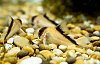 Corydoras
davidsandsi Corydoras
davidsandsi |
 Corydoras
davidsandsi Corydoras
davidsandsiFry-11 days old |
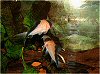 Corydoras
davidsandsi Corydoras
davidsandsiMating ritual-female above |
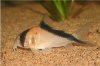 Corydoras
davidsandsi Corydoras
davidsandsi |
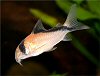 Corydoras
davidsandsi Corydoras
davidsandsi |
 Corydoras
davidsandsi Corydoras
davidsandsi |
 Corydoras
davidsandsi Corydoras
davidsandsi |
 Corydoras
davidsandsi Corydoras
davidsandsi |
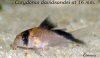 Corydoras
davidsandsi Corydoras
davidsandsi16mm |
If you would like to contribute to the monthly factsheets with an article, information or photos, please e-mail me. You will of course be credited for your work.

If you would like to donate any denomination of monies to the site just click the above link button. All proceeds will go to running the site and hopefully to keep it going for a few years yet.

