SCOTCAT.COM  

your internet guide to all things catfish
≡
  • HOME
  • FACTSHEETS
    • By Month/Year
    • By Family
    • by Genus
    • by Common Names
    • By Specific Names
    • By Continent
      • Index
      • Africa
      • Asia
      • Australasia
      • Europe
      • North America
      • South America
  • GALLERIES
    • Photo Gallery
    • Art Gallery
    • Movie Gallery
    • Stamps Gallery
  • FAMILIES
    • A-B
      • Ailiidae
      • Akysidae
      • Amblycipitidae
      • Amphiliidae
      • Anchariidae
      • † Andinichthyidae
      • Ariidae
      • Aspredinidae
      • Astroblepidae
      • Auchenipteridae
      • Auchenoglanididae
      • Austroglanididae
      • Bagridae
    • C-D
      • Callichthyidae
      • Cetopsidae
      • Chacidae
      • Clariidae
      • Claroteidae
      • Cranoglanididae
      • Diplomystidae
      • Doradidae
    • H-I
      • Heptapteridae
      • Heteropneustidae
      • Horabagridae
      • Ictaluridae
    • K-L-M
      • Kryptoglanidae
      • Lacantuniidae
      • Loricariidae
      • Malapteruridae
      • Mochokidae
    • N-P
      • Nematogenyidae
      • Pangasiidae
      • Phreatobiidae
      • Pimelodidae
      • Plotosidae
      • Pseudopimelodidae
    • R-S-T
      • Ritidae
      • Schilbeidae
      • Scoloplacidae
      • Siluridae
      • Sisoridae
      • Trichomycteridae
  • ARTICLES
    • Index
    • Breeding
    • By Author
    • Cat-Articles
    • General
    • Numbered List
    • Ichthyology
    • Travel/Collecting
  • IDENT-A-CAT
  • RESOURCES
    • Citation
    • Etymology
    • Fishhouse
    • Glossary
    • Scientific Papers
    • ScotShop
  • SITE MAP
  • FB GROUP
  • HELP
    • Index
    • Catfish Anatomy
    • Convertors
    • FAQ
    • Ident-A-Cat
    • Water Chemistry

FACTSHEETS: February 2026 - no. 356

 Aguarunichthys torosus Stewart, 1986


f we are talking about an impressive-looking catfish, we need to go no further than the Bolt cat, Aguarunichthys torosus, from the Pimelodidae family. This catfish grows to 35cm (14 inches) in standard length and is therefore not a good candidate for a typical community fish tank.
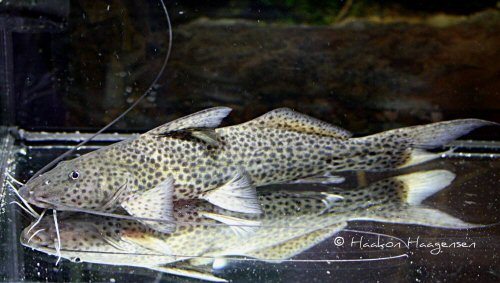
 

Aguarunichthys torosus

    Aguarunichthys torosus


Aguarunichthys torosus is an agile and fearless fighter, making it ideal for a predator aquarium. Feeding time is particularly interesting and promises exciting observations. At other times, it usually rests, giving the impression of a timid and attractive catfish. However, with this species, those first impressions can be deceptive! (Ros, Wolfgang).

The genus Aguarunichthys belongs to the family of the "Antenna Catfishes" (Pimelodidae) and includes, besides the sporadic imported A. torosus, two other species which are rare even in nature and therefore are not imported very often: A. inpai, which at 42 centimeters SL is the biggest species, and A. tocantinsensis, which at nearly 32 centimeters SL is a bit smaller than A. torosus, whose SL in nature is specified at approximately 35 centimeters. Based on a light background, all three have a characteristic fine pattern of black dots/points which vary in number and size depending on the species (Ros, Wolfgang). The key to the three species is in Zuanon et al. (1993).


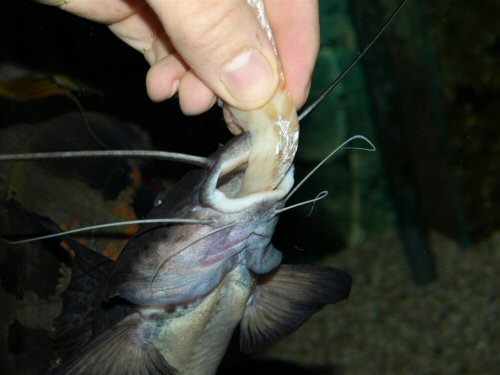
Aguarunichthys torosus - Hand feeding fish fillets


Aguarunichthys torosus - Hand feeding fish fillets


Aguarunichthys torosus was described by Stewart (1986) based on a single specimen from the Peruvian Amazon; it is distinguishable from other pimelodid genera by the unusual shape of the air bladder, which has finger-like projections on its posterolateral margin and anterior tubular extensions, and by a subterminal mouth with broad premaxillaries ending in posterolateral extensions.

Two new species of Aguarunichthys were described and compared with A torosus. Aguarunichthys tocantinsensis, new species, from the Tocantins River, which differs from A. torosus by having a larger orbital diameter, overlapping branchiostegal membranes, a distance between snout tip and anterior nostrils less than the distance between anterior and posterior nostrils, and a distance between snout tip and posterior nostrils less than the distance between postcrior nostrils and posterior edges of orbital rim. Aguarunichthys inpai, new species, from the Solimóes River and from the other two species by having a broader head, smaller eyes, and a wider mouth (Zuznan et al. 1993).


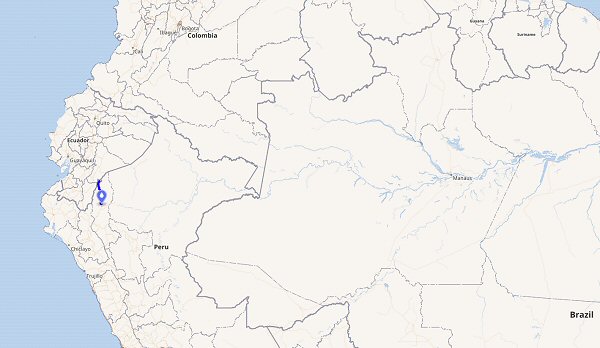
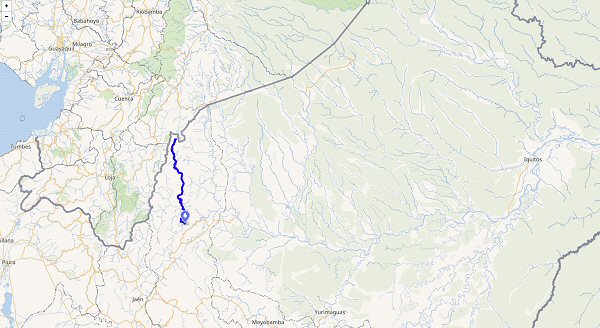
Cenepa River basin

Cenepa River basin, Amazon River drainage, Peru


South America: Cenepa River basin, Amazon River drainage, Peru. Type Locality: Peru, Departamento Amazonas, Río Cenepa, 1.6 km west of Huampami and near Peruvian military camp Chavez Valdivia, about 210 m elev., Approx. 4º28'S, 78º10'W.


The Cenepa River basin is a significant tributary system located entirely within Peru, forming part of the vast Amazon River drainage basin, which collects water from the eastern slopes of the Andes and flows east to the Atlantic. This basin, characterized by dense rainforest and high precipitation, is a crucial ecosystem known for biodiversity, home to unique fish species like Aguarunichthys torosus, and supports local Amazonian communities reliant on the river's cycles, though it faces threats from climate change, deforestation, and mining.


Common Name

Bolt cat

Synonyms

None

Family

Pimelodidae

Subfamily

-

Habitat

Inhabits deep portions of the main channel of large rivers.

Distribution

South America: Cenepa River basin, Amazon River drainage, Peru. Type locality: Peru, Departamento Amazonas, Río Cenepa, 1.6 km west of Huampami and near Peruvian military camp Chavez Valdivia, about 210 m elev., Approx. 4º28'S, 78º10'W.

Size

35.0cm. (14ins)

Temp.

22-27°C (71-81°F)

p.H.

6.0-7.2.

Characteristics

Dorsal fin, short-based with a spine and six rays. Pectoral fin with a spine and 13 rays. Anal fin has 14 rays. The adipose fin is moderately long but well separated from the dorsal and caudal fin. The caudal fin is forked, with the upper lobe longer and more pointed than the lower lobe.

Colouration

Particularly striking is a light zone which is a little upstream of the middle of the body and which extends obliquely to the rear in the form of a strip from the back approximately to the beginning of the pectoral and ventral fins. Young specimens of A. torosus are more brightly coloured, but like adults, they already show the typical stippling/mottling.

Aquarium Care & Compatibility

Very much a catfish for the larger aquarium to be kept by the more serious catfish keeper. As with most species in this genera it will be predatory so would need to be kept with fish that are not too small although this species would be better to be kept on its own as other fish will be seen as prey. A large tank would be needed no smaller than 2 metres (6ft) long and a depth of 70cm (28ins) with powerful filtration, to give it plenty of swimming space

Reproduction

Not reported.

Sexual differences

Not reported.

Diet

Earthworms, fish fillets, frozen foods such as whole and unbroken smelts, shrimp or mussel meat. Tablet and pellet foods will also be taken.

Glossary of Terms

Afdipos fin: Fleshy finlike projection without rays, behind the rayed dorsal fin.
Anal fin
: The median, unpaired, ventrally located fin that lies behind the anus, usually on the posterior half of the fish.
Caudal fin
: The tail.
Dorsal fin
: The primary rayed fin(s) on top of the body.
Pectoral fin: The paired fins just behind the head.
Premaxillary: In relation to the premaxilla (an upper jaw bone) e.g. premaxillary tooth band.
Ventral fins: The paired fins, between the pectorals and the anal fins.

Etymology

Aguarunichthys: From Aguarun, a Peruvian tribe that lives in the limit with Ecuador+ Greek, ichthys = fish.
torosus: Muscular.

IUCN Red List

The species is listed as Least Concern (LC) due to its wide distribution, and its potential presence in some national and departmental reserves in Bolivia and Peru (IUCN 2023).

References

Burgess, W.E. 1989 An atlas of freshwater and marine catfishes. A preliminary survey of the Siluriformes. T.F.H. Publications, Inc., Neptune City, New Jersey (USA). 784 p.
Carvajal-Vallejos, F.M. 2023. Aguarunichthys torosus. The IUCN Red List of Threatened Species 2023.
Ferraris, C.J. Jr., 2007. Checklist of catfishes, recent and fossil (Osteichthyes: Siluriformes), and catalogue of siluriform primary types. Zootaxa 1418:1-628.
ScotCat Article: Ros, Wolfgang;
Sleek, wiry, and striking: The predator catfish Aguarunichthys torosus.
Sleen, van der Peter and Albert, S. James; Field guide of the Amazon, Orinoco & Guianas. Princeton University Press, Princeton and Oxford. 2018.
Zuanon, J.A.S., L.H. Rapp Py-Daniel and M. Jégu, 1993. Two new species of Aguarunichthys from the Amazon basin (Siluroidei: Pimelodidae). Ichthyol. Explor. Freshwat. 4(3):251-260.

Photo Credits

© Haakon Haagensen @ Catfish Codex
© Wolfgang Ros

© Map: Wikepedia 2026.

Donate towards my web hosting bill!


If you would like to contribute to the monthly factsheets with an article, information or photos, please e-mail me. You will, of course, be credited for your work.


If you would like to donate any amount of money to the site, simply click the link above. All proceeds will go to running the site and hopefully to keep it going for a few years yet.


ScotCat Sources

Article Article

Etymology = Genus Etymology-genus name

Etymology = Species Etymology-specific name


Other Sources

Search  Search

Fishbase Fishbase

Wikipedia Wikipedia

Catalog of Fishes Catalog of Fishes

Global Biodiversity Information Facility GBIF

FishNet2 FishNet2

iNaturalist iNaturalist

IUCN IUCN

  • Facebook about us + contact us + citation + translate + site map + scotshop + glossary + etymology +
  • help YouTube

©2026 SCOTCAT.COM