SCOTCAT.COM
your internet guide to all things catfish
FACTSHEETS: July 2010 - no. 169
Ancistrus ranunculus Muller, Rapp Py-Daniel & Zuanon, 1994 |
Ancistrus ranunculus
Both sexes have fleshy 'tentacles' but the males are bushier and longer as typified in the picture of a female below. Inhabits clear running water, to a depth of 3 meters during dry season. Prefers narrow cracks of submerged rocks, small passages between superimposed rocks, or lives below flat rocks on the bottom.
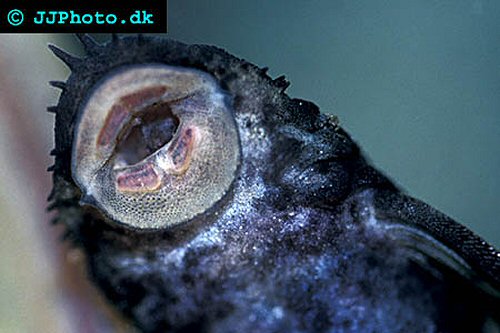
Ancistrus ranunculus - mouth view
In the aquarium you can provide pipe work, flat and rounded stones in a river type setup on a sandy substrate where they will happily reside under as long as the stones are not too heavy. You will also need to provide a good current in the water as they do prefer this and will not do well without it. A similar species exists, Ancistrus sp. (L255), which also has spots when young but this species holds on to this trait into adulthood whereas A. ranunculus does not.
|
 his
Ancistrus species is typified by its unusually
broad head flattened body and its black body colour.
The common name of "Tadpole Bristlenose
Catfish" points to this trait of its unusually
flat head. The males head bristles are very thick
and not branched at the end, unlike most of this genera.
The image below shows the
unbranched and thorn shaped head bristles, or tentacles,
in this male
his
Ancistrus species is typified by its unusually
broad head flattened body and its black body colour.
The common name of "Tadpole Bristlenose
Catfish" points to this trait of its unusually
flat head. The males head bristles are very thick
and not branched at the end, unlike most of this genera.
The image below shows the
unbranched and thorn shaped head bristles, or tentacles,
in this male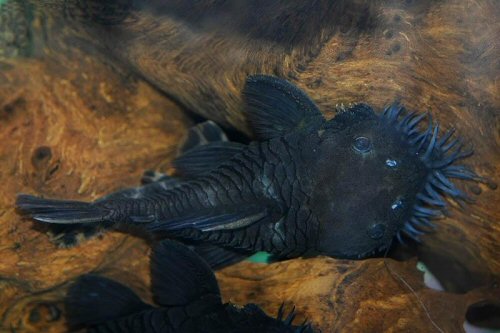
Common Name: |
Tadpole Bristlenose Catfish, L034. |
Synonyms: |
Family: |
Loricariidae |
Subfamily: |
Ancistrinae |
Distribution: |
South America: Brazil, Xingu and Tocantins River basins. Type locality: Brazil, Pará, Rio Xingú, furo do Tucum Seco, near Arroz Cru. |
Size: |
14.0cm. (5½ins) |
Temp: |
26-30°c (79-87°f.) |
p.H. |
6.0-7.0. |
Hardness: |
0-15ºdGH. |
Characteristics |
A broad head and flattened body. Fewer teeth than your average Ancistrus. |
Colouration |
Black body colouration with paler white blotches to the body. |
Aquarium Care & Compatibility |
| No problem with other fishes in the aquarium but due to its liking for a water current you would need to investigate further any species that would be compatable with these conditions. |
Reproduction |
Unreported in the aquarium as A.ranunculus is not one of the easiest species of Ancistrus to spawn. Should be as per typical of this genera. (See breeding articles on ScotCat.) |
Sexual differences |
As with other members of this genus the male sports bristles to the head area, the male having the larger and more impressive tentacles and the female may have shorter bristles. |
Diet |
| Likes a meaty diet which is somewhat different from most members of the Ancistrinae. Feed frozen foods such as bloodworm and pellet, tablet and pre-soaked flake. |
Etymology |
| Ancistrus:
With barbed hooks, (hooked spines). |
IUCN Red List |
Ancistrus ranunculus occurs in the Xingu, Tocantins, and Araguaia river basins. Although it is a relatively abundant and frequent species, it is associated only with rocky and rapid environments. The main threat to its subpopulations is related to the construction of the Belo Monte hydroelectric dam and other dams planned for the Xingu, Tocantins (Marabá hydroelectric dam), and Araguaia (Santa Isabel hydroelectric dam) river basins. Of the locations with confirmed records, only the Iriri River, a tributary of the Xingu, does not have planned dam construction. It is inferred that approximately 26% of the species' range will be impacted by the planned dams. Furthermore, the implementation of hydroelectric dams will imply diffuse threats that could cause additional declines. Thus, a considerable loss of habitat for the species is expected, with a decrease in its range, which would lead to a population reduction of approximately 30% in 25 years (three generational periods). Thus, Ancistrus ranunculus was assessed as Near Threatened (NT), approaching the Vulnerable (VU) category under criterion A3c., (IUCN 2022). |
References |
Ferraris,
C.J. Jr., 2007.
Checklist of catfishes, recent and fossil (Osteichthyes:
Siluriformes), and catalogue of siluriform primary
types. Zootaxa 1418:1-628. |
Photo Credits |
©
Johnny Jensen @ |

|

If you would like to contribute to the monthly factsheets with an
article, information or photos, please e-mail
me. You will of course be credited for your work.
If you would like to donate any denomination of money to the site just click the above link button. All proceeds will go to running the site and hopefully to keep it going for a few years yet.
ScotCat Sources
 Etymology-genera
Etymology-specific
name
Online Sources
 Search
 Fishbase
 Catalog of Fishes
 GBIF
GBIF
 Fishnet2
 iNaturalist
 IUCN
IUCN

