SCOTCAT.COM
your internet guide to all things catfish
FACTSHEETS: June 2012 - no. 192
Ancistrus triradiatus Eigenmann, 1918 |
Ancistrus triradiatus
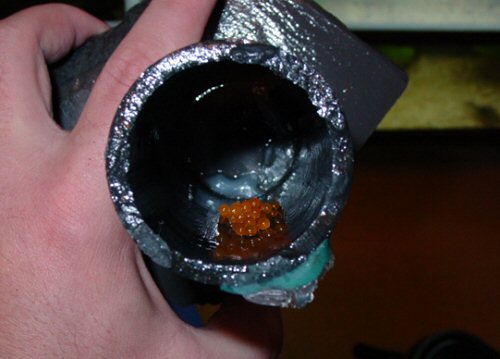
Why the "Three ray bristlenose catfish"?. This is brought about by the three soft rays in the anal fin peculiar to this species, ie: triradiatus, meaning three rays. Below is an image of the orange eggs in pipework. Unlike the Rineloricaria/Loricaria genera who like an open pipe or cave at both ends the Ancistrus males prefer to have one end blocked off although this does not stop a determined pair if it is an open cave, but it does give better options for spawning.
Ancistrus triradiatus - orange eggs
For your tank set up you can provide a sand substrate with driftwood and pipwork with closed ends. Water circulation for oxygen intake is a benefit.
|
 f you would like to venture
into the breeding of the family Loricariidae here
is a species which you can get your teeth into and
start you off and hopefully take you on a journey
to the more fancier L-numbers of the Panaque,
Peckoltia and Hypancistrus genera's. Along
with the various Rineloricaria and Loricaria
the genus Ancistrus is one of the easiest
to begin with
and the many species in this genera have been bred
for many years, and one of them is this months (June
2012) factsheet subject, the Three ray bristlenose
catfish, Ancistrus triradiatus.
f you would like to venture
into the breeding of the family Loricariidae here
is a species which you can get your teeth into and
start you off and hopefully take you on a journey
to the more fancier L-numbers of the Panaque,
Peckoltia and Hypancistrus genera's. Along
with the various Rineloricaria and Loricaria
the genus Ancistrus is one of the easiest
to begin with
and the many species in this genera have been bred
for many years, and one of them is this months (June
2012) factsheet subject, the Three ray bristlenose
catfish, Ancistrus triradiatus.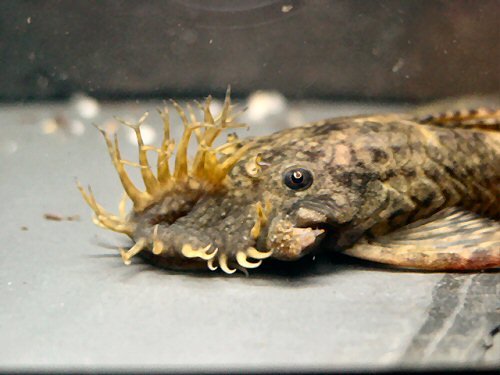
Common Name: |
Three ray bristlenose catfish. |
Synonyms: |
Family: |
Loricariidae |
Subfamily: |
Ancistrinae |
Distribution: |
South America: Colombia, Middle and lower Orinoco River tributaries; Valencia Lake and Los Guayos River basin; southern tributaries of Lake Maracaibo basin. Type locality: Quebrada Cramalote, Villavicencio; Andes east of Bogotá, upper Meta basin, Colombia. |
Size: |
12.0cm. (4¾ins) |
Temp: |
24-28°c (75-83°f.) |
p.H. |
6.5-7.5. |
Characteristics |
Males possess large bushy tentacles to the mouth area, the females are very much smaller. Three rays to the anal fins. |
Colouration |
Variations on mottled brown with the fins sporting brown banding/lines. The juveniles lack the light caudal fin edging that is found in a lot of aquarium bred species of Ancistrus. |
Aquarium Care & Compatibility |
| As with most of this genus it will do well in an aquarium where it will wipe out any algae. You can house with most of the Tropical fish species that are found in the hobby today. Try not to put too many bottom living species with them as this limits there tendancy to concentrate on producing fry. |
Reproduction |
Relatively easy to breed where the female will deposit her eggs, up to 100, in a confined space such as pipe work. The juveniles can be raied on tablet and vegetable foods. |
Sexual differences |
Males have, as in this genera, bushy tentacles to the mouth area and the females have them very small. |
Diet |
| Feed vegetable foods such as lettuce, cucumber and courgette (zucchini). Will eat most aquarium fare. |
Glossary of Terms |
Anal fin:
The fin forward from the anal cavity. |
Etymology |
| Ancistrus:
With barbed hooks, (hooked spines). |
References |
Baensch,
H.A. and R. Riehl 1995
Aquarien Atlas. Band 4. Mergus Verlag GmbH, Verlag
für Natur- und Heimtierkunde, Melle, Germany.
864 p. |
Photo Credits |
© Shane Linder |
|

If you would like to contribute to the monthly factsheets with an
article, information or photos, please e-mail
me. You will of course be credited for your work.
If you would like to donate any denomination of money to the site just click the above link button. All proceeds will go to running the site and hopefully to keep it going for a few years yet.
ScotCat Sources
 Etymology-genera
Etymology-specific
name
Online Sources
 Search
 Fishbase
 Catalog of Fishes
 GBIF
GBIF
 Fishnet2
 iNaturalist

