SCOTCAT.COM  

your internet guide to all things catfish
≡
  • HOME
  • FACTSHEETS
    • By Month/Year
    • By Family
    • by Genus
    • by Common Names
    • By Specific Names
    • By Continent
      • Index
      • Africa
      • Asia
      • Australasia
      • Europe
      • North America
      • South America
  • GALLERIES
    • Photo Gallery
    • Art Gallery
    • Movie Gallery
    • Stamps Gallery
  • FAMILIES
    • A-B
      • Ailiidae
      • Akysidae
      • Amblycipitidae
      • Amphiliidae
      • Anchariidae
      • † Andinichthyidae
      • Ariidae
      • Aspredinidae
      • Astroblepidae
      • Auchenipteridae
      • Auchenoglanididae
      • Austroglanididae
      • Bagridae
    • C-D
      • Callichthyidae
      • Cetopsidae
      • Chacidae
      • Clariidae
      • Claroteidae
      • Cranoglanididae
      • Diplomystidae
      • Doradidae
    • H-I
      • Heptapteridae
      • Heteropneustidae
      • Horabagridae
      • Ictaluridae
    • K-L-M
      • Kryptoglanidae
      • Lacantuniidae
      • Loricariidae
      • Malapteruridae
      • Mochokidae
    • N-P
      • Nematogenyidae
      • Pangasiidae
      • Phreatobiidae
      • Pimelodidae
      • Plotosidae
      • Pseudopimelodidae
    • R-S-T
      • Ritidae
      • Schilbeidae
      • Scoloplacidae
      • Siluridae
      • Sisoridae
      • Trichomycteridae
  • ARTICLES
    • Index
    • Breeding
    • By Author
    • Cat-Articles
    • General
    • Numbered List
    • Ichthyology
    • Travel/Collecting
  • IDENT-A-CAT
  • RESOURCES
    • Citation
    • Etymology
    • Fishhouse
    • Glossary
    • Scientific Papers
    • ScotShop
  • SITE MAP
  • FB GROUP
  • HELP
    • Index
    • Catfish Anatomy
    • Convertors
    • FAQ
    • Ident-A-Cat
    • Water Chemistry

FACTSHEETS: December 2025 - no. 354

 Baryancistrus beggini Lujan, Arce & Armbruster, 2009


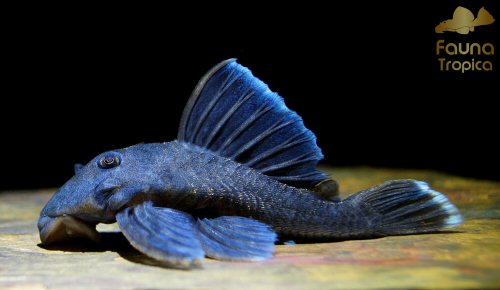
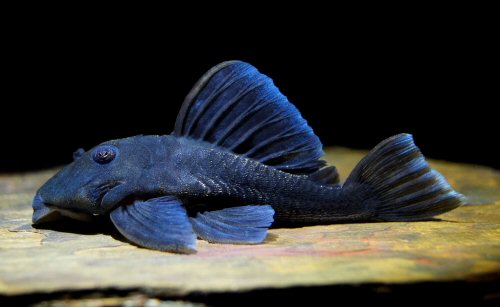
ur subject for the Factsheet of the Month for November 2025 first appeared in the DATZ magazine in July 1997 and was captioned as L239 Ancistrinae sp. You can see in the images why it is called the Blue or Blue-finned Panaque, although it is not closely related to this genus. At the time in 1997, this species could not be placed in any of the described genera due to the overlaps of traits with different genera. Similar to the Scobinancistrus genus, but this genus is smaller and has a more slender body. Mature males have long odontodes behind the gill covers, on the pectorals and the body.


Baryancistrus beggini-male

    Baryancistrus beggini-male


The Baryancistrus genus was erected by Rapp Py-Daniel in 1989, and as of 2025, there are six described species. B. beggini Lujan, Arce & Armbruster, 2009, B. chrysolomus Rapp Py-Daniel, Zuanon & Ribeiro de Oliveira, 2011, B. demantoides Werneke, Sabaj Pérez, Lujan & Armbruster, 2005, B. longipinnis (Kindle, 1895), B. niveatus (Castelnau, 1855), and B. xanthellus Rapp Py-Daniel, Zuanon & Ribeiro de Oliveira, 2011.

B. beggini was the third species to be described, as the other two, B. niveatus (Castelnau, 1855), which was named as a Hypostomus species and later as Hemiancistrus and B. longipinnis (Kindle, 1895), which was named as Hemiancistrus and later as a Parancistrus species when they were first discovered in the 19th century.


Baryancistrus beggini - female

 Baryancistrus beggini - female


Baryancistrus beggini - male & female genital area


Baryancistrus beggini - male & female genital area

In the original paper "N K. Lujan, M. Arce and J W. Armbruster. 2009. A New Black Baryancistrus with Blue Sheen from the Upper Orinoco (Siluriformes: Loricariidae)". They go on to state that B. beggini being assigned to Baryancistrus must be considered as tentative until such time as a more thorough comparative study of basal genera within the Panaque clade can be conducted and several currently undescribed species that might also belong within Baryancistrus can be examined. Problematically, the membranous connection between dorsal and adipose fins in Baryancistrus beggini is not identical to that found in other species of Baryancistrus.

Baryancistrus beggini can be distinguished from all other Baryancistrus by having the last dorsal-fin ray adnate with adipose fin via a posterior membrane that extends beyond the preadipose plate up to half the length of the adipose-fin spine (vs. membrane separated from preadipose plate by up to two plates or stopping at preadipose plate); B. beggini is further distinguished from B. niveatus and B. longipinnis by having a naked abdomen (vs. partially plated), and from B. demantoides by having fewer premaxillary teeth (8–36 vs. 34–54), (N K. Lujan et al 2009).

Phylogenetic research since the original description has revealed that this species actually represents a new, undescribed genus largely restricted to the upper Orinoco along with Baryancistrus demantoides, Hemiancistrus guahiborum and Hemiancistrus subviridis (Lujan, N. K. 2021).


Upper Orinoco


 South America: Upper Rio Orinoco and lower portions of its tributaries, the Rio Guaviare in Colombia and Rio Ventuari in Venezuela. Type Locality: Venezuela, Amazonas, Rio Orinoco drainage, Rio Ventuari, 4u49320N,  66u539340W.


The Guaviare River is is a tributary of the Orinoco in Colombia. It flows together with the upper Orinoco (until here also called Río Parágua), which it clearly surpasses in length (altogether about 1,760 km) and water flow. Thus, the Guaviare is hydrologically the main stream of the Orinoco system. The Ventuari River is the largest tributary of the Orinoco in southern Venezuela. The Ventuari flows from south-central Venezuela in the Guiana Highlands southwest into the Orinoco River. It is 520 km (320 mi) long and its major tributary is the Manapiare River (Wikipedia 2025).

Remarks:
A new tribe, Peckoltini was named in the paper "N. K. Lujan and J W. Armbruster. 2024. New tribe-level classification of Hypostominae (Loricariidae) based on optimization of morphological states on DNA-based relationships, with descriptions of three new tribes and two new genera" which included the Baryancistrus genus and they are widely distributed throughout the Amazon, Orinoco, Essequibo and other coastal basins of the Guianas as well as the trans-Andean Guayas and Esmeraldas drainage's in Ecuador, the Magdalena River, and the Lake Maracaibo basin.

Update: There has now been (2025) two new species described, Baryancistrus isaaci (L274) Oliveira & Rapp Py-Daniel, 2025 and Baryancistrus quilombola (L384) Oliveira & Rapp Py-Daniel, 2025.


Common Name

L239, Blue Fin Panaque, Blue Panaque

Synonyms

None

Family

Loricariidae

Subfamily

Hypostominae

Habitat

Found in shallow fast flowing areas of water with a stony substrate.

Distribution

South America: Upper Rio Orinoco and lower portions of its tributaries, the Rio Guaviare in Colombia and Rio Ventuari in Venezuela.

Size

12.0cm. (4¾ins)

Temp.

24-28°c (75-83°f.)

p.H.

6.5-7.2.

Characteristics

Baryancistrus beggini is unique within Hypostominae in having a uniformly dark black to brown base colour with a blue sheen in life, and the first three to five plates of the midventral series are strongly bent, forming a distinctive keel above the pectoral fins along each side of the body. It is further distinguished by having a naked abdomen, two to three symmetrical and ordered predorsal plate rows including the nuchal plate, and the last dorsal-fin ray adnate with adipose fin via a posterior membrane that extends beyond the preadipose plate up to half the length of the adipose-fin spine.

Colouration

Adults and juveniles dark grey to black with a turquoise blue sheen on fins and flanks. Blue sheen more intense in some, presumably adult males.

Aquarium Care & Compatibility

Can be problematic, especially with inexperienced aquarists, not a beginners fish. As of most of this genera the adults can be extremely territorial, especially with their own kind and other species of Baryancistrus. Prefers higher temperatures and good water circulation.

Reproduction

They are cave spawners that have not been bred often. The male guards the eggs, but the survival of the fry can be problematic. The first reported breeding was carried out in the Basel Zoo. There is an article on PlanetCatfish.com on breeding this species, "Breeding Baryancistrus beggini, the Blue Fin Panaque or L239".

Sexual differences

Baryancistrus beggini is not the easiest pleco when it comes to differentiating male and female. From the side we see not many differences. Head- and body shape looks quite similar. Closer inspection of the heads reveals a minimal bigger head of the male. Also with this species the odontodes can be a bit misleading, since it doesn't have to be that the male shows bigger ones than the female. This counts for both odontodes on the gills and the pectoral fins. Also the little spikes on the tail is seen by both male and female, making sexing not really the easiest task. Since the specimens on these picture are still not adult, the body shape from top also doesn't show too much difference. You could say that the female has a slightly bigger belly. When being gravid, this is of course is visibly better. The biggest difference between male and female appears to be the genital area, see above image. The papilla of the male is slightly smaller, where as the females papilla looks bigger with orange dots around it (Fauna Tropica 2021).

Diet

Vegetarian diet, and will also eat plants in the aquarium. Tablet foods and insect larvae.

Glossary of Terms

Adipose fin: Fleshy finlike projection without rays, behind the rayed dorsal fin.
Nuchal plate: Area between the skull and dorsal fin.
Odontodes: Hair - like stuctures on the body.
Papilla: A small fleshy projection, plural papillae.
Pectoral fin: The paired fins just behind the head.
Preadipose plate: It can refer to an azygous (unpaired) plate-like structure located anterior to the adipose fin in certain fish species.
Predorsal plate: In front of the dorsal fin spine.

Etymology

Baryancistrus: Greek, barys = heavy/sturdy (Ancistrus)+ Greek, agkistron = hook.
beggini: In honour of Chris Beggin for his financial support of this research, ethical ornamental fish business practices, and influence on the professional development of the first author.

IUCN Red List

Most of the distribution of Baryancistrus beggini is around the periphery of Parque Nacional Yapacana; however, the park is experiencing gold mining. In addition, B. beggini is being exported for the aquarium trade. These factors are inferred to be leading to a continuing decline in both habitat extent and quality, and population size. Along with an extent of occurrence (EOO) of 13,832 km2 and three threat-based locations, this supports a ranking of Vulnerable under B1ab(iii,v), (IUCN 2023).

References

Fauna Tropica 2021
Froese, R. and D. Pauly
. Editors. 2025. FishBase. World Wide Web electronic publication. www.fishbase.org, ( 04/2025 ).
N. K. Lujan and J W. Armbruster
. 2024. New tribe-level classification of Hypostominae (Loricariidae) based on optimization of morphological states on DNA-based relationships, with descriptions of three new tribes and two new genera.
N. K. Lujan, M. Arce and J W. Armbruster
. 2009. A New Black Baryancistrus with Blue Sheen from the Upper Orinoco (Siluriformes: Loricariidae).
PlanetCatfish.com:
"Breeding Baryancistrus beggini, the Blue Fin Panaque or L239".

Photo Credits

© Fauna Tropica
© Map: Mapy.com 2025.

Donate towards my web hosting bill!


If you would like to contribute to the monthly factsheets with an article, information or photos, please e-mail me. You will, of course, be credited for your work.


If you would like to donate any amount of money to the site, simply click the link above. All proceeds will go to running the site and hopefully to keep it going for a few years yet.


ScotCat Sources

Etymology = Genus Etymology-genus name

Etymology = Species Etymology-specific name


Other Sources

Search  Search

Fishbase Fishbase

Catalog of Fishes Catalog of Fishes

Global Biodiversity Information Facility GBIF

FishNet2 FishNet2

iNaturalist iNaturalist

IUCN IUCN

  • Facebook about us + contact us + citation + translate + site map + scotshop + glossary + etymology +
  • help YouTube

©2025 SCOTCAT.COM