SCOTCAT.COM
your internet guide to all things catfish
FACTSHEETS: March 2010 - no. 165
Brachyrhamdia marthae Sands & Black, 1985 |
This species is closely related to the subject of the January 2006 Factsheet, Brachyrhamdia meesi Sands & Black, 1985. In fact they were both described by the same authors, in the same publication. However, this does not appear in shops as often as B. meesi.
Brachyrhamdia
marthae As discussed in the B. meesi factsheet, the genus Brachyrhamdia Myers, 1927 has been accepted as being different to Pimelodella Eigenmann & Eigenmann, 1888 since Lundberg & McDade (1986) showed differences in the posterior (the one nearer the dorsal fin spine) fontanel (gap) in the upper cranium. The B. meesi factsheet quotes Lundberg & McDade page 4, which states that “Brachyrhamdia and Pimelodella differ in the former having the posterior cranial fontanelle wide open from the frontals to the supraoccipital whereas it closes to two small foramina in the latter.” This seems to state that in Brachyrhamdia the posterior fontanel is wide open (in an elongated gap) whereas in Pimelodella it closes to two foramina (small openings). However, if one looks at fig. 6 in Lundberg & McDade it appears that it is Brachyrhamdia that has two small foramina, not an elongated posterior fontanel. This is also backed by the text on page 9. Therefore the differences are that it is Pimelodella that has the posterior fontanel as an extended gap, whereas in Brachyrhamdia it is reduced to two small foramina. Therefore it should be corrected to ‘Pimelodella and Brachyrhamdia differ in the former having the posterior cranial fontanelle wide open from the frontals to the supraoccipital whereas it closes to two small foramina in the latter.’ For aquarists the easiest method to use is the much shorter body form in Brachyrhamdia compared to the more elongated body of Pimelodella. B. marthae has been placed in Rhamdia and Pimelodella but is certainly a Brachyrhamdia.
Brachyrhamdia meesi
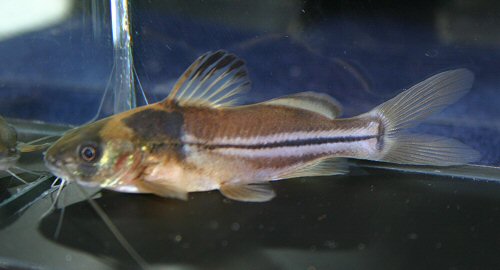
As well as the 5 described species of Brachyrhamdia there are at least 2 undescribed species. 4 of the 7 appear to mimic Corydoras, but what about the other 3? B. heteropleura (Eigenmann, 1912), B. meesi, and B. marthae don’t easily match up with the patterns of other Corydoras. The answer may lie in how I found my two specimens of B. marthae. The two specimens were very small (approx. 2cm) and came in with a wild shipment of a similarly Otocinclus sp; probably O. vestitus Cope, 1872. At this size the two were not easily distinguishable at a cursory glance at the shoal. It may well be that the young of B. marthae and the similar B. meesi mimic Otocinclus rather than Corydoras, and if this is the case they may only do so whilst juvenile, due to the difference in sizes of the respective genera’s adults. They are very greedy eaters, accepting dried and live food but seem to prefer bloodworm. They have grown quite quickly in a short space of time. They can be a little aggressive with other Brachyrhamdia’s and it is important to have a few hiding places such as plants, caves, and pipes to keep aggression down. It differs from the similar B. meesi by the lack of an eye band and there is a slight violet hue to the body.
|
 he
third month of the new decade (2010) brings us to
another indepth look from the catfish world from regular
contributor, aquarist and author, Steve Grant. His
subject is a member of the Heptapteridae family and
a very pretty catfish at that. I now hand you over
to Steve.
he
third month of the new decade (2010) brings us to
another indepth look from the catfish world from regular
contributor, aquarist and author, Steve Grant. His
subject is a member of the Heptapteridae family and
a very pretty catfish at that. I now hand you over
to Steve.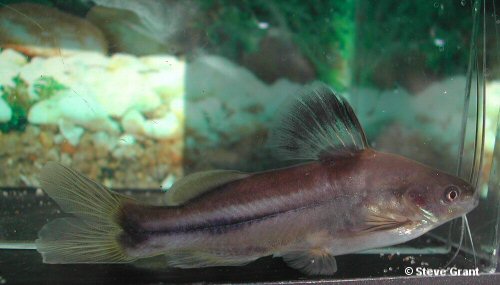
Common Name: |
Martha's Brachyrhamdia |
Synonyms: |
Pimelodella marthae, Rhamdia marthae |
Family: |
Heptapteridae |
Subfamily: |
Rhamdiinae |
Distribution: |
South America: Juruá and Mamoré/Madeira River basins: Brazil, Bolivia and Peru. |
Size: |
8.0cm. (3¼ins) |
Temp: |
24-26°C (75-79°F) |
p.H. |
6.5-7.2. |
Characteristics |
Deep but squat pim-like body. Three pairs of barbels. Posterior cranial fontanelle reduced to two small foramina. Differs from the similar B. meesi by the lack of an eye band and there is a slight violet hue to the body. |
Colouration |
Greyish violet body colour with a violet-black line from the end of dorsal insertion to the caudal peduncle, ending in a small blotch. Similarly coloured markings in the dorsal fin and anal fin. |
Aquarium Care & Compatibility |
| Not to be trusted with smaller inmates such as smaller tetras and fry but will do fine with larger Barbs etc. May nip Corydoras and other Brachyrhamdia species when feeding, so you will need to keep an eye out for this behaviour. |
Reproduction |
As yet unknown. |
Sexual differences |
There are no known external sexual differences, but females are probably more robust in the body. |
Diet |
| Readily accepts all manner of prepared foods. Catfish pellets and tablets and are particularly fond of frozen bloodworm and other "wormlike" foods. |
Glossary of Terms |
Fontanel:
The space(s) between the bones
on top of the skull covered by skin. |
Etymology |
| Brachyrhamdia:
Brachy = short; rhamdia = from the vernucular name
'Nhamdiá or 'Jamdiá. |
IUCN Red List |
Despite the little information available on this species, it has a wide range and no apparent threats. Therefore, it is assessed as Least Concern (IUCN 2023). |
References |
Lundberg,
J. G. and L. A. McDade,
1986. On the South American catfish Brachyrhamdia
imitator Myers (Siluriformes, Pimelodidae), with phylogenetic
evidence for a large intrafamilial lineage. Notulae
Naturae (Philadelphia) No. 463: 1-24. |
Photo Credits |
Top image: ©
Steven Grant @ Bottom Image: © Chris Ralph. |
|

If you would like to contribute to the monthly factsheets with an
article, information or photos, please e-mail
me. You will of course be credited for your work.
If you would like to donate any denomination of money to the site just click the above link button. All proceeds will go to running the site and hopefully to keep it going for a few years yet.
ScotCat Sources
 Etymology-genera
Etymology-specific name
Online Sources
 Search
 Fishbase
 Catalog of Fishes
 GBIF
GBIF
 Fishnet2
 iNaturalist
 IUCN
IUCN

