SCOTCAT.COM
your internet guide to all things catfish
FACTSHEETS: January 2006 - no. 115
Brachyrhamdia meesi Sands & Black, 1985 |
I go right back to the early eighties when I first started to take a keen interest in Catfish and in these days there was a great interest here in the U.K. in the first of Dave Sands books "Catfishes of the World" Vol. 1 which was published in 1983. The third volume (1984) concentrated on the Auchenipteridae and Pimelodidae families and it is this edition that took my interest in the then new finds of the new genes, Brachyrhamdia. There was a difference of opinion on whether the first species identified, B. imitator, was indeed a Pimelodella, Pimelodella imitator. A paper written in 1986 by John Lundberg and Lucinda McDade on this catfish stated that "‘Pimelodella and Brachyrhamdia differ in the former having the posterior cranial fontanelle wide open from the frontals to the supraoccipital whereas it closes to two small foramina in the latter (updated S.Grant, March 2010). They do also state that Brachyrhamdia is a deeper bodied fish than the Pimelodella genus.
Brachyrhamdia
meesi The Brachyrhamdia genus was thought to be monotypic (one species) until 1985 when Barry Black and David Sands identified two more species in B. marthae and B. meesi. There are as of date (updated March 2010), 5 species of Brachyrhamdia, B. heteropleura, B. imitator, B. rambarrani, B. marthae. and this months subject Brachyrhamdia meesi. These catfish have now been removed from their close relatives the Pimelodidae family and are now placed in a new family, Heptapteridae.
Brachyrhamdia meesi
The Brachyrhamdia species tend to be "mimics" of Corydoras species and shoal with them. This is known as Batesian mimicry (Sands 1990) and they share colour patterns and eye masks of very many Corydoras species. They steal substrate food from the Corydoras and are protected in the larger shoal from large predators. They are like most pims, terrritorial with their own kind, and as such it is advisable if keeping more than one that it will need to be over two so that the aggression is spread and diluted through a small group. Hiding places
such as pipework/rocks/slates is a good idea to keep
them confident in their own surroundings. Water quality
would need to be bright with either internal or external
power filters for water movement and with water hardness
as low as possible.
|
 his is the first Factsheet of
a new year (2006) and it marks a significant milestone
in the history of ScotCat as we are now entering into
the ninth year of bringing the latest information
to you on anything that is remotely connected to the
wonderful world of the Catfish.
his is the first Factsheet of
a new year (2006) and it marks a significant milestone
in the history of ScotCat as we are now entering into
the ninth year of bringing the latest information
to you on anything that is remotely connected to the
wonderful world of the Catfish.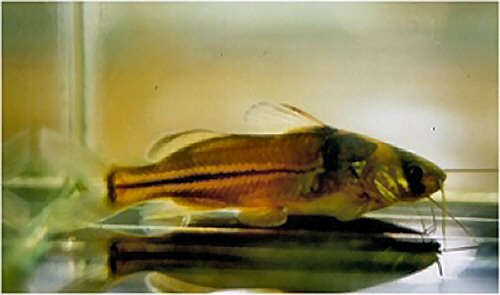
Common Name: |
Mees' pimelodid |
Synonyms: |
Pimelodella meesi |
Family: |
Heptapteridae |
Subfamily: |
- |
Distribution: |
South America: Amazon River basin: Near Belem, Brazil. |
Size: |
8.0cm. (3¼ins) |
Temp: |
24-26°C (75-79°F) |
p.H. |
6.5-7.2. |
Characteristics |
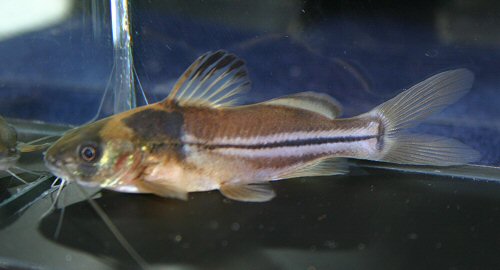
Deep pim-like body. Three pairs of barbels. Posterior cranial fontanelle wide open from the frontals to the supraoccipital. |
Colouration |
Salmon/pink body colour with three lines from the end of dorsal insertion to the caudal peduncle. There are two lighter bands with a darker line in between. Dark band at caudal peduncle. Dark mask over eyes and top of head starting at the beginning of dorsal insertion and carrying on down to midway between pectoral and ventral fins. Dusky tips to adipose fin and dorsal first spine. |
Aquarium Care & Compatibility |
| Not to be trusted with smaller inmates such as smaller tetras and fry but will do fine with larger Barbs etc. May nip Corydoras and other Brachyrhamdia species when feeding, so you will need to keep an eye out for this behaviour. |
Reproduction |
As yet unknown. |
Sexual differences |
There are no known external sexual differences, but females are probably more robust in the body. |
Diet |
| Readily accepts all manner of prepared foods. Catfish pellets and tablets and are particularly fond of frozen bloodworm and other "wormlike" foods. |
Glossary of Terms |
Fontanel:
The space(s) between the bones
on top of the skull covered by skin. |
Etymology |
| Brachyrhamdia:
Brachy = short; rhamdia = from the vernucular name
'Nhamdiá or 'Jamdiá. |
IUCN Red List |
The species has an uncertain geographic distribution due to difficulty in identification methods. There is also lack of information regarding population trends, threats, and conservation status. As such, this species is assessed as Data Deficient until additional information becomes available (IUCN 2023). |
References |
Baensch,
H.A. and R. Riehl 1991
Aquarien atlas. Bd. 3. Melle: Mergus, Verlag für
Natur- und Heimtierkunde, Germany. 1104 p. |
Photo Credits |
Top image:
© Allan James @
|

|

If you would like to contribute to the monthly factsheets with an
article, information or photos, please e-mail
me. You will of course be credited for your work.
If you would like to donate any denomination of money to the site just click the above link button. All proceeds will go to running the site and hopefully to keep it going for a few years yet.
ScotCat Sources
 Etymology-genera
Etymology-specific name
Online Sources
 Search
 Fishbase
 Catalog of Fishes
 GBIF
GBIF
 Fishnet2
 iNaturalist
 IUCN
IUCN

