SCOTCAT.COM
your internet guide to all things catfish
FACTSHEETS: May 2019 - no. 275
Bunocephalus amaurus Eigenmann, 1912 |
|
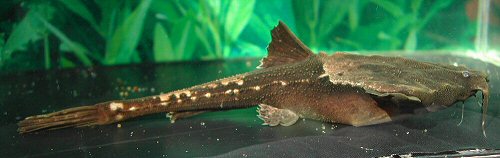
Bunocephalus amaurus - male
The Aspredinidae family is divided into two subfamilies, Bunocephalinae, this months subject, and Aspredininae and can be told apart by the longer anal fin of the latter, and also the longer body. Similar looking to B. coracoideus but is rarer in imports. Frequently occurs in creeks where it plays the role of a typical bottom cleaner, possessing a broad food spectrum. Lives in the leaf litter in small forest creeks of the interior.
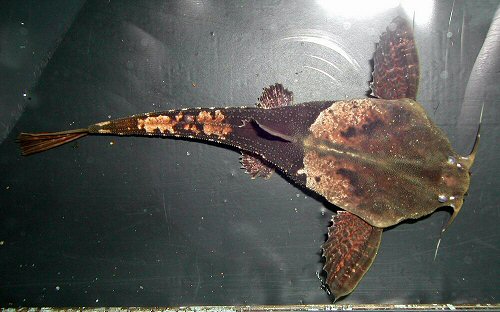
Bunocephalus amaurus - male dorsal head view showing the 'Y' shaped nuchal crest.
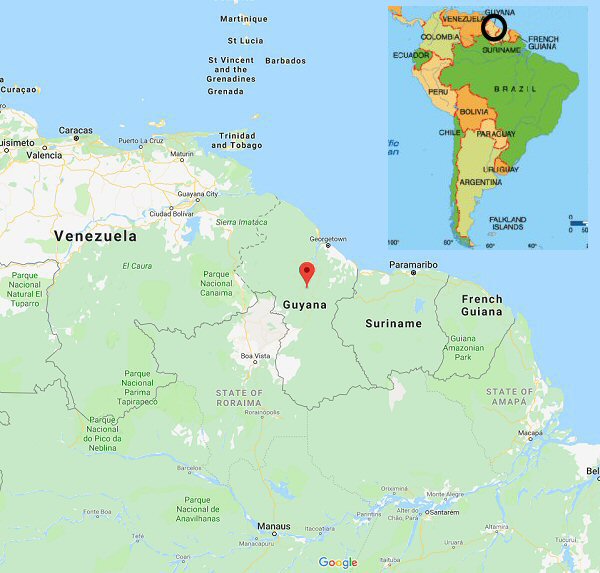
It is documented that some of the aspreniids are salt tolerant and as such are naturally occurring in estuarine environments. Banjo catfish are generally found in fresh water, with some occasionally being found within brackish-water environments of tropical South America. It is also documented that some members of the subfamily Aspredininae live in coastal brackish waters. Lives in the coastal rivers of northern South America between Orinoco to Amazon mouths. Present in all freshwater rivers except the Marowijne River where it is replaced by B. aloikae.
|
 his month (May 2019) we concentrate on a family of
catfish that are, on the most part, overlooked by
even the most ardent catfish hobbyists. The Aspredinidae
family are what is known in the hobby as " Banjo
Cats" or "Guitarrita" (little guitar)
owing to their long flattened banjo/guitar shape.
They are even cited as "Frying Pan Fish".
You will probably get my drift now on the shape of
this months factsheet individual, namely, Bunocephalus
amaurus, the "Camouflaged catfish".
his month (May 2019) we concentrate on a family of
catfish that are, on the most part, overlooked by
even the most ardent catfish hobbyists. The Aspredinidae
family are what is known in the hobby as " Banjo
Cats" or "Guitarrita" (little guitar)
owing to their long flattened banjo/guitar shape.
They are even cited as "Frying Pan Fish".
You will probably get my drift now on the shape of
this months factsheet individual, namely, Bunocephalus
amaurus, the "Camouflaged catfish".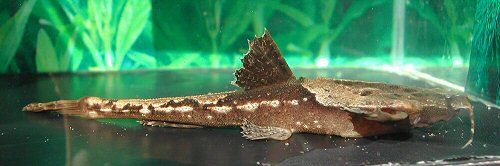
Common Name: |
Camouflaged catfish |
Synonyms: |
Dysichthys coracoideus amaurus, Bunocephalus amaurus aloikae, Bunocephalus amaurus sipaliwini |
Family: |
Aspredinidae |
Subfamily: |
Bunocephalinae |
Distribution: |
South America: Coastal rivers of northern South America between Orinoco to Amazon mouths. Type locality: Konawaruk, British Guiana. |
Size: |
12.0cm. (4¾ins) |
Temp: |
25-28°c (77-83°f.) |
p.H. |
6.0-8.0. |
Characteristics |
The head plate has a shallow 'Y' shaped nuchal crest, its base just in front of the dorsal plate extending forward and dividing level to the base of the pectoral spine. Head and body covered in minute tubercles, plus nine rows of conspicuous tubercles around the tail. |
Colouration |
Dark chocolate brown with lighter saddle between the nuchal crest and the dorsal spine and lighter patches on the back between the dorsal and caudal fins. Barbels banded. Dorsal, caudal and anal fins dark brown to black with a white margin, first rays of dorsal and anal and outer rays of caudal banded. Ventral fins mottled with a white margin. Pectoral fins dark brown to black, last rays lightly mottled. |
Aquarium Care & Compatibility |
| No problem to keep in a community tank and they will forage out in the open when food is introduced. Can be kept in groups and are non aggresive inmates in a shallow tank. The main problem is seeing them as they are a nocturnal species and you may be able to spot them if you feed at lights out in the dusk of a half lit room or fishhouse. Provide sand as a substrate as they will dig themselves into this and will smell food as it is introduced. |
Reproduction |
This species has not been recorded but B. coracoideus has been bred with the eggs boasting a total of 4,000 and are laid in the sand and would probably be better served if they are removed to a smaller tank or container, and when hatched will need to be fed very fine first foods such as brine shrimp and micro worm, after they have used up their yolk sac. They can then be weaned onto small worm foods such as grindel worm and tubifex. |
Sexual differences |
Determining the sexing out of this species is not easy but a rule of thumb is that the females are larger and fuller in the belly and usually a little darker in colouration. |
Diet |
| Adults when settled in their tank are not fussy feeders and can be fed a healthy diet of worm foods such as frozen bloodworm and tubifex and also tablet and pellet foods at lights out. |
Glossary of Terms |
Caudal fin:
The tail. |
Etymology |
| Bunocephalus:
Buno
= mound;
cephalus = head
(with bumps on the head). |
References |
Catfish
Association Great Britain: Magazine No. 14,
April 1977. Page 8. |
Photo Credits |
|
© Steven Grant
@ |
|

If you would like to contribute to the monthly factsheets with an article, information or photos, please e-mail me. You will of course be credited for your work.
If you would like to donate any denomination of money to the site just click the above link button. All proceeds will go to running the site and hopefully to keep it going for a few years yet.
ScotCat Sources
 Etymology-genera
Etymology-specific name
Other Sources
 Search
 Fishbase
 Catalog
of Fishes
Catalog
of Fishes
 GBIF
GBIF
 Fishnet2
 iNaturalist

