SCOTCAT.COM
your internet guide to all things catfish
FACTSHEETS: May 2006 - no. 119
Chrysichthys ornatus Boulenger, 1902 |
Chrysichthys ornatus
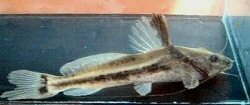
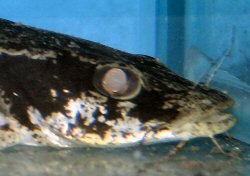
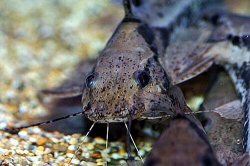
It has often been confused with a South American "Pim" from the Heptapteridae family, Goeldiella eques, the "Fox Face Pimelodella". The difference of course is that the African species, C. ornatus, has an extra pair of barbels in having nasal barbels, a shorter adipose fin and a different head shape. (see below).
Could be used in a fishhouse environment as a feeder for an overrun of Livebearer fry but would be quite happy on commercial foods. Quite tolerant of water parameters but very shy and would need the usual good husbandry and tank regime of weekly water changes and the keeping of the filtration up to the mark. This bagrid is not usually available in aquatic outlets so would be quite a find if you could spot any on your "Fish hunting" travels.
|
 ur
factsheet this month (May 2006) centers on a former
member of the Bagridae family and one of the nicest
looking "Bagrids" around as its common and
specific name entails "The Ornate Bagrid".
The genus Chrysichthys was split off from Bagridae
by Mo in 1991 along with all of the African Bagrids
bar one and is now housed in the Claroteidae
family. You can find out more in the Ichthyology articles
section titled
ur
factsheet this month (May 2006) centers on a former
member of the Bagridae family and one of the nicest
looking "Bagrids" around as its common and
specific name entails "The Ornate Bagrid".
The genus Chrysichthys was split off from Bagridae
by Mo in 1991 along with all of the African Bagrids
bar one and is now housed in the Claroteidae
family. You can find out more in the Ichthyology articles
section titled 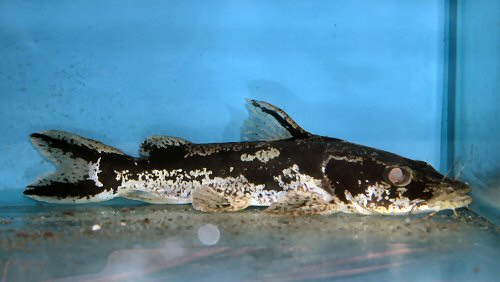
Common Name |
Ornate bagrid |
Synonyms |
Chrysichthys pictus |
Family |
Claroteidae |
Subfamily |
- |
Distribution |
Africa: Congo River system below Stanley Falls. Type locality: l’Ubangi à Banzyville [et] Monsembé, Haut Congo. |
Size |
22.5cm (9ins) |
Temp |
20-25°C (67-77°F) |
p.H. |
6.5-7.2. |
Hardness |
up to 17°dGH |
Characteristics |
Dorsal: 1/6; Anal: 11-13, 6-8 branched. Body elongate, anteriorly hardly compressed, posteriorly strongly so. Dorsal and anal fins short. Dorsal and pectoral fins with stout spines. Ventral fins inserted behind the dorsal. Adipose fin present. 4 pairs barbels ( 1 pair nasal, 1 maxillary, 2 mandibular). Jaws with teeth arranged in bands. Pallete toothed. |
Colouration |
Alternation of large, irregular, dark brown to black blotches and pale, yellowish to brownish blotches, with further small dark spots among them. Belly dirty white. Fins pale with irregular dark spots; each lobe of the caudal with a blurred dark longitudinal band. |
Aquarium Care & Compatibility |
| Not to be trusted with smaller tankmates. Would do better with larger African Tetras or Cichlids. Give it a choice of hiding places to make it feel more comfortable in its surroundings as it can be nocturnal. |
Sexual differences |
Not recorded but I would surmise that females would be heavier when in breeding condition. |
Reproduction |
Not recorded. |
Diet |
| Frozen shrimp and mussels. Frozen bloodworm pellets and tablet food. |
Etymology |
| Chrysichthys:
Chrysos = gold; ichthys
= fish. |
Glossary of Terms |
Nasal
barbels: Barbels on top of the head, by the
nostrils. |
References |
Baensch,
H.A. and R. Riehl
1985 Aquarien atlas. Band 2. Mergus, Verlag für
Natur- und Heimtierkunde GmbH, Melle, Germany. 1216
p. |
Photo Credits |
Chrysichthys ornatus:
© Chris Ralph |

|

If you would like to contribute to the monthly factsheets with an
article, information or photos, please e-mail
me. You will of course be credited for your work.
If you would like to donate any denomination of money to the site just click the above link button. All proceeds will go to running the site and hopefully to keep it going for a few years yet.
ScotCat Sources
 Etymology-genera
Etymology-specific name
Online Sources
 Search
 Fishbase
 Catalog of Fishes
 GBIF
GBIF
 Fishnet2
 iNaturalist

