SCOTCAT.COM
your internet guide to all things catfish
FACTSHEETS: Febuary 1998 - no. 020
Hoplisoma sanchesi (Nijssen & Isbrücker, 1967) |
Hoplisoma sanchesi
The one unusual feature of this Hoplisoma is that the males have an extended top caudal lobe, which you can just see on the male in the accompanying photograph. This is a feature, as far as I know, that is quite unique to the Corydoras/Hoplisoma genus and this alone should make it an interesting species to keep. Corydoras breeder and Catfish Study Group member, Ian Fuller, has bred this species and has notified me that this feature appears on the males on about the 10 week period, so if buying young fish you could very well get your pair, but even better, 2 males and one female. Ian has kindly
prepared for me a spawning report on this species
and the difficulty of rearing them, especially pertaining
to the water temperature, this appears below in the
breeding section, but if you want to see the fry growth
accompanied by the line drawings prepared by him,
it is just a click away in the articles section
of ScotCat.
Hoplisoma sanchesi
Remarks: Corydoras sanchesi is placed in Lineage 9, the "short-snouted" species with the designated type species: C. punctatus. A revision in the future would constitute the resurrection of the genus name Hoplisoma (Agassiz, 1846). Update: As of the latest revision (Dias et al 2024) Corydoras sanchesi has now been placed in Lineage 9 and has the new genus name of Hoplisoma. This species is still found on some online sources as Corydoras sanchesi.
|
 his Corydoras (now
Hoplisoma) is not too well known in the hobby
and has been only sporadically imported into the U.K.
It is quite a plain looking small Cory with a sandy
coloured body, small spots to the head and the predorsal
area, in fact it is not too unlike
his Corydoras (now
Hoplisoma) is not too well known in the hobby
and has been only sporadically imported into the U.K.
It is quite a plain looking small Cory with a sandy
coloured body, small spots to the head and the predorsal
area, in fact it is not too unlike 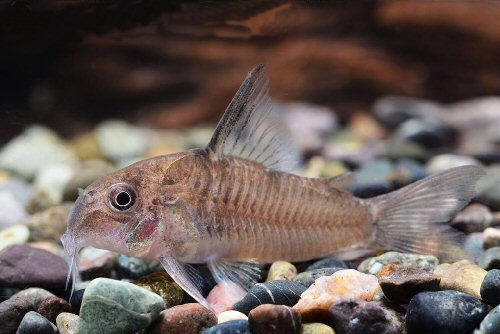

Common Name: |
Sanchesi's Cory |
Synonyms: |
None |
Family: |
Callichthyidae |
Subfamily: |
Corydoradinae |
Distribution: |
South America: The true Hoplisoma sanchesi comes from Surinam. |
Size: |
Male: 4.5cm (1¾ins) Female: 5.0cm (2ins) |
Temp: |
22-25°C (71-77°F) |
p.H. |
6.0-7.2. |
Characteristics |
Dorsal 1/7; Head short and compact. Male with extended top lobe to caudal fin. |
Colouration |
Body sandy coloured with fins all clear with the first spine to dorsal fin darker. Small spots to the head and the predorsal area. |
Aquarium Care & Compatibility |
| This is akin to most of this genus, very peaceful, and would be best housed with small to medium tankmates such as Tetras, Rasboras and Danios or in a species tank for breeding purposes. |
Reproduction |
The spawning followed the typical Corydoras ‘T’ mating position. The fish took over eight hours to lay 50 plus 1.8mm diameter eggs. There was none of the usual hustle and bustle, with the male chasing and pestering the female. He would just gently glide around her offering himself sideways on, first from one side, and then the other. Eventually the female would make contact and they would lock into a clinch. During this locked position, both fish would quiver for a few seconds. Between 3 and 7 light orange coloured eggs would be deposited into the females ventral fin pouch, the pair would then part, with the male wandering off rummaging in the gravel for food, and the female just leaning on one pectoral fin, resting. The female would rest for anything up to ten minutes before scurrying off looking for a suitable place to place her eggs. Most of the eggs were deposited in the Java Moss, with just one or two stuck to the tank sides, and a couple on the side of the filter. Based on the first spawning the eggs will take four days to hatch, and the fry are large enough to take newly hatched brine shrimp three days after hatching. Further foods will be micro worm and powdered flake, followed by larger offerings of grindal worms and sifted Daphnia, as the fry get larger. When the fry get to around 12mm, whole tablet food will also be given. The fry swarm all over these tablets when they are offered. It’s a magic sight to see dozens of fry gathered all around and feeding so avidly.Small water changes are made every day once the fry are feeding, with particular care being taken to use water of exactly the same temperature. If the temperature differs by more than a degree it can wipe out a complete brood. These water changes are essential if the fry are to develop to their full potential. |
Diet |
| The usual fare for adult Corydoras/Hoplisoma, a good quality flake food, tablet food, frozen bloodworm and whiteworm used sparingly. |
Etymology |
| Hoplisoma:
hóplon, shield
or armor; soma, body, referring to bony plates on
sides. |
References |
Alexandrou,
Markos & Taylor, Martin. (2011). Evolution,
ecology and taxonomy of the Corydoradinae revisited. |
Photo Credits |
Top image ©
Flair
Wang |
|

If you would like to contribute to the monthly factsheets with an article, information or photos, please e-mail me. You will of course be credited for your work.
If you would like to donate any denomination of money to the site just click the above link button. All proceeds will go to running the site and hopefully to keep it going for a few years yet.
ScotCat Sources
 Etymology-genera
Etymology-specific name
Other Sources
 Search
 Fishbase
 Catalog
of Fishes
Catalog
of Fishes
 GBIF
GBIF
 Fishnet2
 iNaturalist

