SCOTCAT.COM
your internet guide to all things catfish
FACTSHEETS: August 2001 - no. 062
Ictalurus punctatus (Rafinesque 1818) |
Ictalurus
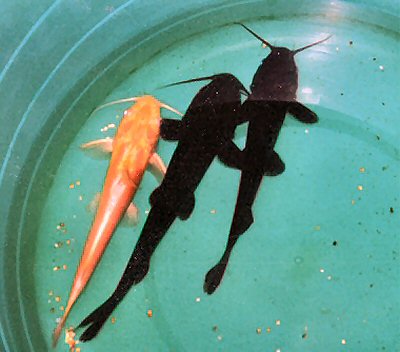
punctatus These North American catfishes used to be the mainstay of aquatic coldwater outlets in the U.K.when I first started out in the hobby and along with "Black Bullheads", (Ameirus melas), were bought to put in with the family goldfish as they looked "different"!, but a year on when they put on size and started to nip the flowing fins of the Goldfish they weren't quite so popular and I suspect a few of them met untimely deaths due to the frustration of the "aquarist". Thankfully they are not imported as much now and it is quite unusual to see them in the U.K. Touching on this subject I received a phone call from a friend last month (June 2001) who was setting up a coldwater tank and was on his way to buy a few goldfish and tank from someone else who was giving up the hobby and he had offered him three catfish which were in the same aquarium. Of course he didn't want them and pleaded to my good nature to relieve himself of them or they would meet a sticky end. Of course being a catfish man I couldn't bear to see them suffer and I was of course intrigued to know what they were, thinking they would probably be Bullheads. Imagine my surprise when he brought three 9 inch Channel Cats along which I duly photographed (pic below), one was an albino and the other two were in what I would call their juvenile colours, (black on top, white underbelly) and to cut a long story short another aquarist had e-mailed me just a few weeks previously wanting to know where he could get some as he has a large pond, and so they went to him on the other side of Scotland with my good wishes. Funny how things turn out!. How they will fare through a Scottish winter and the sometimes subzero temperatures will be interesting and will they hibernate just as Goldfish do?.
Ictalurus punctatus - albino & normal
Well enough of my meanderings and back to the subject of this months factsheet, Ictalurus punctatus, the Channel Catfish. When young they are very "catfish looking" but when they get large, (see pic below) and I have handled a 2ft monster, their heads get very broad and large and they do get heavy, too heavy in fact for an aquarium and as I mentioned above they do better when housed in a pond even though you might not see them too often, unless of course if you have the albino variety which would stand out a little better. The natural form of this fish is a steely grey with a few spots scattered about. They are in the main a very hardy catfish and water parameters can be wide and varied although regular water changes and water movement will benefit the well-being of the Channel Cat.
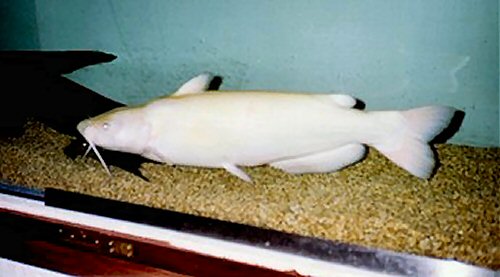
Ictalurus punctatus - adult albino
They have been introduced to a few countries throughout Europe but are native to North America and Mexico and are mainy used as a sport fish in the U.S. where it is one of the species used in the "pay as you fish" ponds. To tell the difference between the "Catfishes" and the "Bullheads" in the family Ictularidae is quite simple, the Catfishes have a forked tail, as in the Channel Catfish, and the Bullhead catfish have a truncate (straightish) caudal fin. There are now moves afoot by the U.K. Government through the Ministry of Agriculture, Fisheries and Food (MAAF) to impose restrictions on some coldwater species like the above mentioned Channel Catfish, due to the dangers of introduction to native waters and the threat to its occupants through disease and predation. In other words you could be paying up to £30 for a license to keep them. In the future due to the exporters having to implement new guidelines on matters such as health records for each fish, they could become quite rare in the U.K.
Update: As of November 1998 in the U. K. you must have a licence to keep the above species. This licence is now issued free, but does take a few months to process. For more information log on to the DEFRA site. Due to the size attained by this species it is doubtful that they will ever be imported into the U. K.
|
 ou
will not find this coldwater catfish in your 'coffee
table book' on community fish as the "Channel
Catfish" is one creature that you can safely
say would decimate a tank of guppies and neon tetras
in no time at all. In
saying that they do make nice pets when small but
beware when they start to put on size even though
they are somewhat slow growers to begin with.
ou
will not find this coldwater catfish in your 'coffee
table book' on community fish as the "Channel
Catfish" is one creature that you can safely
say would decimate a tank of guppies and neon tetras
in no time at all. In
saying that they do make nice pets when small but
beware when they start to put on size even though
they are somewhat slow growers to begin with.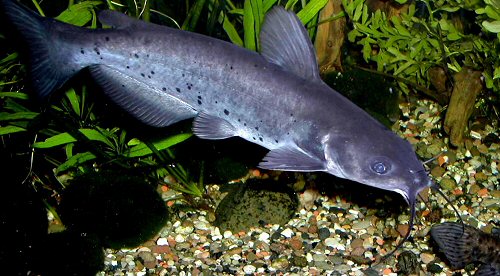
Common Name: |
Channel Catfish |
Synonyms |
Silurus punctatus |
Family |
Ictaluridae |
Subfamily |
- |
Distribution |
North America: Central drainages of the United States to southern Canada and northern Mexico. |
Size |
70.0cm. (27ins) |
Temp |
10-32°C (47-91°F) |
p.H. |
6.5-7.2. |
Characteristics |
Dorsal 1/6; Anal 1/25-30; Pectorals; 1/9; Ventrals 8. Caudal fin forked, jaws equal. |
Colouration |
Colouration variable; pale brown to grey-green, back darker, underside yellowish to clear white with a silver gleam. Sparsely sprinkled dark spots on the flanks. Fins colourless, occasionally with dark edges. Also albino version. |
Aquarium Care & Compatibility |
| Best to be kept on its own, or in a very large tank with other large catfish that can take care of themselves. Housing with large Cichlids is another possibility. |
Reproduction |
Spawning takes place in early spring and the nests are constructed under rocks or caves with the parents guarding the young. |
Diet |
| Inhabits rivers and streams and prefers clean, well oxygenated water. Feeds primarily on small fish, crustaceans, clams and snails. In the aquarium/pond they will eat most food with a preference for live/frozen food and also worms such as earth worms and white worm. Will also take catfish tablets and trout pellets. |
Etymology |
| Ictalurus:
Ichthys = fish; ailouros = cat. |
IUCN Red List |
Listed as Least Concern in view of the large extent of occurrence, large number of subpopulations, large population size, stable or increasing trend, and lack of major threats (needs updating IUCN 2013). |
References |
Burgess,
W.E. 1989 An atlas of freshwater and marine
catfishes. A preliminary survey of the Siluriformes.
T.F.H. Publications, Inc., Neptune City, New Jersey
(USA). 784 p. |
Photo Credits |
Top image: © Reinhold
Wawrzynski
@ |

|

If you would like to contribute to the monthly factsheets with an
article, information or photos, please e-mail
me. You will of course be credited for your work.
If you would like to donate any denomination of money to the site just click the above link button. All proceeds will go to running the site and hopefully to keep it going for a few years yet.
ScotCat Sources
 Article
 Art Gallery
 Etymology-genera
Etymology-specific name
Online Sources
 Search
 Fishbase
 Wikipedia
 Catalog of Fishes
 GBIF
GBIF
 Fishnet2
 iNaturalist
 IUCN
IUCN

