SCOTCAT.COM
your internet guide to all things catfish
FACTSHEETS: April 2007 - no. 130
Malapterurus electricus (Gmelin, 1789) |
It uses its electrical charge for catching prey and defense. It has a negative charge at the head and positive at the tail and consists of greatly modified body muscle fibres. This appears as a thin jelly like sleeve directly under the skin. It has been noted that the species that reside in Lake Tanganyika (M. tanganyikaensis) do not have as large a potential electrical current probably due to the more alkaline conditions that exist there.
Malapterurus
electricus In the not too distant past there used to be only three species in this genus, M. electricus from the Zaire system to west Africa and the Nile, M. microstoma from the Congo basin and M. minjiriya from Lake Kainji, Nigeria. After the work carried out by Steven Norris in 2002 there are now 16 species classified. Along with the "Electric Catfish's" there are only another two species that have the capability of electric shock, The "Electric Eel", Electrophorus electricus and the "Electric Ray", Torpedo marmorata.
Malapterurus electricus
This is an old world catfish and it is reputed that Doctors in ancient Egypt used shocks from the Electric Catfish to reduce the pain of arthritis. This trait is still used today in some areas. It also has the earliest reference of them as hieroglyphics on the walls of ancient Egyptian tombs dating back some 5000 years. Adults can become quite tame for their owners and can be fed from hand. The best aquarium conditions for them would be a planted tank as big as you can afford, anything over a 4ft long tank with it being wide enough to let it turn its body without any strain, 24ins being a good guide. Height is not that important but again 24ins for a guide. Sand or smooth gravel for the substrate and also caves, as they like to hide away during the day and a set-up such as this will mean that you may be see it poking its head out of its cave as they do in their natural environment. Another important point is to position the heater so as not to cause the "Electric Catfish" any damage to its naked body., as they do have an aversion to laying against them. A better bet would be to cover over the heater with a heater guard or invest in the type of external filter that has a space for a heater in its make-up. Filtration would be an external power filter and subdued lighting would be an advantage as they do not like their surroundings to be too bright. With that set-up you can enjoy your pet for many years. A note about removing your "Electric Cat" from the aquarium for any reason. Do not startle it, if you do not feed for a couple of days before and then just move your cat around the tank with a gentle push from a plastic handled fish net, it will then discharge itself with a large charge then a few smaller ones. You can then gently lift it out of the tank with the help of heavy weight rubber gloves for added protection, but sometimes they will be passive anyway, but why take the risk!.
|
 his
is certainly a catfish for the experienced catfish
keeper as it is like no other, and when adult the
electric organ is capable of generating 300-400 volts,
enough to stun a full grown adult of Homo sapian!.
When they are bought, usually as small juveniles,
their electrical output is more of a tingle.
his
is certainly a catfish for the experienced catfish
keeper as it is like no other, and when adult the
electric organ is capable of generating 300-400 volts,
enough to stun a full grown adult of Homo sapian!.
When they are bought, usually as small juveniles,
their electrical output is more of a tingle.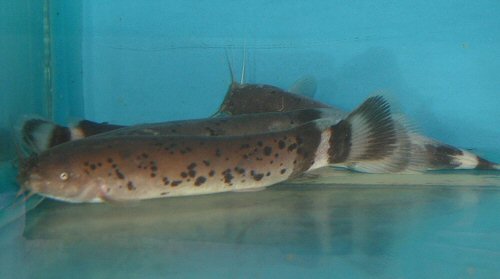
Common Name |
Electric Catfish |
Synonyms |
Silurus electricus |
Family |
Malapteruridae |
Subfamily |
- |
Distribution |
Africa: Nile and tropical Africa (except Lake Victoria and rivers of East Africa north of the Zambezi), Lake Tanganyika and probably Malagarazi, Fernando Poo Island. Also known from the lower and middle Zambezi, Pungwe, lower Save, and throughout the Congo system. |
Size |
90.0cm. (36ins) |
Temp. |
23-30°C (73-87°F) |
p.H. |
6.5-8.0. |
Characteristics |
Anal-9. No rayed dorsal fin, adipose fin short, pectorals without spines, caudal rounded. Head and body rounded and fleshy, mouth terminal, teeth fine, in broad bands on both jaws, 3 pairs barbels, outer mandibulars longest, reaching base of pectorals, gill slits short, restricted to sides. |
Colouration |
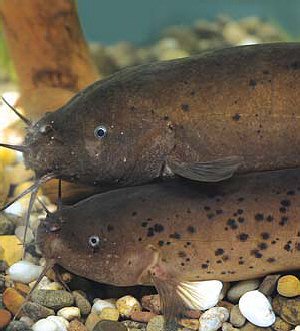
Body grey to to brown above with a white underside. Numerous black spots and blotches along the body, denser on posterior half. Caudal fin dark at base margined with orange or red, anal fin similarly coloured. Ventral and pectoral fins yellowish to red. Young specimens differ from adults - the body being flesh coloured with very few black spots and having a light ring around the caudal peduncle and a vertical black bar at the base of the caudal fin. |
Aquarium Care & Compatibility |
| Not to be trusted when adult so will need to be kept on its own. Juveniles can be kept together but would need to be monitered when growing. |
Reproduction |
In their natural habitat they form pairs and lay their eggs in excavated cavities or holes. Would not be possible in the small confines of an Aquarium. There have been rumours that they are mouth brooders, but this needs to be confirmed. |
Sexual Differences |
The males tend to be more slender than the females. |
Diet |
| In their natural habitat they feed on fishes that are stunned by their electrical charges so adults would need to be fed live fish. If bought as juveniles you may be able to wean them on to worm food such as garden worms, frozen bloodworm, shrimp, krill and small pieces of fish or meat. The urge to overfeed must be avoided as they can get quite gluttonous. They could also be trained to take tablet food. It is a matter of trial and error in different individuals. |
Glossary of Terms |
Mandibular: Pertaining to the lower jaw. (mandibular barbels). |
Etymology |
| Malapterurus
=
Mala =
soft; pter = fin; urus = tail.
(Refers to the adipose fin). |
IUCN Red List |
This species has a wide distribution, with no known major widespread threats. It is therefore listed as Least Concern (IUCN 2025). |
References |
Catfish
Association Great Britain: Volume 1. p,101. |
Photo Credits |
Top: © Chris
Ralph |

|

If you would like to contribute to the monthly factsheets with an
article, information or photos, please e-mail
me. You will of course be credited for your work.
If you would like to donate any denomination of money to the site just click the above link button. All proceeds will go to running the site and hopefully to keep it going for a few years yet.
ScotCat Sources
 Etymology-genera
Etymology-specific name
Online Sources
 Search
 Fishbase
 Wikipedia
 Catalog of Fishes
 GBIF
GBIF
 Fishnet2
 iNaturalist
 IUCN
IUCN

