SCOTCAT.COM
your internet guide to all things catfish
FACTSHEETS: September 2004 - no. 099
Mystus pulcher (Chaudhuri, 1911) |
Mystus pulcher
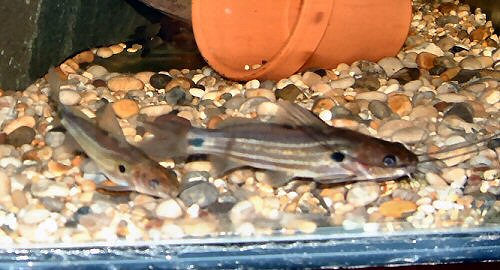
The vernacular name for this species in India is the "Pulcher mystus", pulcher in latin, meaning beautiful, and it can be differentiated from most in this genus by the two dark spots on the body, one on the shoulder area and the other on the base of the caudal. There are also three white/cream longitudinal stripes running from the beginning of the dorsal insertion along to the caudal peduncle. The only other species that is similar is Mystus bimaculatus Volz, 1904, but the colouration of the body is more reddish and the two spots have a lighter outer edge to them and they also lack the 3 body stripes.
Mystus pulcher
This is a fairly easy species to keep and is quite adaptable to different water parameters in the aquarium. It is also a good species for any ambitious breeder to undertake as they do not grow large and are not aggressive. I am at the moment in the process of carrying out this task and I'm hoping of some luck in the future as this is indeed a beautiful species. Hiding places are beneficial to this species as it will give them confidence to come out and feed and to also view them. Substrate can be of your own choice, either sand or gravel. There is quite a confusion with the size given, which in some literature can range from 5cm (2 ins) to 15cm (6ins). I would go with 12cm (5ins) as viewing them they look like that the max. size of 15cm might be just a bit out of their growth range. These sizes are of course standard length which takes in a size measured from the snout to the caudal peduncle.
|
 e
are off to Asia this month (Sep.2004) and to Myanmar,
formerly the state of Burma, and to a Mystus species
that is not all that well known in the hobby but is
one of the most colourful in this genus, Mystus
pulcher. There have been sporadic imports of
this catfish in the United Kingdom in the last year
so what better than a factsheet to celebrate its arrival
to these shores.
e
are off to Asia this month (Sep.2004) and to Myanmar,
formerly the state of Burma, and to a Mystus species
that is not all that well known in the hobby but is
one of the most colourful in this genus, Mystus
pulcher. There have been sporadic imports of
this catfish in the United Kingdom in the last year
so what better than a factsheet to celebrate its arrival
to these shores.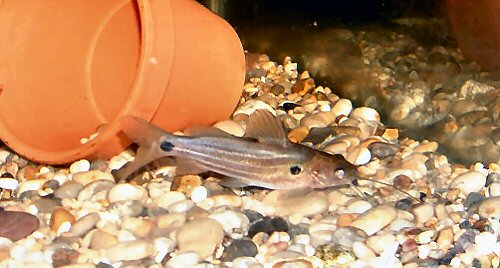
Common Name |
The Pulcher Mystus |
Synonyms |
Macrones pulcher |
Family |
Bagridae |
Subfamily |
- |
Distribution |
Asia: Myanmar, Bhamo close to Yunnan border; small muddy streams along Kaminng Jade Mines Road, Myitkyina district. |
Size |
12.0cm. (5ins) |
Temp. |
23-25°c (73-77°f.) |
p.H. |
6.0-7.0 |
Characteristics |
Four pairs of barbels, 2 maxillary, 2 mandibular and 2 nasal. Two dark spots on the body, one on the tympanum and the other on the caudal peduncle. The supraoccipital process meets the basal bones of the dorsal fin. Maxillary barbels reaching to insertion of anal fin. |
Colouration |
Dorsal and upper part of the body dark brown with lighter or paler whitish brown stripes: one median, from the tip of the snout to the base of the dorsal fin, and two lateral longitudinal on each side, one above and the other below the middle line, which is distinguished by being dotted black for the openings of the lateral organs. Nasal and maxillary barbels blackish brown, adipose fin dark brown, dorsal and caudal fins are brownish with black spots on the membranes between the rays. It has an intensely black tympanic spot (not semiocellus), and also one near the caudal peduncle followed by a thin white band. |
Aquarium Care & Compatibility |
| Will do well in your medium to large aquarium with larger Tetra type fish and Barbs. |
Reproduction |
Not reported but oviparous, distinct pairing possibly like other members of the same family. This genus is known to be egg scatterers and may eat the eggs if they are not separated. Cold water changes may start a pair off if they are kept in a species tank on their own. There have been a couple of instances of successfull breeding attempts with Mystus species, notably M. armatus and M. vittatus. |
Diet |
| Surprisingly they love flake food which will give them all the vitamins they desire. They should of course be fed a varied diet consisting of the former, tablet foods and frozen foods such as bloodworm. |
Etymology |
| Mystus
from “mystax”
meaning whiskered or moustache (hair on the upper
lip). Mystus was first used by Belon in 1553 to describe
all fish with whiskers. |
References |
Grant,
Steven;
The striped catfishes of the genus Mystus
Scopoli, 1777 (Siluriformes: Bagridae) Cat
Chat, The Journal of the Catfish Study
Group (UK) Vol. 5 Issue Number 2 June 2004, 5-17p. |
Photo Credits |
© Allan
James @ |

|

If you would like to contribute to the monthly factsheets with an
article, information or photos, please e-mail
me. You will of course be credited for your work.
If you would like to donate any denomination of money to the site just click the above link button. All proceeds will go to running the site and hopefully to keep it going for a few years yet.
ScotCat Sources
 Article
 Etymology-genera
Etymology-specific name
Online Sources
 Search
 Fishbase
 Catalog of Fishes
 GBIF
GBIF
 Fishnet2
 iNaturalist

