SCOTCAT.COM
your internet guide to all things catfish
FACTSHEETS: July 2006 - no. 121
Phyllonemus typus Boulenger, 1906 |
|
Phyllonemus typus
There are two species of the genus, Phyllonemus, this months subject typus and the much rarer P. filinemus and the differences between them centres on the maxillary barbels where typus has the ends of these barbels thickened (you can just see this in the above picture) and filinemus has them thread like. There is also a difference with the bone structure on the top of the head in these two species, but both have very large eyes. So how does this species fare in an aquarium ?. Very well in fact but needs to be kept in a higher p.H. than normal because of the needs of the many species endemic to this second largest Lake in the world, with the p.H. averaging out at between 8.0 and 8.4. and the optimum temperature of about 25c (77f). Set the tank out as per Tanganyikan with rockwork as they prefer to hide in the crevices provided. They like to rest on the substrate with their maxillary barbels held in a curve out the way and their membranous tips turned towards the front. In their natural habitat in the lake they live in the inshore waters to 20m depths.
|
 e are off to Africa this month (July 2006) and
to a species that resides in one of the Rift Lakes,
Lake Tanganyika, along with one of our other Factsheet
subjects,
e are off to Africa this month (July 2006) and
to a species that resides in one of the Rift Lakes,
Lake Tanganyika, along with one of our other Factsheet
subjects, 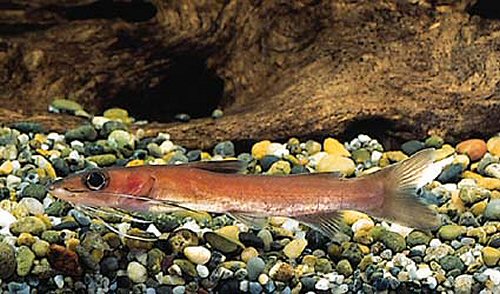
Common Name |
Spatula-barbeled catfish |
Synonyms |
None |
Family |
Claroteidae |
Subfamily |
- |
Distribution |
Africa: Lake Tanganyika. |
Size |
10.0cm (4ins) |
Temp. |
23-26c (73-79f) |
p.H. |
7.5-8.0. |
Characteristics |
Small and slender. 3 pairs of barbels with the maxillary barbels sporting leaf-like ends. Dorsal with one hard spine and 7 or 8 soft rays. Caudal fin forked. Pectoral fin spines strongly serrated on posterior edge. The large eyes have a free orbital rim. The posterior cleithral process is short and has an acute tip. The palate is dentigerous and the premaxillary tooth band is well developed. |
Colouration |
Upper body brown with a slight metallic appearance. Light brown to white belly. Mandibular barbels white/cream and maxillary barbels black. White tip to each lobe of caudal fin. |
Aquarium Care & Compatibility |
| This species is best kept in a group as it does like company of its own kind and will feel more secure as it is quite a shy catfish and can get bullied in a tank with larger aggressive species. As with all Bagrid type fish it will be attracted to smaller fish at night and may predate on fry, but all in all a good addition to a mixed Rift Valley tank set-up. |
Reproduction |
Has been bred in the aquarium where they are mouthbrooders with the male or female incubating the eggs in the mouth. |
Diet |
| In its native habitat they feed on larval insects and crustaceans and in the aquarium they will eat most foods given such as frozen bloodworm, catfish tablets, white worm (sparingly) prawns and shrimp. |
Glossary of Terms |
Cleithral
process:
A flattened pointed posterior
extension of the pectoral girdle (most prominent in
the genus Synodontis). |
Etymology |
| Phyllonemus:
Greek, phyhllon = leaf + Greek, nema = filament. |
IUCN Red List |
It is widely distributed within the littoral zones of Lake Tanganyika, with no widespread threats. Therefore, it is assessed as Least Concern (IUCN 2020). |
References |
Burgess,Warren.
E. Dr.
Freshwater and Marine Catfishes, A prelimanary
Survey of the Siluriformes. 1989. |
Photo Credits |
© |

|

If you would like to contribute to the monthly factsheets with an article, information or photos, please e-mail me. You will of course be credited for your work.
If you would like to donate any denomination of money to the site just click the above link button. All proceeds will go to running the site and hopefully to keep it going for a few years yet.
ScotCat Sources
 Etymology-genera
Etymology-specific name
Other Sources
 Search
 Fishbase
 Wikipedia
 Catalog
of Fishes
Catalog
of Fishes
 GBIF
GBIF
 Fishnet
 iNaturalist
 IUCN
IUCN

