SCOTCAT.COM
your internet guide to all things catfish
FACTSHEETS: March 2009 - no. 153
Porochilus rendahli Whitley, 1928 |
|
Porochilus rendahli
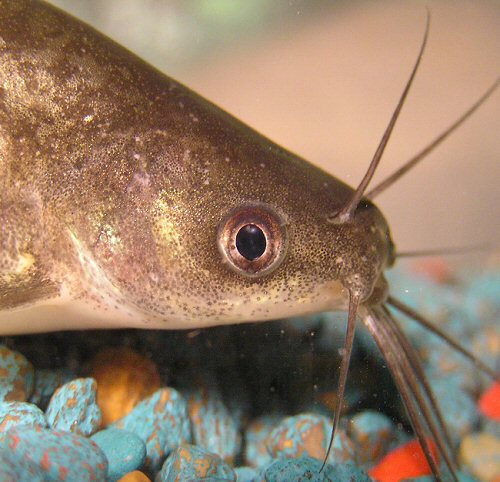
One of the sure fire methods of identifying this species of Porochilus and also seperating it from Neosilurus is by the eye being closer to the mouth on the former and also the steepness of the head up to the insertion of the dorsal fin, and the innner side of the pectoral spine being serrated. You can see the closeness of the eye to the mouth in the lower image.
Porochilus rendahli - head view
The image above shows a juvenile of Porochilus obbesi which was one of the offspring of Dave Wilson of Aquagreen.com a website based in Australia which is an Aquaculture facility located at Howard Springs in the Northern Territory. He provides Australian Native plants and fish to the Aquarium trade and is well known and thought of in his native country. They breed in his ponds, but not in high numbers, and provides them to the aquarium trade. In the aquarium they like company of their own species. They also really like plants to hide in, water sprite and long strands of the plant Vallisneria. seem to be well appreciated. In rocky tanks they often bash their noses when they get stressed, and dart about, so a planted tank would be a good idea. A substrate of gravel or sand would suffice with the appropriate filtration. They tend not to reach their full potential size in the aquarium and 15cm (6ins) would probably be the norm. Occurs in billabongs and streams in slow to fast-flowing water that is clear to turbid with rock, gravel or sand bottoms. Not seen for sale in the U.K. as Australian cats are not often for sale and if so, down to an odd few Neosilurus species. A nice peaceful catfish and would make a change from the norm.
|
 t has been a while now since
we travelled "down under" for our monthly
cafish fix, in fact nearly 2 years
have passed since May 2007
when we
wrote about the "Coral
Catfish,
t has been a while now since
we travelled "down under" for our monthly
cafish fix, in fact nearly 2 years
have passed since May 2007
when we
wrote about the "Coral
Catfish, 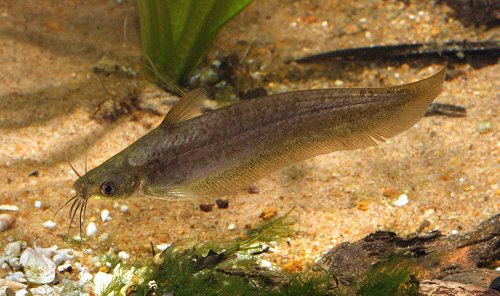
Common Name |
Rendahl's catfish |
Synonyms |
Copidoglanis rendahli, Neosilurus rendahli |
Family |
Plotosidae |
Subfamily |
- |
Distribution |
Oceania: Northern Australia. Western Australia in the Fitzroy and Ord river sytems. Arnhem land in the Northern Territory between the East Aliligator and Roger Rivers. Jardine River near the tip of Cape York Peninsula. |
Size |
20.0cm (8ins) |
Temp. |
18-24°C (63-75°F) |
p.H. |
6.5-8.0. |
Characteristics |
Small, relatively short anterior dorsal fin, composed of a sharp spine and 5-7 soft rays; second dorsal and anal fins confluent with caudal fin, composed of 104-127 rays; pectoral fin with sharp spine and 9-11 soft rays; anterior nostrils above upper lip; pectoral spine bumpy or barbed on inner side. Head concaved with eyes in close proximity to the mouth. |
Colouration |
Overall colouration ranges from a uniform or mottled dark grey to a pale yellowish-brown (occasionally white), usually with a golden sheen. |
Aquarium Care & Compatibility |
| As an Australian native fish they would de well with the larger Rainbow fishes but be sure to keep them in a relatively large tank over 3ft in length. |
Reproducion |
They breed in the early wet season (December-January) and the parents and juveniles migrate back upstream into refuge creeks. |
Sexual Differences |
Not known. |
Diet |
| In their native habitat they feed on aquatic insects, microcrusttaceans and molluscs. In the aquarium they will eat most foods such as frozen bloodworm. |
Glossary of Terms |
Anal fin:
The fin forward from the anal cavity. |
Etymology |
|
Porochilus:
Holed lip (refers to position of nostrils). |
References |
Allen,
G.R., Midgley, S.H. & M. Allen. 2002.
Field Guide to the Freshwater Fishes of Australia.
Western Australian Museum. Pp. 394. |
Photo Credits |
|
First
image: © Dave
Wilson @
|

|

If you would like to contribute to the monthly factsheets with an article, information or photos, please e-mail me. You will of course be credited for your work.
If you would like to donate any denomination of money to the site just click the above link button. All proceeds will go to running the site and hopefully to keep it going for a few years yet.
ScotCat Sources
 Etymology-genera
Etymology-specific name
Other Sources
 Search
 Fishbase
 Catalog
of Fishes
Catalog
of Fishes
 GBIF
GBIF
 Fishnet
 iNaturalist

