SCOTCAT.COM
your internet guide to all things catfish
FACTSHEETS: February 2002 - no. 068
Synodontis nigriventris David, 1936 |
|
Synodontis nigriventris
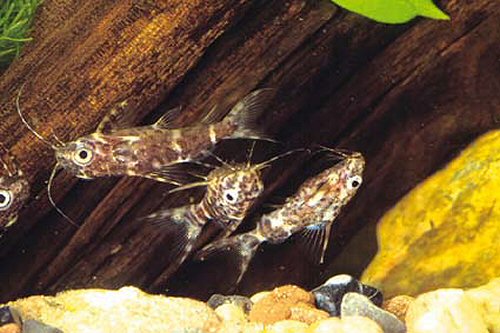
Now the question: 'why do they swim upside down'?. You will notice that the body colour is reversed with the emphasis on the belly being darker as with most other fish this area is lighter so when looking underneath they merge into the light that comes from above and the back is darker to presumably give them some protection from predatory birds. The reverse is somewhat true of Synodontis nigriventris as they feed on the surface upside down. I say somewhat true as the back is only a few shades lighter and sometimes the difference is not all that apparent. A scientific study was carried out in 1976 on this peculiar upside down scenario, why doesn't this fish get forced back over to its 'rightful position'? The swim bladder was normal and there was nothing untoward about the balancing organ of the ear, as it resembles that of other catfish, but what they found was that the nervous circuitry between the brain and the balancing organ of the ear is rather special, as it can be reset to zero once the body has tilted more than a certain critical degree (about 22 degrees).
Synodontis
greshoffi The image above shows the correct way to house this catfish in your tanks. They like to have their bellies pressed up to a surface and bogwood and branches seem to be their favourite foible. They also prefer to be kept in a group where they can interact with one another. A small to medium sized tank with plants floating and submerged and branched rootwork is the ideal environment for this peaceful Synodontis. There is another variety named S.nigriventris "zebra". It may be an undescribed species or it may be just a colour variety of the normal nigriventris, only time will tell on this issue. The normal nigriventris comes from all over the Congo drainage and the "zebra" variety from the region around the town of Kutu, Bandundu and Lac Leopold 11 in the Dem. Republic of the Congo. The genus Synodontis sports three pairs of barbels 1pair: maxillary, 1 pair: outer mandibular and one pair of inner mandibular barbels that are branched (filaments). There are only three species that have filaments on their maxillary barbels as well as the mandibular, and they are, S. clarias, S. decorus and S. flavitaeniatiatus.
|
 his is one of
the few catfishes in the earlier days of the hobby
that was enough to make you into a catfish 'freak'
along with
his is one of
the few catfishes in the earlier days of the hobby
that was enough to make you into a catfish 'freak'
along with 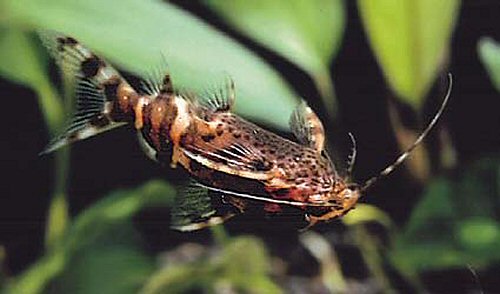
Common Name |
Upside-Down Catfish |
Synonyms |
Synodontis ornatipinnis |
Family |
Mochokidae |
Subfamily |
Mochocinae |
Distribution |
Africa: Central Congo basin. From Kinshasa to Basonga. |
Size |
9.0cm (3½ins) |
Temp. |
22-26°C (71-79°F) |
p.H. |
6.5-7.2. |
Characteristics |
Dorsal: 1/7, Anal: 4/4-9 Characteristic of this species is the smooth anterior face of the dorsal spine, the narrow separation of the eyes and the large size of the eyes. |
Colouration |
Pale grey to cream-coloured with dark brown to black blotches which may run together to form irregular broad transverse bars. Belly uniformly black (nigriventris). The fins are often darkly spotted on a colourless ground. |
Aquarium Care and Compatibility |
| A peaceful occupant of your community tank. Should not be housed with aggressive species such as large Cichlids. |
Reproduction |
It is one of the few Synodontis to be bred in captivity although the few successful attempts have been sketchy and they have been mostly by accident. There have been reports that they lay their eggs in a depression in the gravel and also another report when they laid them in a PVC pipe and also flowerpots. The young seemingly revert to the upside down pose when about 10 weeks old. A good regime for a breeding setup would be to provide pipework and a few clay flowerpots with a gravel substrate and the usual plants and wood to make them feel comfortable thus giving them choices for a hopeful spawning. The females are more noticeably plumper than the males and a bit more lighter in colour. |
Diet |
| In their native habitats they feed on insect larvae at the water surface and also scrape algae of the underside of leaves. A good diet of a good quality flake food, tablet food, frozen bloodworm and livefood such as daphnia should suffice. |
Etymology |
| Synodontis:
Ancient name for an undetermined fish from the Nile
(Cuvier 1816). |
References |
Dr.
Michael Benjamin; Aquarist & Pondkeeper,
Feb.1986. |
Photo Credits |
©
|

|

If you would like to contribute to the monthly factsheets with an article, information or photos, please e-mail me. You will of course be credited for your work.
If you would like to donate any denomination of money to the site just click the above link button. All proceeds will go to running the site and hopefully to keep it going for a few years yet.
ScotCat Sources
 Etymology-genera
Etymology-specific name
Online Sources
 Search
 Fishbase
 Blog
Blog
 Wikipedia
 Catalog of Fishes
 GBIF
GBIF
 Fishnet2
 iNaturalist

