SCOTCAT.COM
your internet guide to all things catfish
FACTSHEETS: March 2008 - no. 141
Scleromystax prionotos (Nijssen & Isbrücker, 1980) |
|
Scleromystax prionotos
This is quite a nice looking species in its own right, may be not as flamboyant as its cousin S. barbatus, but none the less quite distinctive in its dress of a metallic blue lateral band on the body. The males are also not aggressive like S. barbatus males and can be kept in smaller tanks. As this is a Southern Brazilian species it needs cooler waters and a point in question was when I moved 7 of a mixed juvenile/adult batch from my main fishhouse room from a temperature of 76°F ( 24°C) to a newly built rack in a cooler area of the fishhouse which had a water temperature of 70°F to 72°F (21°C - 22°C). The difference was quite marked and they appeared happier in their cooler surroundings and started showing an improvement in colouration.
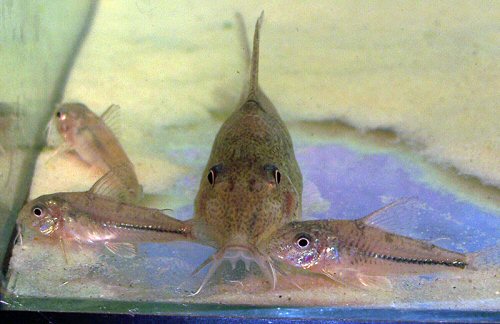
Scleromystax prionotos - adult with young
S. prionotos have been in the U.K. on and of for about 20 years now but it has only been lately that there are getting regularly spawned, with Catfish Study Group members Adrian Taylor and Mark Walters being especially productive. My individuals were from a spawning by Adrian. This species inhabits white water and clearwater streams in the coastal lowlands, where it is sympatric with the similar looking Corydoras nattereri.
Remarks: The genus Scleromystax belongs to lineage 3 and if there was a revision carried out on the Corydoradinae in the future they would remain so, with the designated type species S. barbatus (Günther, 1864).
|
 e
return this month (March 2008) to a member of the
Corydoradinae subfamily, a sort of Corydoras if
you like. It was
4 years ago in 2004 when the genus Scleromystax
was resurrected by taxonomists for the Southern
Brazilian species that sported cheek bristles in the
males, during an ongoing study of Corydoras,
Aspidoras and Brochis.
e
return this month (March 2008) to a member of the
Corydoradinae subfamily, a sort of Corydoras if
you like. It was
4 years ago in 2004 when the genus Scleromystax
was resurrected by taxonomists for the Southern
Brazilian species that sported cheek bristles in the
males, during an ongoing study of Corydoras,
Aspidoras and Brochis.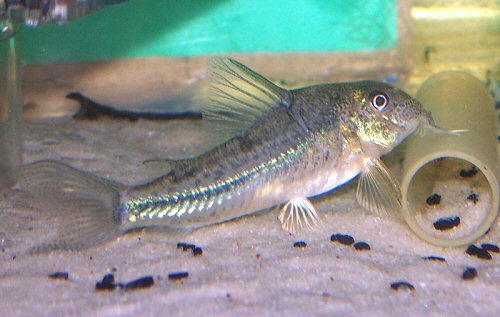
Common Name |
False nattereri |
Synonyms |
Corydoras prionotus |
Family |
Callichthyidae |
Subfamily |
Corydoradinae |
Distribution |
South America: Brazil, Est. Espirito Santo, Linhares (19°22’S, 40°04’W), Lagoa Juparanã, Rio Doce system. |
Size |
Male: 6.0cm (2½ins) Female: 6.5cm (2¾ins) |
Temp. |
21-25°C (69-77°F) |
p.H. |
6.0-7.5. |
Characteristics |
Shape of head, elongated with short snout. |
Colouration |
Body colour, grey-brown. Metallic blue band runs along the body from just the front of the insertion of the dorsal fin to the caudal peduncle. Body has many small pale spots especially on the head and over the top half of body. Three spots along the ridge of the back on the anterior and posterior of the dorsal fin and the adipose fin. |
Aquarium Care & Compatibility |
| As with most of this family, no problem with other tank mates. Would be better to keep with species that are comfortable with cooler temperatures in the aquarium. |
Reproduction |
As per this genus. Has been bred at higher temperatures so a good idea would be to raise the temperture to the high 70s F. for a short period. Articles on the breeding of this family can be found in the breeding articles section here. |
Sexual Differences |
Scleromystax prionotos males do not display the extremely elongated pectoral and dorsal fins, which its congeners do. Also the cheek bristles or beard is barely visible, even in sexually active males. A good guide would be the overall shape with the females sporting a wider girth. |
Diet |
| As with other members of the Corydoradinae they relish tablet and good quality flake food with frozen bloodworm a firm favourite. They are also keen on worm foods such as white worm used sparingly, and grindal worm. |
Glossary of Terms |
| Anterior:
The head end. |
Etymology |
| Scleromystax:
From the Greek "sclero" meaning hard and
the Latin "mystax" meaning moustache. |
References |
Alexandrou,
Markos & Taylor, Martin. (2011). Evolution,
ecology and taxonomy of the Corydoradinae revisited.
|
Photo Credits |
| © Adrian Taylor |
|

If you would like to contribute to the monthly factsheets with an article, information or photos, please e-mail me. You will of course be credited for your work.
If you would like to donate any denomination of money to the site just click the above link button. All proceeds will go to running the site and hopefully to keep it going for a few years yet.
ScotCat Sources
 Etymology-genera
Etymology-specific name
Online Sources
 Search
 Fishbase
 Wikipedia
 Catalog of Fishes
 GBIF
GBIF
 Fishnet2
 iNaturalist

