SCOTCAT.COM
your internet guide to all things catfish
FACTSHEETS: April 1999 - no. 034
Synodontis waterloti Daget, 1962 |
|
Synodontis waterloti
David Sands noted in his Catfishes of the World Vol.2 that the colour changes can be brought upon by the colour of the substrate, the lighter the substrate, the lighter and better colour will show on the body of S. waterloti. Poll noted that the pectoral spines are highly serrated on the front edge and this character could be individual to this species. I find that a good method of identification are the spots on the head area which also reside on the head shield and to the beginning of the humeral process, (the part of the head shield that projects back just above the pectoral fins).
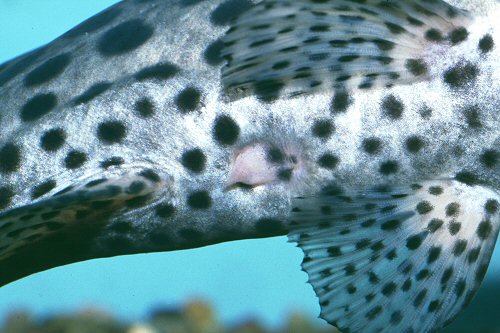
Synodontis waterloti - male specimen showing breeding tube
The genus Synodontis sports three pairs of barbels 1 pair: maxillary, 1 pair: outer mandibular and one pair of inner mandibular barbels that are branched (filaments). There are only three species that have filaments on their maxillary barbels as well as the mandibular, and they are, S. clarias, S. decorus and S. flavitaeniatiatus.
|
 his
Synodontis is not very common in imports but is
certainly one of the nicest marked specimens from
the Synodontis genus.The base colour can vary
from having a yellow background with dark brown markings
to a more duller brown base colour.
his
Synodontis is not very common in imports but is
certainly one of the nicest marked specimens from
the Synodontis genus.The base colour can vary
from having a yellow background with dark brown markings
to a more duller brown base colour.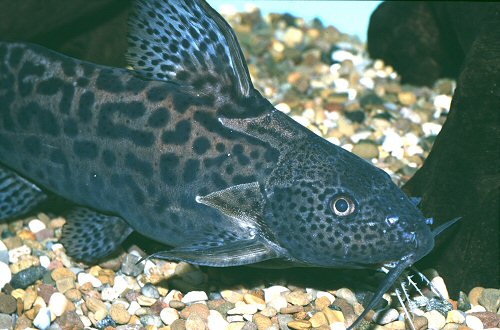
Common Name |
Waterlot's Synodontis |
Synonyms |
None |
Family |
Mochokidae |
Subfamily |
Mochocinae |
Distribution |
Africa: Waanje and Taja Rivers, Sierra Leone; St. John River basin, Liberia; Cess River basin, Côte d’Ivoire; Pra River basin, Ghana. Type locality: Friguiagbé, près Kindia, Guinée. |
Size |
16.0m (6½ins) |
Temp. |
23-25°C (73-77°F) |
p.H. |
6.5-7.5. |
Characteristics |
Pectoral spines highly serrated on the front edge. |
Colouration |
Yellow to light tan background with small spots to head area. Rest of body with brown spots and blotches. Spots and blotches carry on into the adipose fin. |
Aquarium Care & Compatibility |
| The suitability of this species in the aquarium is that it would not be too aggressive to other conspecifics, but do bare in mind that most Synodontis like to have their own territory, be it a cave or pipes, to feel comfortable in their surroundings. |
Reproduction |
Not recorded. |
Diet |
| Will take most prepared aquarium foods such as frozen bloodworm, whiteworm, shrimp, prawns, tablet food, flake food and pellets. A wide varied diet will provide a healthy specimen for many years. |
Etymology |
| Synodontis:
From the Greek syn, meaning together, and odontos,
meaning tooth; in reference to the closely-spaced
lower jaw teeth. |
IUCN Red List |
This species is widely distributed with no major widespread threats known. It is therefore assessed as Least Concern (IUCN 2020). |
References |
Dankwa,
H. & Entsua-Mensah, M.
2020. Synodontis waterloti. The IUCN Red
List of Threatened Species 2020. |
Photo Credits |
© Danny Blundell |
|

If you would like to contribute to the monthly factsheets with an article, information or photos, please e-mail me. You will of course be credited for your work.
If you would like to donate any denomination of money to the site just click the above link button. All proceeds will go to running the site and hopefully to keep it going for a few years yet.
ScotCat Sources
 Etymology-genera
Etymology-specific name
Other Sources
 Search
 Fishbase
 Wikipedia
 Catalog
of Fishes
Catalog
of Fishes
 GBIF
GBIF
 Fishnet2
 iNaturalist
 IUCN
IUCN

